hankyoreh
Links to other country sites 다른 나라 사이트 링크
[Column] The gender voting gap is eroding the foundation of democracy
 Add as preferred source on Google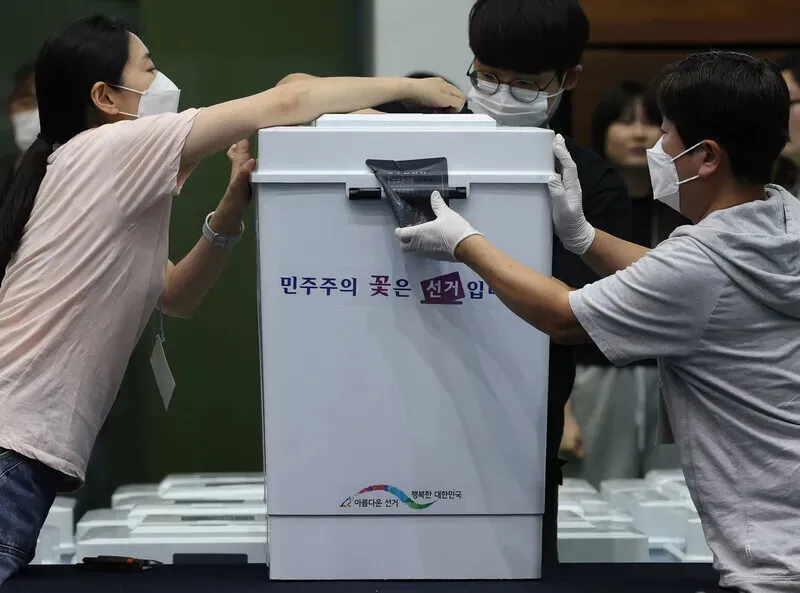

By Hannes Mosler, professor of political science at the University of Duisburg-Essen
Alice Weidel was recently reelected as co-chairperson of the Alternative for Germany (AfD) party at a national convention.
The platform of the AfD — which has been designated by Germany’s Federal Office for the Protection of the Constitution as a “right-wing extremist group” — has a platform that includes everything from traditional family and gender roles to various racially discriminatory policies. Six of its 10 leaders are men.
At the party’s top stands a female leader who is currently raising two adopted sons with her Sri Lankan-born Swiss female partner. At first glance, this might seem like a contradiction, but the reality is closer to sophisticated packaging that obscures the essence of things.
An extreme form of male identity politics wearing a female leader’s face — this is a microcosm of what is currently happening in Germany and throughout Europe.
Behind the phenomenon is a much larger structural trend: the voting gender gap.
A look back on German political history shows a complete reversal in the direction of this gap. During the Adenauer years from the 1950s to the 1970s, the traditional gender divide was one where women who supported church and traditional family structures formed a stable support base for the Christian Democratic Union (CDU) and Christian Social Union in Bavaria (CSU). Left-wing parties, in contrast, were mainly supported by men.
The gap in support between the two sides narrowed in the 1980s and 1990s as more and more women entered the workforce and education levels rose. By the 2020s, at least, the trend has undergone a complete 180.
The contemporary gender gap is one where women have joined the progressive ranks, voting mainly for left-wing parties, while men have allied themselves with the AfD and the far-right spectrum.
In the federal election of 2021, young voters in the 18-24 age range showed a relatively modest gender gap of 12 to 14 percentage points. By just four years later, that divide had widened starkly.
Last year’s election showed women supporting moderate and left-wing parties (the SPD, the Greens, and Die Linke) by a margin of 21.1 percentage points more than men. In contrast, male support for conservative and right-wing parties (the CDU, CSU, FDP, and AfD) exceeded female support by 21.4 percentage points — signaling a polarization of gender politics.
The threat this rift poses to democracy is a serious one.
As soon as gender becomes one of the most important variables predicting someone’s worldview, the foundational principle of democracy based on compromise collapses. Political views spill outside the realm of policy debates and into irresolvable identity conflicts. Once young women and men lose a common language to discuss social issues, the very foundation of social consensus breaks down.
Even more worrying is the fact that studies show this is more than just a youthful dalliance. When the divide becomes cemented in the generation itself — rather than weakening over the life cycle — it can spiral out of control, increasing in scale as the rift extends beyond young people to affect older ones and harden into a structural constant that defines the overall voter landscape.
These days, South Korea has been experiencing one of the most extreme gender voting gaps in the world today. Last month’s local elections showed an overwhelming divide, where female support for the progressive side was 33.0 percentage points higher than male support among those in their 20s and under, while male support for the conservative side led female support by 30.0 percentage points. These divisions continue robustly into people’s 30s.
In contrast with Germany’s multi-party system, South Korea typically has a two-party race with two defining characteristics. One of them is that the scale of the gap is around 10 percentage points larger. The other is that young men’s votes in Korea are essentially concentrated in one single party, as there is no alternative like in Germany, where there’s a broad party spectrum that runs the gamut from radical left-wing to extremist right-wing.
Ultimately, this leads to a paradoxical situation that buttresses and indeed expands the power of a party like the People Power Party that is rapidly careering into radicalism and extremist-right behavior.
The real question posed by the voting gender gap seen in Germany, Korea and around the world isn’t about how young people vote. It’s about what will keep democracy from collapsing for the next generation in a society where voters, divided down gender lines, have lost the very language to win one another over.
Please direct questions or comments to [english@hani.co.kr]

Editorial・opinion
![[Column] The gender voting gap is eroding the foundation of democracy](https://flexible.img.hani.co.kr/flexible/normal/500/300/imgdb/original/2026/0713/2117839308955733.jpg "[Column] The gender voting gap is eroding the foundation of democracy") [Column] The gender voting gap is eroding the foundation of democracy
[Column] The gender voting gap is eroding the foundation of democracy![[Column] The view of China-South Korea relations from Beijing](https://flexible.img.hani.co.kr/flexible/normal/500/300/imgdb/original/2026/0713/1317839308249368.jpg "[Column] The view of China-South Korea relations from Beijing") [Column] The view of China-South Korea relations from Beijing
[Column] The view of China-South Korea relations from Beijing- [Editorial] In NATO 3.0 era, Korea too must think about the future of its alliances
- [Editorial] Convict Yoon Suk-yeol must use prison term to reflect on his crimes
- [Column] The twin adversaries of North and South Korea
- [Editorial] Seoul must respond firmly to US’ biased claims about Coupang
- [Column] The Tumen is the new Yalu, the Yalu is the new Pearl River
- [Column] Who is the antichrist today?
- [Editorial] Mockery of Gwangju at high school ball game shouldn’t be treated lightly
- [Column] Does profit-driven investment by chaebol make them ‘national heroes’?
Most viewed articles
- 1Premiers of North Korea, China talk expanding economic cooperation and exchanges
- 2[Q&A] Is democratic socialism about to go mainstream in America?
- 3Marriages nosedived 40% over last 10 years in Korea, a factor in low birth rate
- 4[Column] The twin adversaries of North and South Korea
- 5Bank of Korea says chip upcycle to continue for foreseeable future
- 6[Column] The view of China-South Korea relations from Beijing
- 7[Column] The gender voting gap is eroding the foundation of democracy
- 8Hot off record American IPO, SK Hynix races to expand its memory capacity
- 9[Editorial] Defense cooperation with NATO could cost Korea
- 10[Column] From complete denuclearization of North Korea to managing nuclear risk