hankyoreh
Links to other country sites 다른 나라 사이트 링크
[Column] The view of China-South Korea relations from Beijing
 Add as preferred source on Google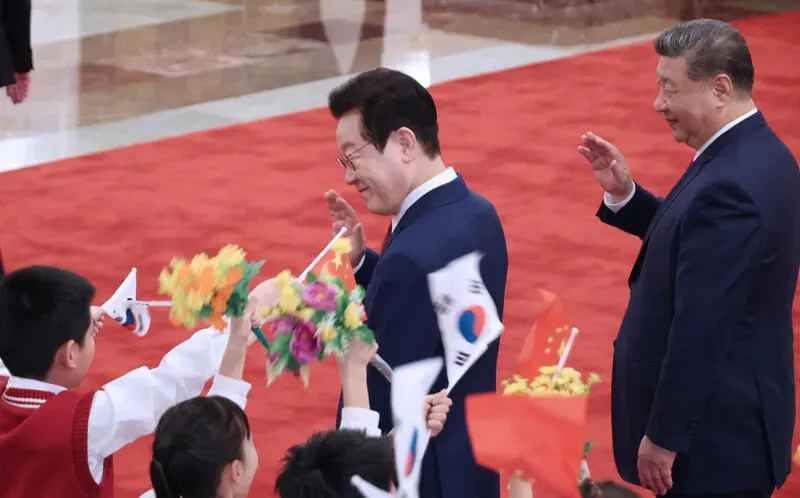
By Chung-in Moon, James Laney Distinguished Professor at Yonsei University
Earlier this month, I visited Beijing to attend the World Peace Forum at Tsinghua University. Following the forum, I got to join an in-depth discussion of Korea-China relations and Northeast Asian affairs with several Chinese participants at the forum.
There was no disagreement that relations between Seoul and Beijing have greatly improved following Korean President Lee Jae Myung’s state visit to China in January. But there were serious misgivings about Korea’s triumphalist rhetoric about the restoration of bilateral relations.
An issue of universal concern for my Chinese interlocutors was Taiwan, the most central of China’s core interests. While the Chinese appreciate that Lee had endorsed the “One China” principle since the beginning of his presidency, they have viewed some of his more recent actions with suspicion.
A prime example was the deletion of the phrase “China (Taiwan)” (中國臺灣) from the Korean e-arrival registration form. The Korean government explained that the phrase was removed as part of a recent system update, but the Chinese believe the change was due to pressure from Taiwan’s ruling Democratic Progressive Party.
Another move with which the Chinese took issue was a visit to Taiwan by a Korean parliamentary delegation. The Chinese were particularly annoyed that the delegation included members not only of the opposition People Power Party but also the ruling Democratic Party.
Language in a joint statement issued after Lee’s recent summit with the leaders of the EU was another source of discomfort for China. “We reiterate our support for the freedom of navigation and overflight, including in the South China Sea,” the two sides said in the statement. “We stress the importance of preserving peace and stability across the Taiwan Strait and oppose unilateral attempts to change the status quo in the Indo-Pacific.”
The Chinese asked whether it was really necessary for the Korean leader to bring up the Taiwan and South China Sea issues on a trip to Europe.
Another worrisome trend is the circulation of unconfirmed Korean news reports in Chinese media. For example, Shanghai-based news website Guancha.cn, citing an article from the Korean media, reported that National Intelligence Service (NIS) director Lee Jong-seok had played up the leverage offered by Taiwan. “Chinese cooperation is of absolute importance for arranging inter-Korean dialogue and improving relations with the North. To set the stage, we should look for the right moment to play the Taiwan card,” the NIS director had supposedly said, at least according to the article.
I struggled to understand how Chinese leaders and Korea Peninsula experts were slamming the Korean government over an article that I’d personally confirmed was totally untrue.
A second sticking point was Japan.
Japanese Prime Minister Sanae Takaichi said before the House of Representatives on Nov. 7, 2025, that a contingency in Taiwan could represent “a crisis of national survival” for Japan that could permit the exercise of collective self-defense. The Chinese government responded to her remarks with a show of force against Japan. Beijing-Tokyo relations remain at a low point today.
Chinese forum participants regarded Takaichi’s comments as signaling the revival of Japan’s past militarism, linking them to Japan’s increased defense spending and the emerging outlines of a regional alliance. The Chinese argued that Korea should work with China to block Japan’s turn toward militarism and to seek peace and stability in the region. They also expressed natural concern about Lee’s “shuttle diplomacy” with Takaichi and Seoul’s trilateral security cooperation with Tokyo and Washington.
The Chinese people with whom I conversed were also sharply opposed to Seoul’s proposal for a trilateral summit with Beijing and Tokyo, a bigger role for the Trilateral Cooperation Secretariat, and the resumption of talks for a trilateral free trade agreement. A former high-ranking diplomat bluntly advised Korea to shelve any idea of acting as a mediator between Beijing and Tokyo.
Third, my Chinese interlocutors thought it was suspicious that Lee had personally attended this year’s NATO summit in Ankara, unlike last year, and that he has actively pursued security cooperation with NATO.
Considering that Lee was the only major figure from NATO’s Indo-Pacific Four (IP4) partners (Korea, along with Japan, Australia and New Zealand) to attend the summit, they asked why Korea is so gung-ho about an “Asian NATO.”
My counterparts didn’t buy my explanation about security cooperation related to Korea’s business interests in the European defense procurement market and warned that South Korea’s actions could provoke greater cooperation between China, Russia and North Korea.
At the same time, some of them were keenly interested in how Northeast Asian affairs might change after Xi’s visit to the US in late September and what trilateral exchange and cooperation with Korea might ensue.
In addition to these issues, there’s also an evident gap between Korean and Chinese attitudes on the denuclearization of the Korean Peninsula, anti-Korean and anti-Chinese sentiment, and cooperation and competition on technology and the economy.
To be sure, Korea and China’s national interests are bound to be different, and they could not possibly accommodate all of each other’s demands.
That said, the national interest-oriented pragmatic foreign policy espoused by the Lee administration requires a clear-eyed, empirical understanding of reality and a strategic empathy that enables us to see the world as others do.
In light of that, it’s time to make some sensible and prudent adjustments to our relationship with China.
Please direct questions or comments to [english@hani.co.kr]

Editorial・opinion
![[Column] The gender voting gap is eroding the foundation of democracy](https://flexible.img.hani.co.kr/flexible/normal/500/300/imgdb/original/2026/0713/2117839308955733.jpg "[Column] The gender voting gap is eroding the foundation of democracy") [Column] The gender voting gap is eroding the foundation of democracy
[Column] The gender voting gap is eroding the foundation of democracy![[Column] The view of China-South Korea relations from Beijing](https://flexible.img.hani.co.kr/flexible/normal/500/300/imgdb/original/2026/0713/1317839308249368.jpg "[Column] The view of China-South Korea relations from Beijing") [Column] The view of China-South Korea relations from Beijing
[Column] The view of China-South Korea relations from Beijing- [Editorial] In NATO 3.0 era, Korea too must think about the future of its alliances
- [Editorial] Convict Yoon Suk-yeol must use prison term to reflect on his crimes
- [Column] The twin adversaries of North and South Korea
- [Editorial] Seoul must respond firmly to US’ biased claims about Coupang
- [Column] The Tumen is the new Yalu, the Yalu is the new Pearl River
- [Column] Who is the antichrist today?
- [Editorial] Mockery of Gwangju at high school ball game shouldn’t be treated lightly
- [Column] Does profit-driven investment by chaebol make them ‘national heroes’?
Most viewed articles
- 1Premiers of North Korea, China talk expanding economic cooperation and exchanges
- 2[Q&A] Is democratic socialism about to go mainstream in America?
- 3Marriages nosedived 40% over last 10 years in Korea, a factor in low birth rate
- 4[Column] The twin adversaries of North and South Korea
- 5Bank of Korea says chip upcycle to continue for foreseeable future
- 6[Column] The view of China-South Korea relations from Beijing
- 7[Column] The gender voting gap is eroding the foundation of democracy
- 8Hot off record American IPO, SK Hynix races to expand its memory capacity
- 9[Editorial] Defense cooperation with NATO could cost Korea
- 10[Column] From complete denuclearization of North Korea to managing nuclear risk