hankyoreh
Links to other country sites 다른 나라 사이트 링크
[Editorial] In NATO 3.0 era, Korea too must think about the future of its alliances
 Add as preferred source on Google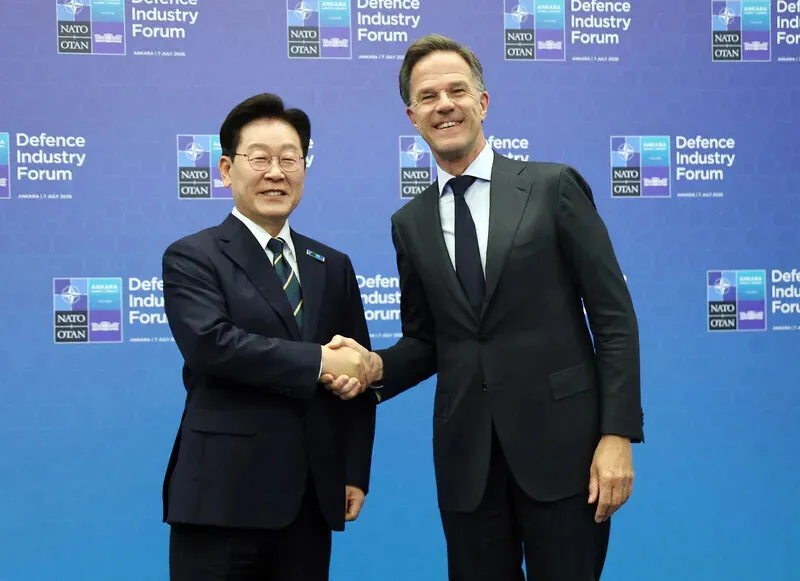
Last week’s NATO summit in Ankara, Turkey, was an important turning point signaling the advent of “NATO 3.0.”
The alliance’s European members both secured a reaffirmation of the collective security commitment from US President Donald Trump, who had previously threatened to withdraw from the treaty organization, and pledged to shoulder a greater share of the alliance’s defense burden.
South Korean President Lee Jae Myung, who attended the NATO summit, would have witnessed this significant shift unfold firsthand at the gathering. Korea, too, must think about what a modernized alliance with the US should look like and develop proposals that Washington will find acceptable.
The NATO heads of state reaffirmed Article 5 of the North Atlantic Treaty, which states that “an armed attack against one or more [alliance members] in Europe or North America shall be considered an attack against them all” in the Ankara Summit Declaration, which was released on Wednesday.
They also emphasized how European nations and Canada were delivering on the Hague defense commitment in which NATO allies pledged to allocate 5% of GDP annually to defense-and security-related spending, noting how investments were increased in “core defense requirements by more than US$139 billion.”
“European allies and Canada are assuming greater responsibility for our shared security,” said NATO Secretary General Mark Rutte during a press conference on Wednesday. “We are rebalancing our security for the better; that is what NATO 3.0 is all about.”
The term “NATO 3.0” was coined by none other than Elbridge Colby, the US undersecretary of defense for strategy and force development, the architect of the second Trump administration’s defense policy.
In a speech made in February, Colby referred to NATO during the Cold War as “NATO 1.0,” the period following the end of the Cold War and as Europe began to rely more on the US as “NATO 2.0,” and “NATO 3.0” as the period following the outbreak of the Ukraine war in 2022 to the present day.
In essence, he called on Europe to shoulder greater responsibility in this new strategic environment shaped by the growing threat posed by Russia.
According to a Wall Street Journal article published July 5, European leaders who had convened in Brussels in January commiserated over how, in the words of the Belgian prime minister, Europe risked becoming “a miserable slave” to the US.
Europe is in a position where it must secure a high degree of strategic autonomy from the US, whose sole concern is putting “America first,” but it cannot build defense self-sufficiency overnight. The conclusion it reached at the summit — to keep the alliance intact while expanding its own role — would have been the outcome of intense deliberation.
Korea faces a similar challenge while grappling with other issues such as regaining wartime operational control (OPCON) of its armed forces from the US. Much like Europe, it has no choice but to retain its alliance with the US while also expanding its strategic independence. However, we must take innovative steps to enhance our role and assume greater responsibilities in response to the evolving strategic environment.
Please direct questions or comments to [english@hani.co.kr]

Editorial・opinion
![[Column] The gender voting gap is eroding the foundation of democracy](https://flexible.img.hani.co.kr/flexible/normal/500/300/imgdb/original/2026/0713/2117839308955733.jpg "[Column] The gender voting gap is eroding the foundation of democracy") [Column] The gender voting gap is eroding the foundation of democracy
[Column] The gender voting gap is eroding the foundation of democracy![[Column] The view of China-South Korea relations from Beijing](https://flexible.img.hani.co.kr/flexible/normal/500/300/imgdb/original/2026/0713/1317839308249368.jpg "[Column] The view of China-South Korea relations from Beijing") [Column] The view of China-South Korea relations from Beijing
[Column] The view of China-South Korea relations from Beijing- [Editorial] In NATO 3.0 era, Korea too must think about the future of its alliances
- [Editorial] Convict Yoon Suk-yeol must use prison term to reflect on his crimes
- [Column] The twin adversaries of North and South Korea
- [Editorial] Seoul must respond firmly to US’ biased claims about Coupang
- [Column] The Tumen is the new Yalu, the Yalu is the new Pearl River
- [Column] Who is the antichrist today?
- [Editorial] Mockery of Gwangju at high school ball game shouldn’t be treated lightly
- [Column] Does profit-driven investment by chaebol make them ‘national heroes’?
Most viewed articles
- 1Premiers of North Korea, China talk expanding economic cooperation and exchanges
- 2[Q&A] Is democratic socialism about to go mainstream in America?
- 3Marriages nosedived 40% over last 10 years in Korea, a factor in low birth rate
- 4[Column] The twin adversaries of North and South Korea
- 5Bank of Korea says chip upcycle to continue for foreseeable future
- 6[Column] The view of China-South Korea relations from Beijing
- 7[Column] The gender voting gap is eroding the foundation of democracy
- 8Hot off record American IPO, SK Hynix races to expand its memory capacity
- 9[Editorial] Defense cooperation with NATO could cost Korea
- 10[Column] From complete denuclearization of North Korea to managing nuclear risk