hankyoreh
Links to other country sites 다른 나라 사이트 링크
Yoon’s ideological diplomacy is driving the Korean Peninsula to the brink
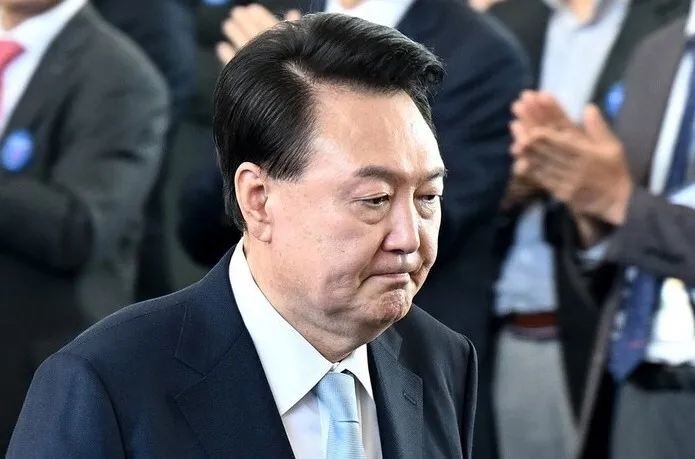
Following their summit on Oct. 24, South Korean President Yoon Suk-yeol and Polish President Andrzej Duda held a joint press conference. Poland provides military aid to Ukraine.
A Polish reporter asked Yoon if South Korea has intentions to “send superior weapons to Ukraine” or “directly deploy troops to Ukraine.” This was Yoon’s answer:
“Our support for Ukraine thus far has been on a humanitarian basis. However, if North Korea dispatches special forces to the Ukraine war as part of Russia-North Korea cooperation, we will support Ukraine in stages and also review and implement measures necessary for security on the Korean Peninsula.”
“While we have maintained our principle of not directly supplying lethal weapons, we can also review our stance more flexibly, depending on the level of North Korean military activities,” Yoon added.
Based on the Polish reporter’s question, Yoon’s comments can be interpreted as saying: “Depending on what North Korea does, we are open to sending weapons and dispatching troops.” Truly frightening.
The more he serves as head of state, the worse our national security gets
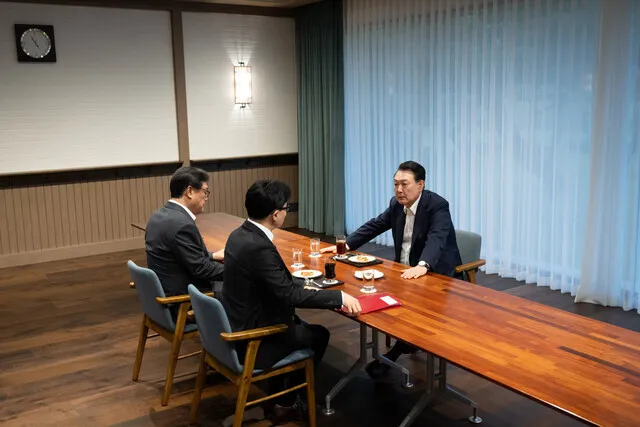
Yet what was scarier than Yoon’s words was the overly confident look on his face. Brimming with pride, his face seemed to say: “I’m the president of the Republic of Korea.” It was a completely different look from the angry facial expressions he gave during his meeting with People Power Party (PPP) leader Han Dong-hoon. It was as if he’d forgotten his plummeting approval ratings, the absolute parliamentary majority held by the opposition party, and his spat with Han over issues related to Kim Keon-hee, the first lady.
Grant, our Constitution says the president is “Head of State and represent the State vis-a-vis foreign states.” It also says: “The President shall be Commander-in-Chief of the Armed Forces under the conditions as prescribed by the Constitution and Act.”
Yoon has had more important events related to foreign policy and national security as they pertain to North Korea’s troop deployments to Russia. He talked on the phone with Ursula von der Leyen, the president of the European Commission, on Oct. 28. He also talked with NATO Secretary-General Mark Rutte. On Oct. 29, he talked on the phone with Ukrainian President Volodymyr Zelenskyy. The two leaders agreed to exchange state delegations and special envoys and to enhance bilateral intelligence sharing and cooperation. Yoon spoke with Canadian Prime Minister Justin Trudeau on the phone on Oct. 30.
Yoon is offering the intelligence and analysis of our government to foreign state leaders. The eyes and ears of the world are focused on the words of Yoon and our state authorities in diplomacy and national security. Domestic media outlets have also begun devoting lengthy coverage to the ripples in international geopolitics caused by North Korea’s troop deployments to Russia. After being troubled by the controversy surrounding the first lady, Yoon can finally take a breather.
On Oct. 31, the Democratic Party released audio recordings of phone calls involving Yoon that point to his interference in nominations for elected office. Regarding the recordings, the presidential office has said: “Nothing of great importance was discussed. Myung kept on talking about Kim Young-sun’s nomination, so the president was just playing along.” Can Yoon clear the hurdles posed by the liabilities and allegations surrounding the first lady and Myung Tae-kyun? We shall have to wait and see.
As far as Yoon is concerned, he wants to continuously and successfully fulfill his critical duties as “head of state” and as the “commander-in-chief of the armed forces.” Paradoxically, the more Yoon concentrates on his role of “head of state” and “commander-in-chief,” the worse our diplomatic and national security situation become. Just what in the world is happening?
What would happen if we sent weapons and troops to Ukraine? South and North Korean soldiers would fight each other on Ukrainian soil as proxy forces representing NATO and Russia. Embers from the inter-Korean war along the Ukrainian front could easily blow over to the Korean Peninsula. It’s too terrible to even think about. How did we get to this point?
Shifts in international geopolitics do not occur as the result of one or two specific nations or leaders. Responsibility for the war in Ukraine falls mostly on Russia. Yet when analyzing the root causes, some responsibility also falls on the US, NATO and Ukraine for backing Russia into a corner.
In the same context, responsibility for North Korean troops on Russian soil mostly falls on North Korea. Since the news swept the globe, the international geopolitical situation has been rocked and become much more precarious. Responsibility for elevating the risk of war on the Korean Peninsula absolutely falls on North Korea.
Yet once again, when looking at root causes, some responsibility falls on the US and on us for pushing North Korea and Russia together.
Ossification of power struggle between South Korea-US-Japan and North Korea-China-Russia
Democratic Party lawmaker Park Jie-won posted something on his Facebook page on Oct. 26. Park was the Kim Dae-jung’s administration’s special envoy for arranging the first inter-Korean summit, and has spent a long time working to improve inter-Korean relations. Under the Moon Jae-in administration, he was the head of the National Intelligence Service (NIS).
“Based on my experience in inter-Korean dialogue, I think North Korea can become a pro-US nation if the North and South carry out their own exchanges and cooperation alongside the US. Kim Jong-il received two sets of instructions from Kim Il-sung. First, establish relations with the US and guarantee the regime’s security. Second, achieve economic development by repealing US sanctions. When I met with Kim Jong-il, he said that historically and geographically, Japan, China and Russia have continually invaded the Korean Peninsula and tried to colonize it, but that the US, historically and geographically, never tried to do such a thing, and has no desire to. He actually hated Japan, China and Russia and liked the US,” he said.
“Policy judgments between South Korea and the US have missed the mark. Amid the extreme power struggle between the US and China, we have made diplomatic errors, pushing a North Korea that could have become a pro-US nation into becoming a pro-Russia nation,” Park went on.
I think Park is right.
Democratic lawmaker Wi Sung-lac is an expert who was the Ministry of Foreign Affairs’ director of North American affairs, South Korea’s chief nuclear envoy to the Six-Party Talks, and the South Korean ambassador to Russia. In an OhMyNews interview published on Oct. 28, Wi said the following:
“The Russia-North Korea alliance and North Korea’s troop deployments to Russia are the result of countless actions and reactions involving the West and Russia from the end of the Cold War to Russia’s invasion of Ukraine and during the time since the war broke out. During that time, there was the Camp David summit [South Korea-US-Japan summit] and the Nuclear Consultative Group. But the Yoon administration says that Russia invaded Ukraine, and they needed weapons, so they got them from North Korea, and then they needed troops, so North Korea sent those too. He talks as if these things have occurred in a vacuum. If you approach it that way, you can never devise a proper solution.”
“You need to view the numerous incidents that have occurred until now as the results of interactions to be able to come up with a cold-headed solution. [Without that] If you just say, ‘If you send troops, we respond by sending weapons,’ you cannot devise a fundamental problem-solving strategy. We are in a moment when the dynamics in the region surrounding the Korean Peninsula are changing. And it’s possible that the structure of those dynamics will suffocate us for decades.”
I think Wi’s views are correct. At the center of all these crises is Yoon Suk-yeol. So what has he done so wrong?
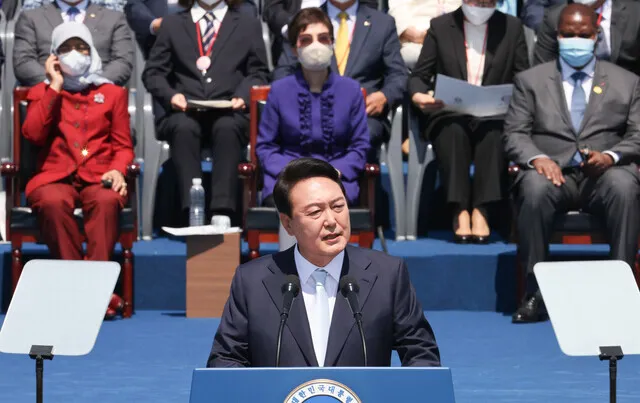
In his inauguration address on May 10, 2022, Yoon used the word “freedom” 35 times. He expanded this ideology of freedom to the international stage. He had declared a campaign of ideological diplomacy.
“Individual countries must do so but global citizens must also come together in solidarity to address these injustices if and when they arise. Hunger, poverty, abuse of power and armed conflict strips away our individual freedom and robs us of our inalienable right to the pursuit of happiness. We, as global citizens who enjoy real freedom, must never turn a blind eye when freedom is attacked.”
The real objective behind enhancing military power
What do you think? The quasi-military alliance between South Korea, the US and Japan; the dissolution of inter-Korean relations; and the weakening of China-Russia relations – all of which has happened since Yoon’s inauguration – were in fact prophesied during Yoon’s inauguration speech. Wholehearted support for Ukraine can be viewed under the same context.
Yoon’s ideological diplomacy is a big deviation away from South Korea’s traditional national-interest-driven diplomacy. It’s unprecedented. Past presidents like Syngman Rhee and Park Chung-hee prioritized our national interests as the foundation of their national interest diplomacy.
Thanks to Yoon’s ideological diplomacy, the political situation on the Korean Peninsula is creeping closer to crisis. It’s a major problem. Even the so-called conservative media and pundits have started to worry. In a piece published on Oct. 29, Chosun Ilbo columnist Kim Dae-jung argued that South Korea “should not send weapons to Ukraine.”
“The reason we foster the military strength of the Republic of Korea and develop various weaponry is to protect the lives of our citizens and our national territory.”
“Sending lethal weapons or combat weapons to Ukraine falls outside that purpose.”
Ko Sang-tu, professor emeritus at Yonsei University, wrote a column published in the Munhwa Ilbo on Oct. 29, titled “Russia’s Historical Upheavals and Sensible North Korea Policy.”
“In international politics, there are no permanent friends or permanent enemies. The only constant is the national interest.”
“If we reactivate our diplomatic resources toward North Korea to achieve a practical inclusion of Russia, the Russia-North Korea cooperation brought on by the war in Ukraine can be reversed.”
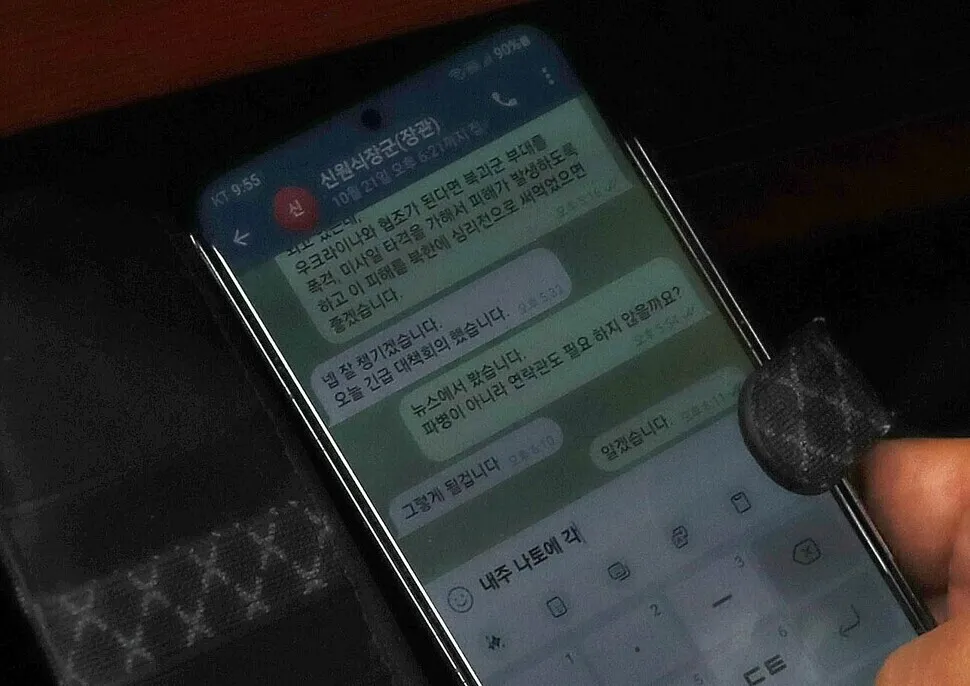
I’ll wrap this up. People Power Party Han Ki-ho told national security adviser Shin Won-sik in a text message: “If we cooperate with Ukraine, we can conduct airstrikes and missile attacks against North Korea’s puppet units to cause casualties and then use these casualties in the psychological war against North Korea.”
Even after this incredible blunder, Han held a press conference. He declared: “Just what about my text was so problematic?” He even looked angry. The Ministry of National Defense and the presidential office distanced themselves from Han’s remarks, saying they did not reflect the government’s stance. But in reality, it’s doubtful if Yoon’s understanding of the situation is much different from Han’s. What do you think, dear reader?
By Seong Han-yong, senior political writer
Please direct questions or comments to [english@hani.co.kr]

Editorial・opinion
![[Column] Xi Jinping exploits growing rift in Transatlantic alliance](https://flexible.img.hani.co.kr/flexible/normal/500/300/imgdb/original/2026/0408/1017756384434781.jpg "[Column] Xi Jinping exploits growing rift in Transatlantic alliance") [Column] Xi Jinping exploits growing rift in Transatlantic alliance
[Column] Xi Jinping exploits growing rift in Transatlantic alliance![[Column] Trump’s war boomerangs on US hegemony and alliances](https://flexible.img.hani.co.kr/flexible/normal/500/300/imgdb/original/2026/0407/6417755465363376.jpg "[Column] Trump’s war boomerangs on US hegemony and alliances") [Column] Trump’s war boomerangs on US hegemony and alliances
[Column] Trump’s war boomerangs on US hegemony and alliances- [Column] Negotiating with bombs
- [Column] What the debate over Atlas and robots in factories missed
- [Editorial] There’s no more relying on US after Iran war
- [Column] A year on from ‘Liberation Day,’ is America any greater?
- [Editorial] US threat to ‘reexamine’ NATO shows Korea can’t delay defense self-reliance
- [Column] Was Seoul’s choice to pursue dialogue, not war, in 1994 a ‘strategic error’?
- [Column] Is the PPP’s far-right shift a path to self-destruction
- [Column] Putin, Trump and Netanyahu: All tactics, no strategy
Most viewed articles
- 1[Column] Xi Jinping exploits growing rift in Transatlantic alliance
- 2[News analysis] North Korea says it wants no clashes with South — but no talks either
- 3[Column] Iran, from Heidegger to Kant
- 4China, Russia veto UNSC resolution aimed at opening Strait of Hormuz
- 5Real-life heroes of “A Taxi Driver” pass away without having reunited
- 6North Korea welcomes South Korean leader’s expression of regret over civilian drone incursion
- 7US will halt attacks on Iran for 2 weeks, Trump says
- 8‘Korea didn’t help us’: Trump blasts allies for not coming to US’ aid in Strait of Hormuz
- 9Seoul spy agency calls Kim Jong-un’s daughter ‘heir apparent’
- 10[Column] Trump’s war boomerangs on US hegemony and alliances