hankyoreh
Links to other country sites 다른 나라 사이트 링크
[Editorial] South Korea needs proactive, multi-faceted diplomacy now more than ever
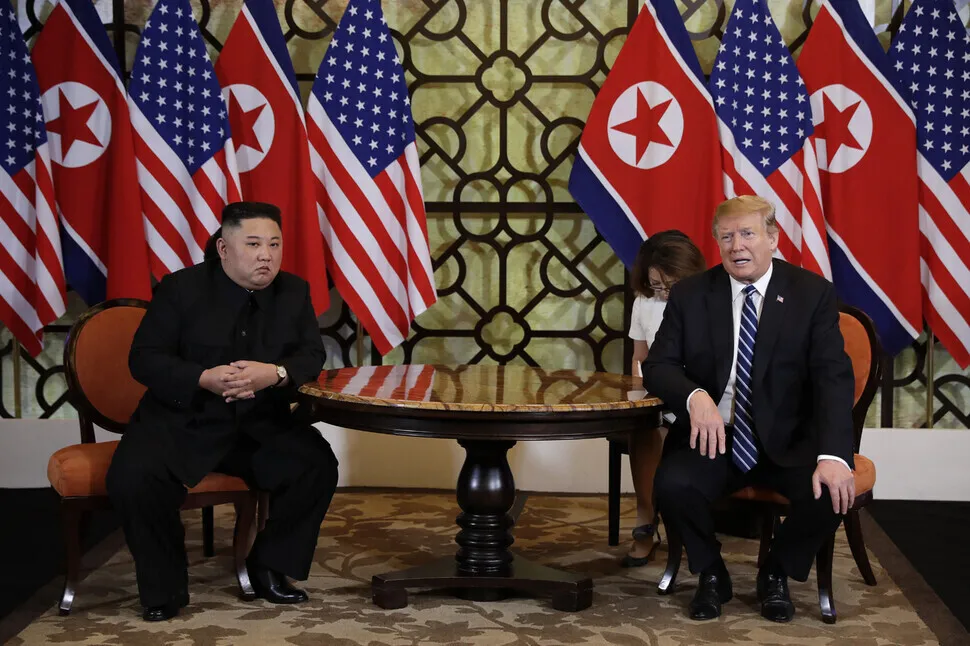
After sending a large contingent of troops to Russia, North Korea has fired what appears to be a new type of solid-fuel intercontinental ballistic missile (ICBM) just days before the US presidential election. North Korea has already upgraded its alliance with Russia, and now it appears to be underlining its status as a de facto nuclear weapon state to whoever becomes the next American president.
Because of the hostile policy that South Korean President Yoon Suk-yeol has pursued toward North Korea and his foreign policy of placing all his chips on relations with the US and Japan, South Korea can do little but helplessly watch North Korea’s strategic moves. Seoul needs to be proactive in its foreign policy with the US to ensure that South Korea’s security interests aren’t sacrificed when the incoming US administration deals with the North Korean nuclear issue.
“We detected North Korea firing a long-range ballistic missile at a lofted trajectory toward the east coast at 7:10 am today. This could have been the test launch of a new solid-fuel ballistic missile,” South Korea’s Joint Chiefs of Staff said on Thursday.
The Joint Chiefs surmised that the launch represents North Korea’s “strategy of increasing bargaining power since the US presidential election is just around the corner.”
Warning information about the North Korean missile has been shared in real time between South Korea, the US and Japan since December 2023. That was also the month that North Korea fired off a Hwasong-18 to an altitude of over 6,000 kilometers, verifying its ability to hit anywhere in the US.
Pyongyang’s relationship with Washington will have direct ramifications for South Korea’s security going forward. Depending on the outcome of Tuesday’s election, we could be left in a situation in which it’ll be hard to grasp just how US-North Korea ties will develop. Should Donald Trump win the election, it could trigger a swift shift in US foreign policy — including accepting North Korea as a nuclear weapon state. If Kamala Harris is elected, however, she looks likely to, by and large, inherit the Biden administration’s policy toward North Korea. This would mean a continuation of the “strategic patience” that has been in place since the Obama administration, and lead to a situation in which we alone are forced to shoulder the burden of the North Korean nuclear issue as Washington continues to do nothing about it.
What’s even more dismaying is the fact that since the relationship between Seoul and Pyongyang today has turned into one between “two states hostile to each other,” there’s hardly any chance that we can pry open the door to dialogue on our own. If this state of affairs is allowed to fester, South Korea could be left out of major decisions related to the Korean Peninsula. This alone means we need to pursue multi-faceted diplomacy that doesn’t lean only on the US and Japan.
The Yoon Suk-yeol administration mustn’t forget that if it uses this matter in which our country’s safety is wrapped up as a way to take the spotlight off domestic political turmoil, it could have irreversible consequences.
Please direct questions or comments to [english@hani.co.kr]

Editorial・opinion
![[Column] Xi Jinping exploits growing rift in Transatlantic alliance](https://flexible.img.hani.co.kr/flexible/normal/500/300/imgdb/original/2026/0408/1017756384434781.jpg "[Column] Xi Jinping exploits growing rift in Transatlantic alliance") [Column] Xi Jinping exploits growing rift in Transatlantic alliance
[Column] Xi Jinping exploits growing rift in Transatlantic alliance![[Column] Trump’s war boomerangs on US hegemony and alliances](https://flexible.img.hani.co.kr/flexible/normal/500/300/imgdb/original/2026/0407/6417755465363376.jpg "[Column] Trump’s war boomerangs on US hegemony and alliances") [Column] Trump’s war boomerangs on US hegemony and alliances
[Column] Trump’s war boomerangs on US hegemony and alliances- [Column] Negotiating with bombs
- [Column] What the debate over Atlas and robots in factories missed
- [Editorial] There’s no more relying on US after Iran war
- [Column] A year on from ‘Liberation Day,’ is America any greater?
- [Editorial] US threat to ‘reexamine’ NATO shows Korea can’t delay defense self-reliance
- [Column] Was Seoul’s choice to pursue dialogue, not war, in 1994 a ‘strategic error’?
- [Column] Is the PPP’s far-right shift a path to self-destruction
- [Column] Putin, Trump and Netanyahu: All tactics, no strategy
Most viewed articles
- 1[Column] Xi Jinping exploits growing rift in Transatlantic alliance
- 2[News analysis] North Korea says it wants no clashes with South — but no talks either
- 3[Column] Iran, from Heidegger to Kant
- 4China, Russia veto UNSC resolution aimed at opening Strait of Hormuz
- 5Real-life heroes of “A Taxi Driver” pass away without having reunited
- 6North Korea welcomes South Korean leader’s expression of regret over civilian drone incursion
- 7US will halt attacks on Iran for 2 weeks, Trump says
- 8‘Korea didn’t help us’: Trump blasts allies for not coming to US’ aid in Strait of Hormuz
- 9Seoul spy agency calls Kim Jong-un’s daughter ‘heir apparent’
- 10[Column] Trump’s war boomerangs on US hegemony and alliances