hankyoreh
Links to other country sites 다른 나라 사이트 링크
[Column] At this rate, the next battlefield could be Korea

By Gil Yun-hyung, editorial writer
Viewing the disturbing news of North Korean troops being dispatched to Russia made my heart drop into my stomach. There have been many doomsday warnings about another war on the Korean Peninsula before, but until now, I’d never actually been struck by the fear that this time, war might actually break out.
To catch a break from North Korea, I cracked open Japanese Prime Minister Ishiba Shigeru’s book and policy overview (“Conservative Politician: My Policies, My Destiny”), which was published in August. While reading his book, I became interested in “Showa 16 (1941): The Summer that Lost the War,” a book that Ishiba always recommends to his audience during his talks and lectures.
The book deals with the painful miscalculation that Japan made over 80 years ago. Under the objective of “contributing to national policy by researching the option of total national war,” the Japanese government established an entity called the Total War Research Institute in September 1940. The institute comprised representatives from the Japanese army and navy and from government departments such as the Home Ministry, the Finance Ministry, and the Ministry of Economy, Trade and Industry. The institute also represented publicly funded companies like Nippon Steel, Nippon Yusen, and the Domei News Agency (the wire service that became today’s Kyodo News).
Members were mostly social elites in their early and mid-30s. The institute conducted a war “simulation” starting in July 1941, just a few months before Japan declared war on the US. The results of the simulation were that while Japan would have the advantage in the early phases, the US would exhibit the might of its industry as the conflict wore on. The Soviet Union would eventually join the American side and Japan would lose the war within three to four years, the simulation predicted.
The evidence was clear. Japan needed to avoid a war with the US. Hideki Tojo, the chief of staff of the Japanese imperial army, disputed the results of the simulation.
“While I know what you are saying, as evidenced by the Russo-Japanese War, you can never know the results of a war before you actually fight it,” Tojo argued.
In the end, Japan attacked Pearl Harbor on Dec. 7, 1941. As the elites of the Total War Research Institute predicted, Japan surrendered to the United States three years and eight months later. As suggested by the book’s title, Japan lost the war with the US before it even started.
On Oct. 18, South Korea’s National Intelligence Service announced that it had confirmed that North Korean troops were on Russian soil. The announcement sparked vicious rhetoric both within the government and beyond. President Yoon Suk-yeol announced less than a week later, on Oct. 24, that Seoul would consider sending “lethal weapons” to Ukraine in response.
In a conversation via text message, national security adviser Shin Won-sik and Han Ki-ho, a People Power Party lawmaker and member of the National Defense Committee, were seen discussing cooperating with Ukraine to “bomb the troops sent by the North Korean puppets” and using reports of casualties in such bombings as “psychological warfare” against North Korea. They seem enthusiastically ready to immediately go to war with the North Korea-Russia alliance, which has been upgraded into a “blood alliance.”
Amid the present moment’s geopolitically tumultuous times, I have no wish to argue with Yoon’s policy of enhancing military cooperation with the US and Japan. However, if the administration had appointed competent people to lead this initiative, they would have continued communicating with their counterparts in North Korea, China and Russia and adjusted the rate and direction of their policies accordingly. Drunk on the flattering compliments from Japan and the US, the Yoon administration is simply going full throttle. Yoon needs to know that such compliments contain the message: “You sure about this? Because if things go wrong, the buck ultimately stops with you.”
Just two years and a half years after Yoon’s inauguration, inter-Korean relations have deteriorated completely, the North Korea-Russia military alliance has been restored, and over 30 years of diplomacy with North Korea has been rendered useless. On Oct. 24, South Korean Foreign Minister Cho Tae-yul called on China to “take a more active role” on the North Korean nuclear issue and the illegal cooperation between North Korea and Russia. Yet we cannot expect the other side to follow our wishes while we continue to do whatever we want.
What we do from this moment onward is of utmost importance. Addressing the possibility of South Korea sending lethal weapons to Ukraine, Russian Foreign Ministry spokesperson Maria Zakharova said on Wednesday: “Russia will provide a tough response to any actions that could threaten the security of our country and its citizens, wherever they may be.”
Zakharova added that “Russia and the Republic of Korea have a history of productive cooperation, mutual understanding, and cooperation in economic and humanitarian areas.”
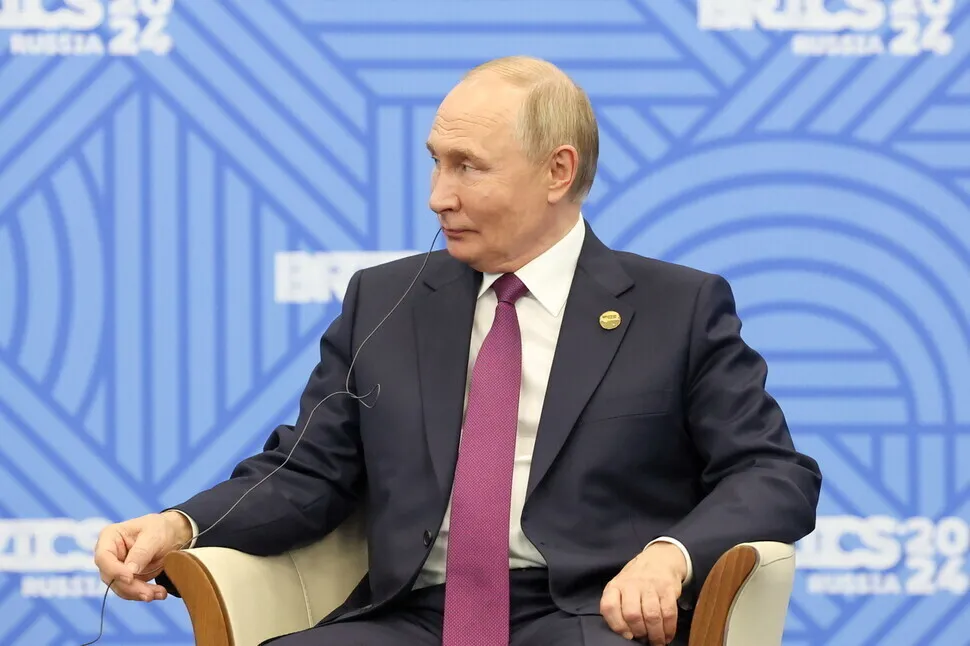
On Thursday and Friday, alluding to Article 4 of Russia’s Treaty on Comprehensive Strategic Partnership with North Korea that Putin signed in June, Russian President Vladimir Putin said Russia’s military cooperation with North Korea was “up to us to decide what we will do,” referring to Moscow and Pyongyang.
Putin is essentially using Article 51 of the UN Charter, which justifies military action for purposes of “collective self-defense,” to argue that Russia is legally justified in receiving military support from North Korea to achieve Moscow’s objective of reclaiming territory taken by Ukrainian forces in the Kursk region this past August.
Accepting this argument at face value is problematic, but Russia is clearly sending the message that it does not wish to scrap its relations with South Korea entirely. The “you never know until you try” attitude expressed in Tojo’s military adventurism over 80 years ago is seriously problematic. We need to conduct a thorough simulation that includes the “very worst” that the enemy can throw at us.
If we go head-to-head with the Russia-North Korea alliance, Moscow will suffer temporary, situational, and tactical losses, but the amplification device known as North Korea will lead to permanent, total, and strategic losses on our side. Depending on the depth of the military cooperation between Moscow and Pyongyang, the “extended deterrence” (nuclear umbrella) promised by the US may suddenly fall apart. Poland and the three Baltic States don’t have to live next to North Korea, but we do. If we continue on this path, the next battlefield will be the Korean Peninsula.
Please direct questions or comments to [english@hani.co.kr]

Editorial・opinion
![[Column] Xi Jinping exploits growing rift in Transatlantic alliance](https://flexible.img.hani.co.kr/flexible/normal/500/300/imgdb/original/2026/0408/1017756384434781.jpg "[Column] Xi Jinping exploits growing rift in Transatlantic alliance") [Column] Xi Jinping exploits growing rift in Transatlantic alliance
[Column] Xi Jinping exploits growing rift in Transatlantic alliance![[Column] Trump’s war boomerangs on US hegemony and alliances](https://flexible.img.hani.co.kr/flexible/normal/500/300/imgdb/original/2026/0407/6417755465363376.jpg "[Column] Trump’s war boomerangs on US hegemony and alliances") [Column] Trump’s war boomerangs on US hegemony and alliances
[Column] Trump’s war boomerangs on US hegemony and alliances- [Column] Negotiating with bombs
- [Column] What the debate over Atlas and robots in factories missed
- [Editorial] There’s no more relying on US after Iran war
- [Column] A year on from ‘Liberation Day,’ is America any greater?
- [Editorial] US threat to ‘reexamine’ NATO shows Korea can’t delay defense self-reliance
- [Column] Was Seoul’s choice to pursue dialogue, not war, in 1994 a ‘strategic error’?
- [Column] Is the PPP’s far-right shift a path to self-destruction
- [Column] Putin, Trump and Netanyahu: All tactics, no strategy
Most viewed articles
- 1[Column] Xi Jinping exploits growing rift in Transatlantic alliance
- 2[News analysis] North Korea says it wants no clashes with South — but no talks either
- 3[Column] Iran, from Heidegger to Kant
- 4China, Russia veto UNSC resolution aimed at opening Strait of Hormuz
- 5Real-life heroes of “A Taxi Driver” pass away without having reunited
- 6North Korea welcomes South Korean leader’s expression of regret over civilian drone incursion
- 7US will halt attacks on Iran for 2 weeks, Trump says
- 8‘Korea didn’t help us’: Trump blasts allies for not coming to US’ aid in Strait of Hormuz
- 9Seoul spy agency calls Kim Jong-un’s daughter ‘heir apparent’
- 10[Column] Trump’s war boomerangs on US hegemony and alliances