hankyoreh
Links to other country sites 다른 나라 사이트 링크
[Editorial] Trump return necessitates shift to flexible foreign policy from Seoul
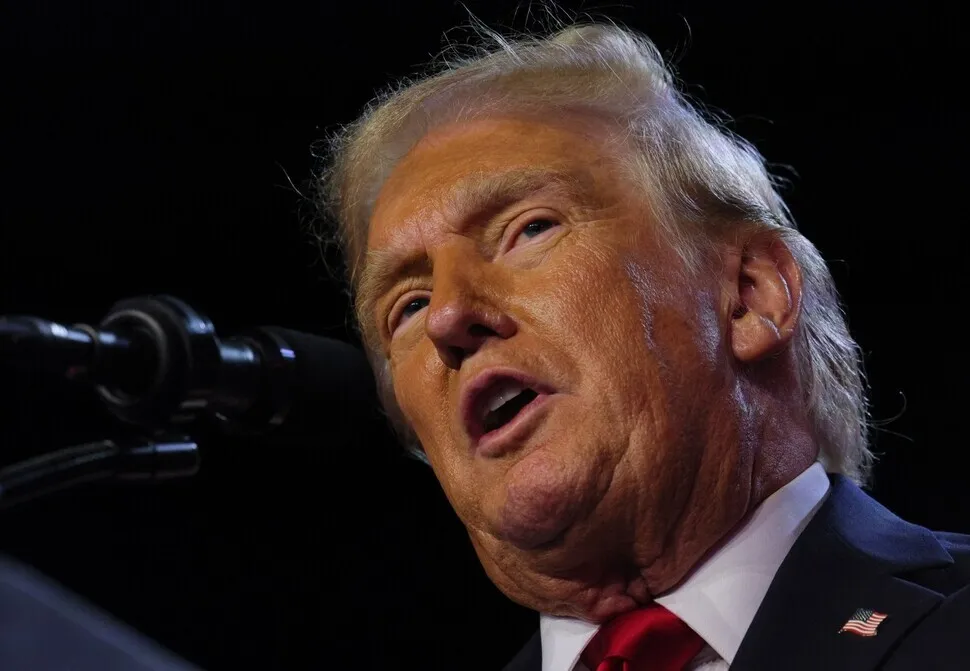
The US presidential election on Tuesday was supposed to be a nail-biter, but Donald Trump, at the age of 78, managed to pull off a surprisingly easy victory. American voters sided with Trump’s boisterous pledge to tackle the issues of inflation and immigration under his “America First” banner.
Trump’s victory raises the likelihood that American foreign policy will pivot away from “values-based diplomacy,” or collaborating with allied countries holding similar values in a struggle with China and Russia, and toward a unilateral pursuit of the exclusive interests of the US. The South Korean government will need to maximize communication to minimize the “Trump risk” while shifting toward a more pragmatic foreign policy that prioritizes the national interest over values.
Trump appeared at a convention center in Palm Beach, Florida, at 2:27 am following Election Day to declare victory, saying it was an “honor” to be elected the 47th president of the United States. Given the results being reported by major American news outlets, Trump is set to win all seven of the hotly contested battleground states.
At the time of writing, Vice President Kamala Harris, the presidential candidate for the Democratic Party, was behind by a daunting 3-6 points in all three of the Rust Belt states of Pennsylvania, Michigan and Wisconsin, which have been a critical bellwether in previous elections.
The main issues in this election were inflation and immigration — domestic matters that have real-life consequences for many Americans. Trump angled for the support of white voters in his campaign by playing up hatred of foreigners and playing upon the insecurities of Americans who see their prospects as dwindling.
Trump promised to impose 10% tariffs across the board on all countries and 60% tariffs on imports from China, underscoring his radically isolationist and protectionist tendencies. And he described South Korea as a “money machine,” while vowing to collect 10 billion dollars (around 1.4 trillion won) in burden-sharing contributions from Seoul each year, or 10 times the current contribution from America’s ally.
In effect, the white middle-class workers who make up the majority of American society saluted and signed on to Trump’s call to “make America great again.”
Trump’s reelection represents a serious quandary for South Korea, which has adopted values-based diplomacy in coordination with the Biden administration. A hostile turn in inter-Korean relations has allowed North Korea and Russia to reach a strategic agreement more than 30 years after the end of the Cold War.
Kim Tae-hyo, South Korea’s principal deputy national security adviser, asserted in a press briefing on Wednesday that the Yoon administration has “maximized our national security and economic interests according to our vision of a global pivotal state” over the past two and a half years. But the threat of war on the Korean Peninsula is greater than ever before.
Amid this crisis, a second Trump administration may well turn the screws on South Korea after Trump returns to office on Jan. 20, 2025. That would leave Seoul beset by foes on all sides.
Terrible as it is to consider, Trump could demand the cancelation of the Special Measures Agreement that South Korea and the US reached early in October, while blackmailing South Korea with the possibility of withdrawing US troops from the peninsula or scrapping the Washington Declaration, which the Yoon administration has heralded as one of its greatest diplomatic achievements.
In such a situation, spoiling for a fight with Russia by offering to give Ukraine lethal weapons and blustering about scrapping with China over Taiwan are totally unhelpful as far as our national interest is concerned.
Please direct questions or comments to [english@hani.co.kr]

Editorial・opinion
![[Column] Xi Jinping exploits growing rift in Transatlantic alliance](https://flexible.img.hani.co.kr/flexible/normal/500/300/imgdb/original/2026/0408/1017756384434781.jpg "[Column] Xi Jinping exploits growing rift in Transatlantic alliance") [Column] Xi Jinping exploits growing rift in Transatlantic alliance
[Column] Xi Jinping exploits growing rift in Transatlantic alliance![[Column] Trump’s war boomerangs on US hegemony and alliances](https://flexible.img.hani.co.kr/flexible/normal/500/300/imgdb/original/2026/0407/6417755465363376.jpg "[Column] Trump’s war boomerangs on US hegemony and alliances") [Column] Trump’s war boomerangs on US hegemony and alliances
[Column] Trump’s war boomerangs on US hegemony and alliances- [Column] Negotiating with bombs
- [Column] What the debate over Atlas and robots in factories missed
- [Editorial] There’s no more relying on US after Iran war
- [Column] A year on from ‘Liberation Day,’ is America any greater?
- [Editorial] US threat to ‘reexamine’ NATO shows Korea can’t delay defense self-reliance
- [Column] Was Seoul’s choice to pursue dialogue, not war, in 1994 a ‘strategic error’?
- [Column] Is the PPP’s far-right shift a path to self-destruction
- [Column] Putin, Trump and Netanyahu: All tactics, no strategy
Most viewed articles
- 1[Column] Xi Jinping exploits growing rift in Transatlantic alliance
- 2[News analysis] North Korea says it wants no clashes with South — but no talks either
- 3[Column] Iran, from Heidegger to Kant
- 4China, Russia veto UNSC resolution aimed at opening Strait of Hormuz
- 5Real-life heroes of “A Taxi Driver” pass away without having reunited
- 6North Korea welcomes South Korean leader’s expression of regret over civilian drone incursion
- 7US will halt attacks on Iran for 2 weeks, Trump says
- 8‘Korea didn’t help us’: Trump blasts allies for not coming to US’ aid in Strait of Hormuz
- 9Seoul spy agency calls Kim Jong-un’s daughter ‘heir apparent’
- 10[Column] Trump’s war boomerangs on US hegemony and alliances