hankyoreh
Links to other country sites 다른 나라 사이트 링크
[Editorial] A step in the right direction for South Korea and China
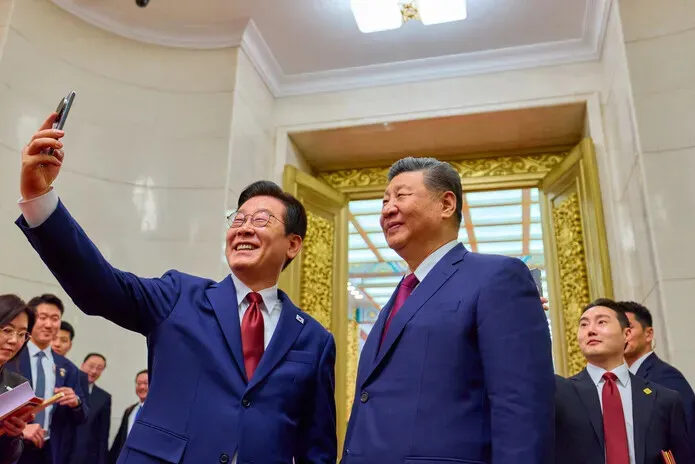
President Lee Jae Myung has wrapped up his state visit to China, the first visit of its kind by a South Korean leader in nine years. Lee and President Xi Jinping of China have agreed to expand cultural exchanges and continue discussions at the vice-minister level regarding China’s construction of structures in the West Sea.
This visit to China succeeded in creating an atmosphere for fully restoring bilateral relations, as evidenced by the signing of memoranda of understanding in 15 different spheres of cooperation.
However, it’s clear that there needs to be more dialogue regarding key strategic issues such as North Korea’s nuclear weapons programs, Taiwan, and China’s installations in the West Sea, also known as the Yellow Sea.
Fate has made China Korea’s neighbor, one that has had a definitive influence on our nation’s destiny for thousands of years. We must build on the fruits of the recent summit to create room for amicable relations and friendly development while still protecting our strategic interests.
During his meeting with Chinese Premier Li Qiang on Tuesday, the third day of his visit, Lee shared his commitment to “treating this year as Year 1 in fully restoring South Korea-China relations” and “robustly establishing the advancement of South Korea-China relations as an irreversible historical current.”
During discussions regarding Korea-China cooperation during his summit with Xi a day earlier, Lee proposed “horizontal and mutually beneficial cooperation in areas directly connected with the public standard of living as we redouble our efforts to resolve livelihood issues” and “exploring practical options for achieving peace on the Korean Peninsula.”
Yet when looking at the Chinese Foreign Ministry’s official statements, the points emphasized by Beijing differ from those highlighted by Seoul. Xi, while stressing the importance of Korea-China relations, said that “changes unseen in a century are unfolding at a faster pace, the world is undergoing greater transformation and turbulence,” and called for both countries to “stand firmly on the right side of history and make correct strategic choices.”
Xi’s statement can be interpreted as telling Korea to face the reality that the US’ hegemony is crumbling, and that Korea should not place all its eggs in the US’ basket.
Regarding North Korea policy, Xi’s remarks stopped at saying that China’s policy on South Korea “has maintained continuity and stability.” Xi made no direct reference to the ban on Korean content within China.
As the US-China rivalry intensifies, China is shying away from mentions of North Korea’s denuclearization. While there were no major expectations for a full cancellation of the K-content ban, it is disappointing that Xi made no mention of it.
While the Lee administration stressed the restoration of Korea-China relations, which deteriorated under Lee’s predecessor, Yoon Suk-yeol, China looked eager to chip away at trilateral cooperation between the US, Japan and Korea with references to Korea and China’s shared struggle against Japanese militarism in the past.
With the international order in such disarray, sensitive issues between Korea and China will not be resolved in one or two meetings. That’s why even amid the strategic rivalry between the US and China, we must continue cool-headed but resilient diplomacy that ensures we have enough room to maneuver so that we may maximize our national interest.
Please direct questions or comments to [english@hani.co.kr]
Editorial・opinion
![[Editorial] Trump’s baseless claim that Iran bombed girls’ school crosses line](https://flexible.img.hani.co.kr/flexible/normal/500/300/imgdb/original/2026/0309/4217730446901883.jpg "[Editorial] Trump’s baseless claim that Iran bombed girls’ school crosses line") [Editorial] Trump’s baseless claim that Iran bombed girls’ school crosses line
[Editorial] Trump’s baseless claim that Iran bombed girls’ school crosses line![[Correspondent’s column] JD Vance’s 67-hour disappearance](https://flexible.img.hani.co.kr/flexible/normal/500/300/imgdb/original/2026/0306/2517727866984907.jpg "[Correspondent’s column] JD Vance’s 67-hour disappearance") [Correspondent’s column] JD Vance’s 67-hour disappearance
[Correspondent’s column] JD Vance’s 67-hour disappearance- [Column] Withstanding Trump’s predatory hegemony
- [Editorial] US dragging Kurds into its war with Iran would be a disaster
- [Column] US allies in the Gulf are in flames. Can Korea avoid a similar fate?
- [Editorial] North Korea’s tough talk mustn’t deter Seoul’s efforts to rebuild trust
- [Editorial] Attack on Iranian girls’ school is an indefensible crime against humanity
- [Editorial] Trump’s unjustified war with Iran threatens chaos for us all
- [Column] What a Korean man’s foiled plan to seek assisted death in Switzerland reveals
- [Column] This is what accountability looks like
Most viewed articles
- 1Korea named as target of new Section 301 probe by US
- 2‘Made in USA’: Scraps of missile that killed Iranian children point to US responsibility
- 3[Editorial] No greater sign that South Korea must prioritize building its own defense abilities
- 4US may seek exit from Iran war by moving the goalposts of victory
- 5US Democrats say Trump’s investment pressure has ‘deeply unsettled’ alliance with Seoul
- 6[Column] Misconceptions about America’s war with Iran
- 765% of Korean men say gender equality has gone ‘far enough’; only 42% of women agree
- 8How much is the US willing to risk for the Strait of Hormuz?
- 9Coupang investors insinuate that US is planning Section 301 probe into Korea
- 10[News analysis] Air defense pullout signals new era of US strategic flexibility in Korea