hankyoreh
Links to other country sites 다른 나라 사이트 링크
[News analysis] Seoul and Beijing put touchy topics on back burner to focus on rebuilding ties
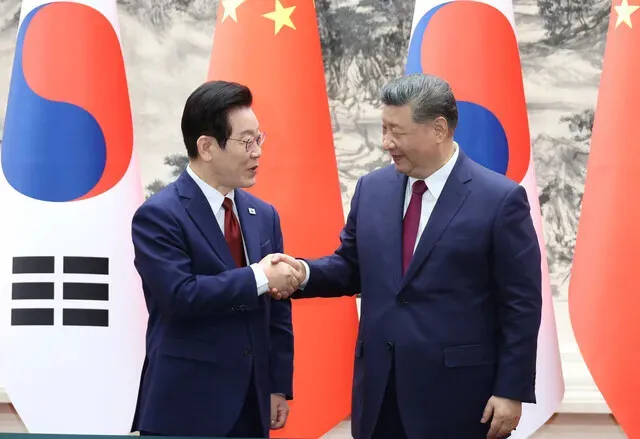
On Tuesday, President Lee Jae Myung held back-to-back meetings with Zhao Leji, who serves as chair of the Standing Committee of the National People’s Congress, and Premier Li Qiang, Beijing’s chief economic policymaker. These meetings with China’s second- and third-highest-ranking officials followed his summit with President Xi Jinping the previous day.
The People’s Daily, the Chinese Communist Party’s official newspaper, reported on the Korea-China summit on its front page the same day, featuring two photos for the lead story in an eye-catching layout. This suggests the Chinese government holds bilateral relations with South Korea in high regard.
Official meetings with China’s top leadership have now effectively concluded amid urgent international developments such as competition between the US and China, Sino-Japanese tensions, and the crisis in Venezuela. The South Korean government appears relieved, considering this a successful clearing of the first hurdle toward “full normalization” of bilateral relations.
However, concrete solutions to sensitive issues — such as the denuclearization of the Korean Peninsula, lifting the ban on Korean cultural content in China, and resolving the dispute over Chinese installations in the Yellow Sea — remain tasks for future discussions.
The main achievement of this summit, held just two months after Lee and Xi’s bilateral meeting in Gyeongju last November, is that it provided momentum for the “full restoration of relations” between the two countries. Korea-China relations deteriorated in the past few years due to clashes over the deployment of the US Terminal High Altitude Area Defense, or THAAD, missile defense system in Korea, and the Yoon Suk-yeol administration’s anti-China policies.
Lee stated that this meeting was “an important opportunity for making this the first year of fully restoring Korea-China relations,” while telling Xi that Seoul is “ready to cement the momentum of a full recovery of bilateral ties, seek common ground while putting aside differences, deepen the ROK-China strategic cooperative partnership.”
However, the absence of a joint statement, coupled with differences in the two nations’ respective announcements, remains concerning for the Korean government. While the two leaders achieved some tangible results in securing practical mutual benefits in areas such as people’s livelihoods and the economy, they notably failed to narrow differences on sensitive issues such as the regional security order, China’s regulations on Korean culture within its borders, and maritime conflicts.
In a briefing of the summit, Blue House national security adviser Wi Sung-lac spoke on the security issue of achieving peace and denuclearization on the Korean Peninsula, which the Korean government prioritized.
“The two leaders reaffirmed the importance of resuming dialogue with North Korea and China’s commitment to playing a constructive role for peace and stability on the Korean Peninsula,” Wi said. “Based on this, the South Korean and Chinese leaders agreed to continue exploring creative ways to build peace.”
However, it remains unclear what kind of “constructive” role China will play. The statement from China, which is approximately 1,200 characters, makes no mention whatsoever of the denuclearization of the Korean Peninsula, or even that the two leaders discussed issues regarding the region. This appears to reflect China’s awareness of North Korea’s growing geopolitical significance amid the US-China rivalry for hegemony.
“It is currently difficult for South Korea and China to produce concrete results regarding the situation on the Korean Peninsula,” assessed Lee Hee-ok, the honorary director of the Sungkyun Institute of China. “However, it appears both countries share the understanding that they should cooperate to contribute to building peace on the peninsula.”

Kim Sung-bae, the president of the Institute for National Security Strategy, noted that the two leaders “deliberately avoided mentioning denuclearization, mindful of North Korea’s opposition to the agenda.”
“Once President Lee returns to Korea, he should hold a call with US President Donald Trump as soon as possible to share what was discussed at this summit and explore how to initiate North Korea-US dialogue through strategic cooperation,” he suggested.
As anticipated, China centered the issue of Taiwan in discussions of security. This was evident in the Chinese statement, which emphasized that Lee stated that South Korea “respects China’s core interests and major concerns and stays committed to the one-China stance.”
China also emphasized the two nations’ cooperation against Japan, as well as joint countermeasures against US hegemony and protectionism. According to the Chinese statement, Xi stated, “Over 80 years ago, China and the ROK made great sacrifices in resisting Japanese militarism and achieved victory.”
To this, Lee is said to have responded that Korea and China “stood together” against Japanese militarist aggression and that Korea “appreciates” China’s preservation of Korean independence movement sites within China.
In his public remarks, Xi delivered a message applying pressure to Korea. “Both countries, with broad common interests, should stand firmly on the right side of history and make correct strategic choices,” he said, signaling China’s watchful eye on South Korea’s actions in the context of the US-China rivalry.
Regarding the ban on Korean cultural content, a key concern for South Korea, the two countries reached a “consensus to gradually expand cultural content exchanges starting with acceptable areas,” according to the Blue House. However, there was no progress on allowing K-pop performances in China, and the possibility of lifting the ban remains unclear. The two countries only agreed to expand exchanges in Go and soccer, deferring the issue of distributing Korean dramas and films in China to future working-level consultations.
Regarding the structures China has installed in the West Sea, also known as the Yellow Sea, the two leaders reportedly shared the “recognition of making the West Sea a peaceful sea,” but no concrete solution emerged. Slight progress was made in that both sides agreed to strive to hold vice-ministerial-level maritime boundary demarcation talks before the end of the year.
The most notable achievements came in the areas of civilian livelihoods and the economy. This included signing 14 memoranda of understanding on cooperation in new technologies such as intellectual property protection, artificial intelligence, and big data, and agreeing to create a regular dialogue platform between South Korea’s Ministry of Trade, Industry and Resources and China’s Ministry of Commerce.
“[The summit] laid the foundation and created momentum for future developments, but we must now work toward concrete results,” emphasized Lee Hee-ok. “The ban on Korean cultural content can only be resolved gradually, and the West Sea situation must be managed so that relations do not deteriorate.”
Kim Sung-bae called it “significant” that Lee “emphasized ‘strategic autonomy’ amid US-China conflict and an unstable international landscape.”
By Park Min-hee, senior staff writer; Shin Hyeong-cheol, staff reporter
Please direct questions or comments to [english@hani.co.kr]

Editorial・opinion
![[Editorial] Trump’s baseless claim that Iran bombed girls’ school crosses line](https://flexible.img.hani.co.kr/flexible/normal/500/300/imgdb/original/2026/0309/4217730446901883.jpg "[Editorial] Trump’s baseless claim that Iran bombed girls’ school crosses line") [Editorial] Trump’s baseless claim that Iran bombed girls’ school crosses line
[Editorial] Trump’s baseless claim that Iran bombed girls’ school crosses line![[Correspondent’s column] JD Vance’s 67-hour disappearance](https://flexible.img.hani.co.kr/flexible/normal/500/300/imgdb/original/2026/0306/2517727866984907.jpg "[Correspondent’s column] JD Vance’s 67-hour disappearance") [Correspondent’s column] JD Vance’s 67-hour disappearance
[Correspondent’s column] JD Vance’s 67-hour disappearance- [Column] Withstanding Trump’s predatory hegemony
- [Editorial] US dragging Kurds into its war with Iran would be a disaster
- [Column] US allies in the Gulf are in flames. Can Korea avoid a similar fate?
- [Editorial] North Korea’s tough talk mustn’t deter Seoul’s efforts to rebuild trust
- [Editorial] Attack on Iranian girls’ school is an indefensible crime against humanity
- [Editorial] Trump’s unjustified war with Iran threatens chaos for us all
- [Column] What a Korean man’s foiled plan to seek assisted death in Switzerland reveals
- [Column] This is what accountability looks like
Most viewed articles
- 1Korea named as target of new Section 301 probe by US
- 2‘Made in USA’: Scraps of missile that killed Iranian children point to US responsibility
- 3[Editorial] No greater sign that South Korea must prioritize building its own defense abilities
- 4US may seek exit from Iran war by moving the goalposts of victory
- 5US Democrats say Trump’s investment pressure has ‘deeply unsettled’ alliance with Seoul
- 6[Column] Misconceptions about America’s war with Iran
- 765% of Korean men say gender equality has gone ‘far enough’; only 42% of women agree
- 8How much is the US willing to risk for the Strait of Hormuz?
- 9Coupang investors insinuate that US is planning Section 301 probe into Korea
- 10[News analysis] Air defense pullout signals new era of US strategic flexibility in Korea