hankyoreh
Links to other country sites 다른 나라 사이트 링크
Lee commits to ‘fully restoring’ Seoul-Beijing ties in meetings with senior Chinese leaders
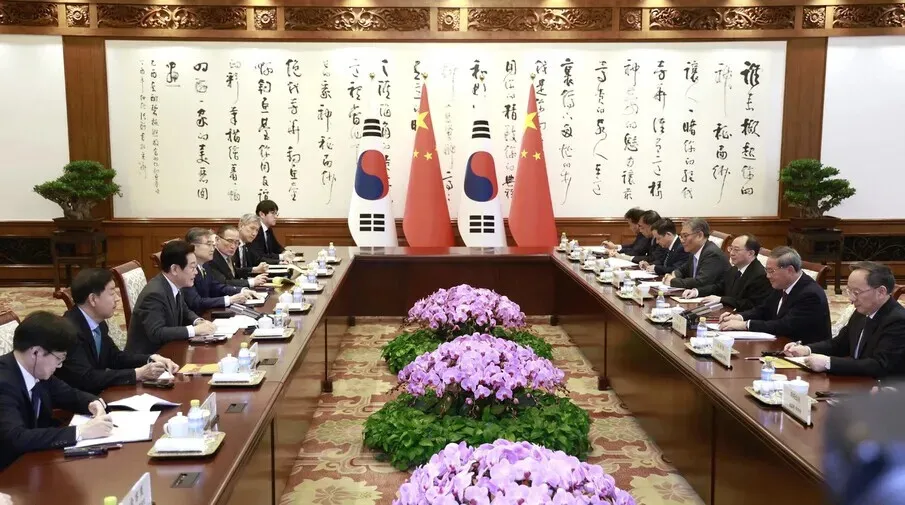
In a meeting with the second- and third-ranking figures in the Chinese state hierarchy on Tuesday, South Korean President Lee Jae Myung shared his commitment to “treating this year as Year 1 in fully restoring South Korea-China relations” and “robustly establishing the advancement of South Korea-China relations as an irreversible historical current.”
His remarks came while meeting with Chinese Premier Li Qiang and Zhao Leji, who serves as chairperson of the National People’s Congress Standing Committee. Following his affirmation of a commitment to fully restoring bilateral relations during a summit the day before with Chinese President Xi Jinping, Lee’s comments Tuesday were focused on laying the groundwork for practical results in terms of economic cooperation and stronger attitudes of friendship.
Blue House spokesperson Kang Yu-jung quoted Lee as saying during a meeting with Li at Beijing’s Diaoyutai State Guesthouse on Tuesday that he “looked forward to the further expansion of opportunities for reciprocal cooperation between South Korea and China during China’s implementation of its 15th five-year plan.”
Li reportedly answered that China intended to “maintain its focus on external development while sharing opportunities for development with various countries, including South Korea.”
In connection with this, Kang said the meeting participants had “shared an awareness of the need to usher [bilateral relations] toward goodwill competition that promotes mutual development,” adding that they had “commitment to ongoing efforts to establish an environment for promoting mutual investment, including cooperation in emerging areas such as the digital economy, biotechnology, and the environment as well as industrial zone collaboration.”
This was the third meeting between Lee and Li, after previous encounters at an ASEAN+3 (Association of Southeast Asian Nations plus South Korea, China and Japan) summit and Group of 20 summit in October of last year.
Referring to this point, Lee commented, “In South Korea, we have the saying that ‘with friends, older is better, and with clothes, newer is better.’ It means that older friendships are good because the feeling goes deeper.”
He also expressed his “hope that through exchanging opinions candidly like true old friends, this can be a historic turning point for advancement in South Korea-China relations.”
Li was quoted as sharing his “readiness to have even more honest dialogue” with Lee.
“As our two sides continue pursuing cooperation in different eras, this will surely bring even greater welfare to the people of both countries,” he reportedly declared.
Lee was further quoted as requesting Li’s cooperation in “working together to ensure that peace and stability on the Korean Peninsula and in Northeast Asia can translate into practical benefits for the lives of people in both countries.” Li reportedly expressed his agreement on the importance of peace and stability on the peninsula and in the region and on the need for stronger communication to this end.
Before his encounter with Li, Lee had met earlier in the day with Zhao, whose role in China is analogous to the speaker of the National Assembly. During that meeting, Lee reportedly asked for the “active support and assistance of the National People’s Congress toward further advancing South Korea-China relations on a foundation of solid trust.”
In particular, Lee reportedly emphasized the importance of “efforts not only to increase interchange in terms of people to promote mutual understanding and friendly sentiments among people on both sides, but also to promote cultural interchange within the scope of what is mutually possible.” To this end, he called on China to “consider the additional loan of a panda pair,” Kang reported.
In response, Zhao was quoted as saying that China would “support the encouragement of interchange in order to establish a solid base of popular will as a bridge for bilateral relations, including not only the two countries’ parliaments but also areas relating to young people, culture, media, academics, regions and so forth.”
The two sides also agreed that cooperation in historically related areas — including the preservation of historic sites from the Korean independence movement — would provide a useful instance of taking advantage of the past as a medium to broaden mutual rapport and understanding.
By Seo Young-ji, staff reporter; Shin Hyeong-cheol, staff reporter
Please direct questions or comments to [english@hani.co.kr]

Editorial・opinion
![[Editorial] Trump’s baseless claim that Iran bombed girls’ school crosses line](https://flexible.img.hani.co.kr/flexible/normal/500/300/imgdb/original/2026/0309/4217730446901883.jpg "[Editorial] Trump’s baseless claim that Iran bombed girls’ school crosses line") [Editorial] Trump’s baseless claim that Iran bombed girls’ school crosses line
[Editorial] Trump’s baseless claim that Iran bombed girls’ school crosses line![[Correspondent’s column] JD Vance’s 67-hour disappearance](https://flexible.img.hani.co.kr/flexible/normal/500/300/imgdb/original/2026/0306/2517727866984907.jpg "[Correspondent’s column] JD Vance’s 67-hour disappearance") [Correspondent’s column] JD Vance’s 67-hour disappearance
[Correspondent’s column] JD Vance’s 67-hour disappearance- [Column] Withstanding Trump’s predatory hegemony
- [Editorial] US dragging Kurds into its war with Iran would be a disaster
- [Column] US allies in the Gulf are in flames. Can Korea avoid a similar fate?
- [Editorial] North Korea’s tough talk mustn’t deter Seoul’s efforts to rebuild trust
- [Editorial] Attack on Iranian girls’ school is an indefensible crime against humanity
- [Editorial] Trump’s unjustified war with Iran threatens chaos for us all
- [Column] What a Korean man’s foiled plan to seek assisted death in Switzerland reveals
- [Column] This is what accountability looks like
Most viewed articles
- 1Korea named as target of new Section 301 probe by US
- 2‘Made in USA’: Scraps of missile that killed Iranian children point to US responsibility
- 3[Editorial] No greater sign that South Korea must prioritize building its own defense abilities
- 4US may seek exit from Iran war by moving the goalposts of victory
- 5US Democrats say Trump’s investment pressure has ‘deeply unsettled’ alliance with Seoul
- 6[Column] Misconceptions about America’s war with Iran
- 765% of Korean men say gender equality has gone ‘far enough’; only 42% of women agree
- 8How much is the US willing to risk for the Strait of Hormuz?
- 9Coupang investors insinuate that US is planning Section 301 probe into Korea
- 10[News analysis] Air defense pullout signals new era of US strategic flexibility in Korea