hankyoreh
Links to other country sites 다른 나라 사이트 링크
[Editorial] Korea, US need a ‘gentlemen’s agreement’ on what job creation entails
 Add as preferred source on Google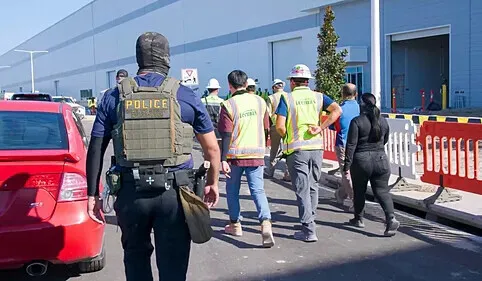
A major breakthrough has been reached on the arrest and detention of over 300 Korean workers by US immigration authorities. The US has agreed to let the Koreans return home voluntarily rather than deporting them.
But the failure to fully address the root causes of the debacle remains troubling. While the visa issue is being vigorously debated, the disconnect between Korean and American attitudes on job creation is another serious issue.
Underlying the incident is the push to create more jobs for Americans. The raid on the construction site of the Hyundai Motor-LG battery factory in Georgia was prompted by complaints filed with the local media and US Immigration and Customs Enforcement by Americans disappointed by the number of locals hired for the construction project.
When Korean companies inked the contract to build the factory in 2022, they promised to create 8,500 jobs over eight years in exchange for receiving tax benefits. Needless to say, a promise is a promise — but these jobs are typically created not during construction, but when the factory actually opens. That’s when locals are hired, trained and placed on the assembly line. Or at least that’s how the process typically goes.
But now the US is making the unreasonable demand that Americans be hired during the factory construction phase.
That kind of thinking would be ruinous for both countries.
Considering that the US manufacturing sector has been in shambles for more than two decades now, how could inexperienced American workers be used to build some of the world’s most advanced factories? While some grumbling from the local community is to be expected, it’s unacceptable for local politicians — let alone government bureaucrats — to indulge such impulses.
We can all agree that building a cutting-edge battery factory necessitates a high degree of expertise. Furthermore, these companies are building factories not in their own backyards but overseas, while still being obligated to meet construction deadlines without any hitches. Scheduling delays typically cause costs to snowball.
That’s why these companies have gotten in the habit of using trusted business partners and contractors. They need those partners to do the job because only highly skilled workers are capable of transporting equipment and installing production machinery. To be sure, simple tasks can be performed by local workers, but the US needs to understand that such tasks only account for a fraction of the whole.
More factories will be built in the US as part of large-scale investment packages worth astronomical sums of money. Failing to resolve these issues now could create major disruptions down the line.
Surely the US doesn’t want to block the construction of high-tech factories that would make it a producer of the world’s finest goods.
For the two countries to have a win-win relationship, they need to pay heed to the business obstacles in the planning phase and craft more granular solutions than what we have at present.
We hope that the two sides can reach a gentleman’s agreement on both the visa issue and job creation expectations so they can surmount, or at least manage, their disagreements.
Please direct questions or comments to [english@hani.co.kr]

Editorial・opinion
![[Editorial] Korean Peninsula once again becomes the front line of a geopolitical rivalry](https://flexible.img.hani.co.kr/flexible/normal/500/300/imgdb/original/2026/0721/9917846225973516.jpg "[Editorial] Korean Peninsula once again becomes the front line of a geopolitical rivalry") [Editorial] Korean Peninsula once again becomes the front line of a geopolitical rivalry
[Editorial] Korean Peninsula once again becomes the front line of a geopolitical rivalry![[Editorial] Regulatory action needed after another preventable warehouse fire](https://flexible.img.hani.co.kr/flexible/normal/500/300/imgdb/original/2026/0721/7717846225003099.jpg "[Editorial] Regulatory action needed after another preventable warehouse fire") [Editorial] Regulatory action needed after another preventable warehouse fire
[Editorial] Regulatory action needed after another preventable warehouse fire- [Column] Seeking the Korean soldiers who showed mercy during Vietnam massacres
- [Reporter’s notebook] Trump’s White House windfall
- [Column] Will Lee’s NATO partnership end differently than Yoon’s support for Ukraine?
- [Editorial] For Korea’s disputes with the US, the only way out is through
- [Column] Trump’s war at home
- [Column] Another sign of an empire in decline
- [Column] The gender voting gap is eroding the foundation of democracy
- [Column] The view of China-South Korea relations from Beijing
Most viewed articles
- 1A whole new China-North Korea alliance is taking shape, report argues
- 2[Editorial] Korean Peninsula once again becomes the front line of a geopolitical rivalry
- 3[Column] Will Lee’s NATO partnership end differently than Yoon’s support for Ukraine?
- 4South Korea carefully walks tightrope between China, US on AI
- 5[Column] Seeking the Korean soldiers who showed mercy during Vietnam massacres
- 6[Reporter’s notebook] Trump’s White House windfall
- 7[Editorial] Regulatory action needed after another preventable warehouse fire
- 8[Korea travels] Move over K-BBQ, it’s Korean charcuterie’s time to shine
- 9SK chief calls memory shortage ‘utter chaos,’ hints at plans to invest in US
- 10[Editorial] For Korea’s disputes with the US, the only way out is through