hankyoreh
Links to other country sites 다른 나라 사이트 링크
[News analysis] Behind split strategies, Kim Jong-un stays focused on regime security, advancement
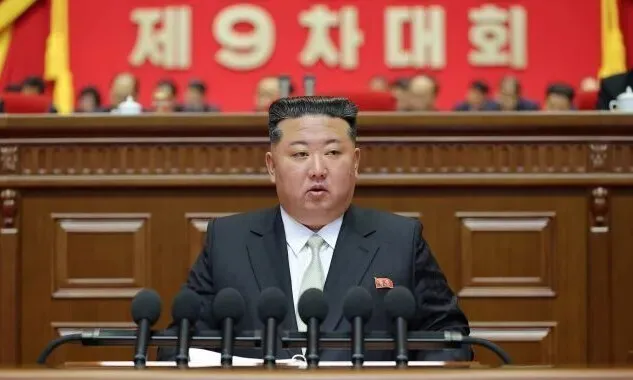
Two key themes emerge from North Korea’s strategies toward South Korea, the US and its nuclear program rolled out at the ruling Workers’ Party of Korea congress over the past week. First, in order to protect its regime, North Korea must both arm itself with nuclear weapons and sever ties between the two Koreas. Second, if it hopes to pursue development, it must first sort out its relationship with the all-powerful US.
The problem isn’t the familiar rhetoric itself, but the fact that Kim Jong-un has reasserted that this will be the overarching strategy for the country — one that will remain in place until the next Workers’ Party of Korea congress, scheduled for 2031.
In short, barring a major shift in attitude from Kim Jong-un, South Korea has little reason to expect inter-Korean exchanges, cooperation or inter-governmental dialogue to resume during President Lee Jae Myung’s term.
The most striking part of Kim’s speech was the fact that he did not walk back remarks made in December 2023, when he declared that relations with the South were relations between two “hostile states” opposed to reunification. Instead, he stated, “The DPRK remains strong and conclusive in its determination and will to regard the ROK just as a very hostile state and eternal enemy on this principle in the future.” (ROK is short for the Republic of Korea, the official name of South Korea; DPRK is the abbreviated form of the Democratic People’s Republic of Korea, or North Korea.)
By defining the South as a “very hostile state and eternal enemy,” the North Korean leader has declared that the North will “exclude the ROK from the category of compatriots forever.”
The attempt to build a wall to isolate the Koreas from one another is, Kim emphasized, due to perceived threats to the North Korean regime posed by the South.
“The ROK’s ultimate ambition is to turn the whole Korean Peninsula into one under the capitalist reactionary system of ‘liberal democracy,’” Kim said. “While outwardly advocating deceptive ‘reconciliation’ and ‘peace,’ it is seeking to disarm the DPRK under the signboard of the ‘denuclearization of the Korean peninsula.’”
Kim went on to claim that the “successive ruling forces of the ROK [. . .] have worked hard to spread their culture within our country by abusing the opportunities for reconciliation and cooperation in a sinister attempt to bring about its change and the final collapse of its social system.”
In other words, the only way to stop unification by absorption and shield itself from ideological corruption caused by the influx of South Korean TV shows, movies and songs spreading among the North Korean youth is to build a wall to block out all influences.
This explains Kim’s slamming of the Lee administration’s North Korea policy as a “clumsy, deceptive farce.” Kim’s view is that in the roughly three decades since the end of the Cold War and the first inter-Korean summit in 2000, North-South exchanges and cooperation have delivered little on their promise of aiding North Korea’s economic development, and instead only functioned as threats to the regime.
While he did not say it outright, this stance also appears to be driven by disillusionment with South Korea’s self-appointment as diplomatic mediator after the 2018/2019 summit diplomacy with Seoul and Washington that had been brokered by President Moon Jae-in ultimately collapsed.
However, Kim’s stance on the South was not outright pugilistic, as evidenced by his comments that “the only way for the ROK to live safely is to abandon everything related to us and not to irritate us.” The future he envisions for the two Koreas is one where they engage in neither dialogue nor conflict — in other words, a cold peace.
Despite labelling the US as a “top-class rogue” that “unhesitatingly resort[s] to aggression and use of force against sovereign states,” Kim also stated that “there is no reason why [North Korea] cannot get on well with the US.” This, in effect, is Kim’s attempt to give Washington a green light for dialogue.
Of course, it comes with its own conditions: the acknowledgement of the DPRK’s “present position [. . .] specified in the Constitution,” which enshrines the country’s status as a “responsible nuclear weapons state,” and the withdrawal of the US’ “hostile policy toward the DPRK.” In other words, the US and South Korea should halt joint military exercises and the deployment of US strategic weapons to the Korean Peninsula.
While it concedes that mending ties with the US, the global hegemon, is unavoidable if it wants to develop, North Korea is also signaling that it has no intention of giving up its nuclear arsenal.
With this, Kim is saying that he’s open to talking with Trump when the US travels to China in late March, but that it’s up to the US to decide whether their relationship will be one of “peaceful coexistence or eternal confrontation.”
Kim declared that the North would continue its “strategic and tactical external activities,” emphasizing diplomacy over military confrontation. Much like how Kim did not respond to Trump’s various proposals to meet around the 2025 APEC summit in Gyeongju, Kim has once again made clear that he will not meet Trump unless the US makes the first move to ease military tensions.
By Lee Je-hun, senior staff writer
Please direct questions or comments to [english@hani.co.kr]

Editorial・opinion
![[Column] Japan and South Korea: An alliance of middle powers?](https://flexible.img.hani.co.kr/flexible/normal/500/300/imgdb/original/2026/0615/4017815116945786.jpg "[Column] Japan and South Korea: An alliance of middle powers?") [Column] Japan and South Korea: An alliance of middle powers?
[Column] Japan and South Korea: An alliance of middle powers?![[Editorial] Korea must use G7 summit to band together with fellow middle powers](https://flexible.img.hani.co.kr/flexible/normal/500/300/imgdb/original/2026/0615/5817815111712322.jpg "[Editorial] Korea must use G7 summit to band together with fellow middle powers") [Editorial] Korea must use G7 summit to band together with fellow middle powers
[Editorial] Korea must use G7 summit to band together with fellow middle powers- [Editorial] Sinking Korean youth employment in AI era requires action, and fast
- [Editorial] Korean students show how to protest ballot fiasco without resorting to conspiracies
- [Column] What do people crying election fraud in Korea even want?
- [Column] Once security assets, US bases are now liabilities to host countries
- [Column] Takaichi is putting Japan’s constitution in crisis
- [Editorial] Losing Seoul mayor’s race should be a wakeup call for Democrats
- [Column] Naming the enemy: The unsettling return of ideological litmus tests in Korea
- [Editorial] No excusing ballot shortage fiasco
Most viewed articles
- 1[Editorial] Korean democracy 20 years after the death of Park Jong-cheol
- 2Korean court rules same-sex union entitled to legal protection in homewrecker suit
- 3[Column] Japan and South Korea: An alliance of middle powers?
- 4[Editorial] For a traitor like Yoon, even 30 years is too lenient
- 5Shinsegae heir’s anti-communist posts cause stock prices to plummet
- 6With 400,000 undocumented workers in Korea, Lee administration weighs paths to legal status
- 7Starbucks Korea faces backlash for ‘Tank Day’ promotion on anniversary of Gwangju massacre
- 8Shinsegae chief and all Starbucks Korea employees to receive history, sensitivity training after ‘Tank Day’ fiasco
- 9[Q&A] Why Japan is angling for a military logistics pact with South Korea
- 10After 106 days of war, US and Iran confirm MOU to end fighting has been reached