hankyoreh
Links to other country sites 다른 나라 사이트 링크
Threatening North Korea has not made peninsula any safer, says South Korea’s Lee
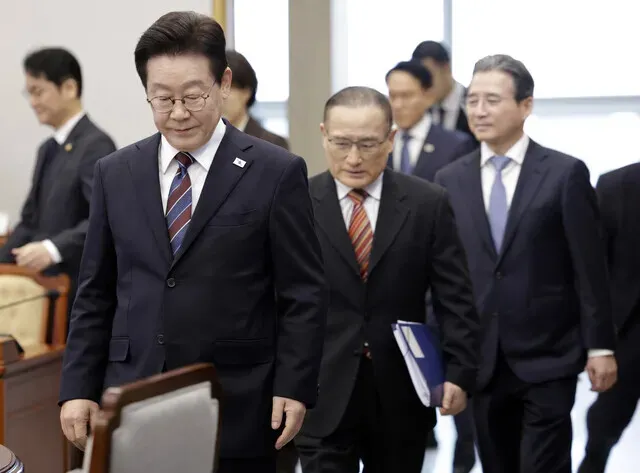
After North Korean leader Kim Jong-un described South Korea as “a very hostile state and eternal enemy,” the Blue House and the South Korean government said his remarks were “regrettable.”
Seoul was responding to Kim’s refusal to acknowledge South Korea as a dialogue partner and his disparagement of the conciliatory gestures South Korean President Lee Jae Myung has made to restore inter-Korean relations since taking office as “a clumsy deceptive farce and poor work.”
Nevertheless, Lee reiterated his intention to remain steadfast in his push for peaceful coexistence on the Korean Peninsula. “There’s an old saying that you can’t fill your belly with a single spoonful,” he remarked, suggesting that success takes time.
After Kim vowed to uphold the view that the relationship between North and South Korea is one of “two state hostile to each other” in his recent speech at the 9th Congress of the Workers’ Party of Korea, South Korea’s Ministry of Unification said in a statement that it is “regrettable” that North Korea is “not engaging with our government’s efforts at peaceful coexistence on the Korean Peninsula.”
North Korea has stuck to its hard-line stance against the South even though Seoul has pledged to acknowledge the North Korean regime, not pursue “unification through absorption,” and not engage in any hostile activities. Seoul has furthermore taken conciliatory measures, such as moving gradually but preemptively to restore a 2018 inter-Korean comprehensive military agreement aimed at easing tensions and building mutual military trust.
The Lee administration has proposed what it calls the “END” initiative — restoring trust to promote exchange (E) and normalize (N) relations, leading to denuclearization (D).
“There’s no need to blame anybody else, and doing so won’t fix the problem,” Lee said in a meeting with senior secretaries and aides at the Blue House on Thursday.
“It’s time that we seriously reflect upon whether the insults and threats we’ve made toward North Korea over the years have actually helped bring peace and stability to the Korean Peninsula or preserve the national interest and national security,” Lee mused.
“The values we need to promote [are and have been] peace and stability,” he said.
“Our government needs to consistently and patiently promote policies of peace and coexistence on the Korean Peninsula while remaining dispassionate among the vicissitudes of fortune,” said Unification Minister Chung Dong-young during a border region peace and safety joint session, held at the Inter-Korean Relations Management Bureau in Seoul’s Jongno District on Thursday.
“The president already figured that a breakthrough in inter-Korean relations wouldn’t happen overnight. If we try for a little while only to quit, people will just say they told us that would happen,” a source in the Blue House said.
“North Korea can throw up barriers, but that’s no reason to change our policy foundation. Since North Korea has left open the possibility for dialogue with the US in April, we will work to keep up our role as pacemaker,” said a source in the Unification Ministry.
By Shin Hyeong-cheol, staff reporter
Please direct questions or comments to [english@hani.co.kr]

Editorial・opinion
![[Editorial] Trump’s baseless claim that Iran bombed girls’ school crosses line](https://flexible.img.hani.co.kr/flexible/normal/500/300/imgdb/original/2026/0309/4217730446901883.jpg "[Editorial] Trump’s baseless claim that Iran bombed girls’ school crosses line") [Editorial] Trump’s baseless claim that Iran bombed girls’ school crosses line
[Editorial] Trump’s baseless claim that Iran bombed girls’ school crosses line![[Correspondent’s column] JD Vance’s 67-hour disappearance](https://flexible.img.hani.co.kr/flexible/normal/500/300/imgdb/original/2026/0306/2517727866984907.jpg "[Correspondent’s column] JD Vance’s 67-hour disappearance") [Correspondent’s column] JD Vance’s 67-hour disappearance
[Correspondent’s column] JD Vance’s 67-hour disappearance- [Column] Withstanding Trump’s predatory hegemony
- [Editorial] US dragging Kurds into its war with Iran would be a disaster
- [Column] US allies in the Gulf are in flames. Can Korea avoid a similar fate?
- [Editorial] North Korea’s tough talk mustn’t deter Seoul’s efforts to rebuild trust
- [Editorial] Attack on Iranian girls’ school is an indefensible crime against humanity
- [Editorial] Trump’s unjustified war with Iran threatens chaos for us all
- [Column] What a Korean man’s foiled plan to seek assisted death in Switzerland reveals
- [Column] This is what accountability looks like
Most viewed articles
- 1Korea named as target of new Section 301 probe by US
- 2‘Made in USA’: Scraps of missile that killed Iranian children point to US responsibility
- 3[Editorial] No greater sign that South Korea must prioritize building its own defense abilities
- 4US may seek exit from Iran war by moving the goalposts of victory
- 5US Democrats say Trump’s investment pressure has ‘deeply unsettled’ alliance with Seoul
- 6[Column] Misconceptions about America’s war with Iran
- 765% of Korean men say gender equality has gone ‘far enough’; only 42% of women agree
- 8How much is the US willing to risk for the Strait of Hormuz?
- 9Coupang investors insinuate that US is planning Section 301 probe into Korea
- 10[News analysis] Air defense pullout signals new era of US strategic flexibility in Korea