hankyoreh
Links to other country sites 다른 나라 사이트 링크
‘What have we done to deserve this?’ Korean workers decry ‘degrading’ treatment in ICE detention
 Add as preferred source on Google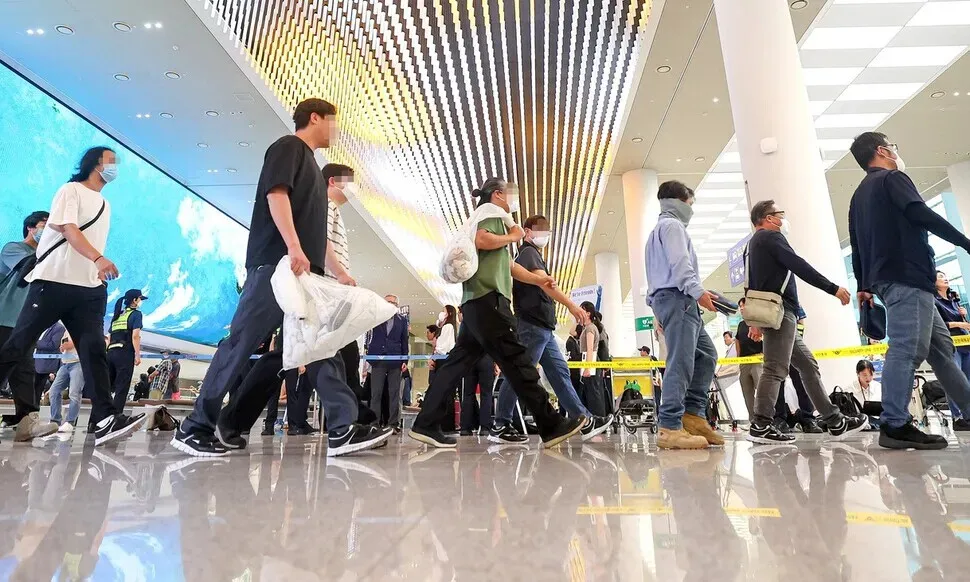
Hands bound to their waists, they had to bow their heads to lap up water to quench their thirst. When using the toilet, they were only given a piece of fabric to cover their lower bodies, as there were no private stalls. Almost no sunlight came in through the “window,” which was nothing more than a fist-sized hole in the wall, and they were only allowed to go outside for two hours a day to wander around a tiny yard.
Upon their return to Korea, workers who had been detained by US immigration authorities expressed utter dismay at the degrading human rights violations they were subjected to during their eight days of imprisonment — conditions they never could have imagined for themselves as ordinary Koreans in the year 2025.
Since the 330 workers arrested in an immigration raid at a Hyundai-LG battery plant under construction in Georgia returned to Korea on Friday, many have begun to speak out about the human rights violations they were subjected to during custody.
Testimonies made public on Sunday showed that the detention center failed to meet any of the UN Standard Minimum Rules for the Treatment of Prisoners, also known as the Mandela Rules, when it came to hygiene, contact with the outside world, complaints regarding treatment, and providing information on circumstances.
The problems began with the arrest process itself. Workers were reportedly left in the dark about what was happening as the authorities failed to give them the Miranda warning or any other explanation of the situation.
“We didn’t even know that we were being arrested. We thought we were going through identity checks, but they made us sign some random document,” stated an individual in his 40s, surnamed Seo, an employee of one of LG’s subcontractors.
The family of another individual, 48, who asked for anonymity, said, “The word ‘arrest’ stood out blatantly on the form, so the workers whispered amongst themselves because they thought signing it would be a bad idea. Since they were surrounded by agents with guns, they had no choice but to go ahead and sign it.”
US Immigration and Customs Enforcement agents ordered the workers to take out everything in their pockets before collecting their cell phones and other belongings in a mesh bag, then used chains to tie the workers’ arms and legs. Once they ran out of chains, they started to bind the workers with cable ties.
Early on in their incarceration, the workers were crammed into a temporary detention center, which was a room that could house 72 people. A worker’s account made public by Yonhap News Agency described the facility as having rows of bunk beds with moldy mattresses. Hygiene products such as toothpaste, toothbrushes and blankets appear only to have been provided on their second day of detention. Workers wrapped themselves in their towels to protect themselves from the chilly air. The stench in the water prevented many from quenching their thirst, and the only food the workers received came in the form of canned beans and toast.
The workers were slowly sorted into two-person rooms on the third and fourth days of their detention. The rooms were around 4.96 square meters in size and contained one bunk bed and a steel desk. The biggest problem was the toilet, which was in a completely open communal space. The only privacy the workers were afforded was a piece of cloth that they could use to cover their lower bodies.
“Our human rights were not guaranteed at all, especially regarding certain bodily functions,” said Jo Yeong-hui, 44, who works at a subcontractor. “It just couldn’t be dealt with in a bathroom without walls.”
Two hours spent in the yard — a small field half the size of a basketball court — was the only chance that the workers got to see the sun each day.
Another worker, whose family conveyed the emotional toll he faced during his time in detention to the Hankyoreh, expressed a sense of helplessness at his inability to even protest the incomprehensible treatment he faced.
“He was subjected to inhumane confinement without knowing what he’d done so wrong to deserve it,” his family said. “The fact that no one was offering any apology hit him really hard.”
In fact, when Korean consular officials met with the workers at the detention center, workers reportedly expressed their frustration, saying, “What have we done so wrong? Shouldn’t someone be figuring this out?”
The total shock of being arrested at a work site where they had been building a plant at the behest of the US seems to have made the experience all the more terrifying.
“When we take a look at testimony that has come out so far — about the arrest process, how dozens of people were forcibly taken away and the poor bathroom conditions and inadequate food that was provided — we see that there are plenty of areas in which the treatment of these detainee does not meet international standards,” said Lee Seong-hun, the vice president of the Korean Association of Human Rights Studies.
“While the US may tend not to care so much about these sorts of things, it’s within our rights to raise issues on human rights grounds,” he said.
South Korea’s Foreign Ministry said that the government had been expressing regret to the US from the onset of the issue while consistently emphasizing that the rights and interests of Korean citizens should not be infringed upon during law enforcement procedures.
“While some requests regarding limited communication with the outside and health checks by medical staff at the detention center were implemented and improved, we plan on working with the companies involved to continue to assess whether any human rights violations or unfair treatment of our citizens occurred and take necessary action accordingly,” the ministry said.
By Cho Hae-yeong, staff reporter; Jang Jong-woo, staff reporter; Seo Young-ji, staff reporter; Lee Seung-wook, staff reporter
Please direct questions or comments to [english@hani.co.kr]

Editorial・opinion
![[Editorial] Korean Peninsula once again becomes the front line of a geopolitical rivalry](https://flexible.img.hani.co.kr/flexible/normal/500/300/imgdb/original/2026/0721/9917846225973516.jpg "[Editorial] Korean Peninsula once again becomes the front line of a geopolitical rivalry") [Editorial] Korean Peninsula once again becomes the front line of a geopolitical rivalry
[Editorial] Korean Peninsula once again becomes the front line of a geopolitical rivalry![[Editorial] Regulatory action needed after another preventable warehouse fire](https://flexible.img.hani.co.kr/flexible/normal/500/300/imgdb/original/2026/0721/7717846225003099.jpg "[Editorial] Regulatory action needed after another preventable warehouse fire") [Editorial] Regulatory action needed after another preventable warehouse fire
[Editorial] Regulatory action needed after another preventable warehouse fire- [Column] Seeking the Korean soldiers who showed mercy during Vietnam massacres
- [Reporter’s notebook] Trump’s White House windfall
- [Column] Will Lee’s NATO partnership end differently than Yoon’s support for Ukraine?
- [Editorial] For Korea’s disputes with the US, the only way out is through
- [Column] Trump’s war at home
- [Column] Another sign of an empire in decline
- [Column] The gender voting gap is eroding the foundation of democracy
- [Column] The view of China-South Korea relations from Beijing
Most viewed articles
- 1A whole new China-North Korea alliance is taking shape, report argues
- 2[Editorial] Korean Peninsula once again becomes the front line of a geopolitical rivalry
- 3South Korea carefully walks tightrope between China, US on AI
- 4[Column] Will Lee’s NATO partnership end differently than Yoon’s support for Ukraine?
- 5[Column] Seeking the Korean soldiers who showed mercy during Vietnam massacres
- 6[Reporter’s notebook] Trump’s White House windfall
- 7[Editorial] Regulatory action needed after another preventable warehouse fire
- 8[Korea travels] Move over K-BBQ, it’s Korean charcuterie’s time to shine
- 9SK chief calls memory shortage ‘utter chaos,’ hints at plans to invest in US
- 10[Editorial] For Korea’s disputes with the US, the only way out is through