hankyoreh
Links to other country sites 다른 나라 사이트 링크
Tariffs, layoffs, deportations: Trump’s year of upending the lives of Americans
“Don’t shoot us!”
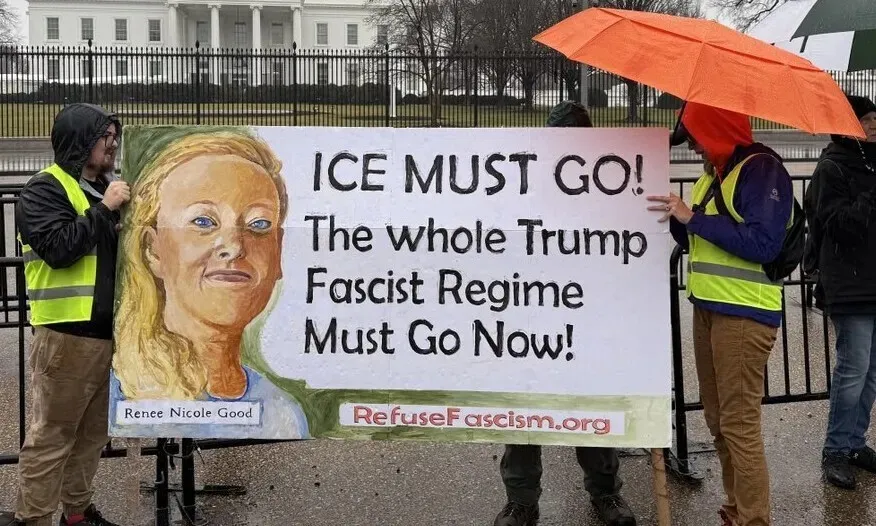
At 1 pm on Saturday, a hundred or so Americans gathered at Lafayette Square, just north of the White House, despite the falling rain.
One protestor wearing a poncho held a poster that said, “Wake up America.” Another poster posed a rhetorical question to agents of US Immigration and Customs Enforcement (ICE): “How does it feel to shoot young mothers?”
The protests were held in condemnation of the fatal shooting of Renee Nicole Good, aged 37, by an ICE agent in Minneapolis, Minnesota, on Wednesday.
“When I first saw the video from Minneapolis, I was shocked but not surprised. Those people are trained to be OK with actions of this kind. It feels like being stuck in a nightmare that never ends. We’re asking for things to get better,” said one protestor who spoke with the Hankyoreh.
“This is the same thing that happened with George Floyd. It’s a red line for us,” one speaker at the protest said.
Over a thousand memorials and “ICE Out for Good” demonstrations were held around the US on the first weekend after the fatal shooting in Minneapolis and a subsequent shooting by border patrol agents in Portland, Oregon.
The shooting is seen as symbolizing the first year of Trump’s second term, in which the US president has sought to move the country in a fundamentally different direction by taking decisive action in a wide range of areas — adopting a harsh immigration policy, slashing federal spending, halting diversity programs, raising tariffs, combatting drug smugglers, and attacking Venezuela, along with continuing efforts to end conflicts in Ukraine and Gaza.
During that year, Trump has made over 5,500 posts to social media and signed 227 executive orders — six more than he signed during his entire first term — with major consequences for the lives of ordinary Americans.
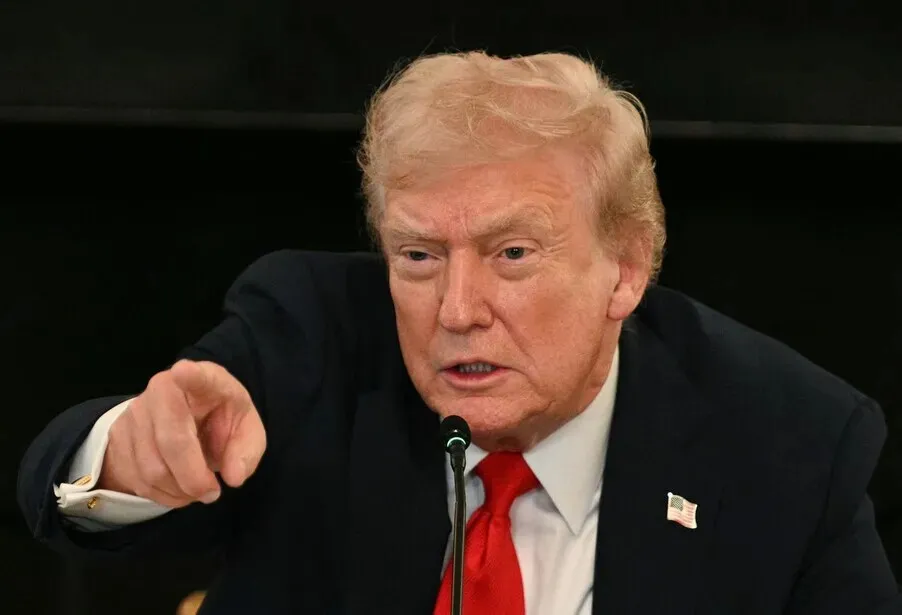
To mark the first anniversary of Trump’s inauguration on Jan. 20, the Hankyoreh heard from Americans who were directly impacted by Trump’s policies in 2025.
A toy seller laments a lost year
“You just couldn’t make any plans in 2025,” remarked Abigail Adelsheim-Marshall, the co-owner of Mischief, a toy store she has run with her parents in Saint Paul, Minnesota, since 2015.
Around 90% of the store’s toys are imported from China. She would like to buy more American-made toys, but that’s a tall order.
“Over the past century, America has moved its industrial base overseas. We don’t have the productive capacity to make the things people expect. I’ve talked to lots of suppliers, and they say there are only a couple of places in the world — most of them in China — with factories capable of making these products,” she said.
“Even if you wanted to make toys in the US, you’d still have to buy the manufacturing equipment from Chinese companies, and there would be tariffs to pay on that, too. If we wanted to bring manufacturing back to the US, we ought to have invested in the requisite infrastructure before raising tariffs,” she said.
Beginning on Feb. 1, 2025, Trump signed more than 35 executive orders on tariffs — a number that only goes up if you include the official proclamations that publicize the president’s political intentions to the world.
“At one point, tariffs on China exceeded 100%. They changed depending on the date container ships arrived, and sometimes they shifted weekly,” Adelsheim-Marshal told the Hankyoreh over the phone.
Some companies lowered prices when tariffs dropped, but others maintained high prices in anticipation that tariffs would rise again. The responses varied widely among over 500 trading companies.
“Our main strategy last summer was to order as much as possible to secure as much inventory as possible before tariffs went into effect,” Adelsheim-Marshal said.

Trump pursued a hard-line trade policy, successively imposing high reciprocal tariffs and item-specific tariffs on nearly all US trading partners across the world. Last year, the overall average effective tariff rate in the US exceeded 18%, the highest since 1934.
Adelsheim-Marshall joined forces with nine other businesses, including a board game publisher, a children’s apparel business, a fine art collector, and a kitchenware business, on April 24 to file a lawsuit against the Trump administration. The case argues that the implementation of reciprocal tariffs based on the International Emergency Economic Powers Act (IEEPA) is unlawful, echoing the contention outlined in a case currently being reviewed by the Supreme Court.
“Our attorney informed us that the Supreme Court decision will be out in January. I can only hope that the court decides that no one is above the law,” the toy seller said.
Trump’s tariff war has had knock-on effects for exports as well, with China countering aggressive tariffs with its own retaliatory tariffs and by halting imports of US soybeans, the US’ top agricultural export.
The US had exported an average of 29 million tons of soybeans to China each year, but the number dropped drastically to zero by October 2025. The export volume, equivalent to approximately 20 times South Korea’s annual soybean consumption for food, feed and processing combined, vanished in an instant.
Grant Kimberley, a soybean farmer in Hampton, Iowa, who serves as the Iowa Soybean Association’s senior director of market development, visited both South Korea and Japan in September of last year to explore new export markets.
“If we’re to make up for the losses from the Chinese market, we need to break into markets all over the world,” he told the Hankyoreh.

The leaders of the US and China came to a major trade agreement in Busan in October of last year. China agreed to import 12 million tons of American soybeans in November and December and to import 25 million tons annually starting the following year. However, even if both sides stick to the agreement, that’s less than the average annual soybean exports to China before trade tensions rose.
“China has bought an estimated 7 million to 8 million tons from the market, but those shipments haven’t been loaded. It looks unlikely that they’ll make good on their promise to purchase 12 million tons until February of this year,” Kimberley said.
China currently levies a 10% tariff on US soybeans, but has no tariff in place on Brazilian soybeans. The hope of many US farmers this year is for China to drop its tariff on American soybeans.
“This tariff is retribution in response to the fentanyl tariff imposed by the US. If transactions in fentanyl precursor chemicals are successfully deterred, then I think tariffs from both sides can be eliminated,” Kimberley said.
“Agricultural trade is mutually beneficial, so I hope we can cooperate,” he added.
National Guard troops in cities, kidnappings at workplaces, and resistance
On June 6, it finally happened to Citlali’s family. After migrating from a commune of descendants of the Zapotec tribe in Oaxaca, Mexico, 14 members of the family were apprehended and kidnapped while working at a clothing warehouse in Los Angeles, California, by ICE agents. They were all handcuffed and shuttled into a van.
This was part of ICE’s first large-scale operation to enforce immigration laws in sanctuary cities, which limit cooperation with federal immigration enforcement. Many saw it as the opening salvo of a war on sanctuary cities and immigrants.
Anti-ICE protesters swarmed the city. Then, Trump sent the National Guard into Los Angeles, in what would become the first of many similar deployments across the US.
It was difficult to tell who had been taken and where they’d been taken. While she finally found the facility where her relatives were being detained, attorney visitations were impossible.
“Moreover, at first they lied that my family wasn’t there, then they later said they were there,” Citlali told the Hankyoreh. “I couldn’t even call my family to talk to them within the facility.”
That’s when the intense fight to find her family began. One relative signed a document, believing it was related to COVID-19 testing, but was deported 36 hours later before anyone could do anything. Together with other activists, Citlali formed the group Lucha Zapoteca.
The only place to turn to was the courts. The Trump administration has rejected requests for bond hearings, requiring plaintiffs to invoke habeas corpus, but the procedure is complicated and costly. This is a high barrier for migrants who are either poor or can’t speak English.
“The judge determined the unconstitutionality of the detainment, allowing us a bond hearing that not only released my relatives but also allowed other people in the same situation to receive bond hearings without the additional procedural burden of habeas corpus. It was a major victory,” Citlali said.
Her relatives are now preparing for their trial. Fortunately, she has raised over US$170,000 through crowdfunding.
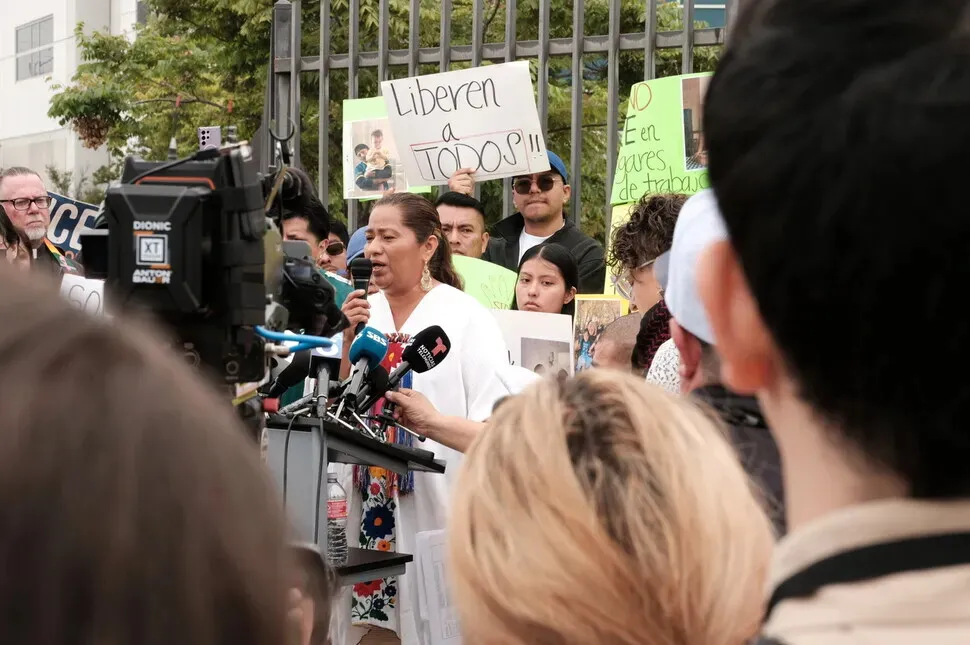
“ICE is still raiding workplaces. People working hard to make a living each day are being kidnapped at their places of work,” Citlali said. “While the TV only shows violence and desperation, we can resist if we stick together. The fact that we were able to do something gave me hope.”
The Trump administration deported over 622,000 people last year. Over 1.9 million have voluntarily left the country. Limits on birthright citizenship, restrictions on refugee and asylum claims, and higher fees for H-1B visas have narrowed the window for legal immigration.
FEMA employees vs. DOGE
“If there’s a fire, you should do everything possible to put it out. Even contractors who have no protections were signing it, so I couldn’t just stand by. At least if I get fired, I get a pension,” said James Stroud, who is currently in his fourth month of indefinite administrative leave from the Federal Emergency Management Agency, better known as FEMA.
On Aug. 25, the 20th anniversary of Hurricane Katrina, 192 FEMA employees issued a statement to “sound the alarm” about the state of leadership over the agency. Stroud was one of the employees who signed the statement using his real name. He was put on leave 36 hours after the statement came out.
Under the leadership of billionaire businessman Elon Musk, the so-called Department of Government Efficiency (DOGE) took a chainsaw to federal agencies, all but dissolving USAID and the Department of Education.
FEMA also couldn’t evade the categorization of a “massive and inefficient bureaucratic organization” requiring cuts. It has since lost 33% of its payroll.
The declaration issued by FEMA employees was a plea stating that they couldn’t simply stand by and witness the collapse of FEMA management.
“The acting chief didn’t know anything about FEMA operations. Over 100 people died during the Texas floods back in August, but he couldn’t be reached. As a result, the rescue team was deployed 72 hours late,” Stroud told the Hankyoreh over the phone.

Citing the need for strict fiscal management, the Trump administration has required all spending requests above US$100,000 to be approved by US Homeland Security Secretary Kristi Noem. Stroud and his coworkers claim that Noem has rejected their requests for arbitrary reasons.
“The funds we needed for the rescue operation in Texas were delayed 72 hours because of the $100,000 dollar rule,” a FEMA employee who spoke on the condition of anonymity told the Hankyoreh. “Reform is necessary, but this is an overall dismantling of the organization, and people will die as a result.”
It’s difficult to find any special reason for dismantling FEMA.
“They say that state governments, not the federal one, should attend to local disasters, but their actions are contradictory. They also nixed all federal funding to bolster state capacity for disaster management,” Stroud said.
The FEMA worker who requested anonymity said that FEMA was being targeted because it runs something called the “Disaster Relief Fund.”
“I think they want to privatize the fund and let companies have control over it,” they said.
Even in such a situation, Stroud said that his coworkers who are fighting for their jobs give him hope.
“Even amid pressure from the executive branch, my colleagues continue to go to work every morning to help people. When I see them, I am inspired,” he added.
“People who had been working at the call center for only a year signed the statement. I’m so proud of them, and their sense of duty gives me hope,” said the FEMA worker who requested anonymity.
By Kim Won-chul, Washington correspondent
Please direct questions or comments to [english@hani.co.kr]

Editorial・opinion
![[Editorial] Trump’s baseless claim that Iran bombed girls’ school crosses line](https://flexible.img.hani.co.kr/flexible/normal/500/300/imgdb/original/2026/0309/4217730446901883.jpg "[Editorial] Trump’s baseless claim that Iran bombed girls’ school crosses line") [Editorial] Trump’s baseless claim that Iran bombed girls’ school crosses line
[Editorial] Trump’s baseless claim that Iran bombed girls’ school crosses line![[Correspondent’s column] JD Vance’s 67-hour disappearance](https://flexible.img.hani.co.kr/flexible/normal/500/300/imgdb/original/2026/0306/2517727866984907.jpg "[Correspondent’s column] JD Vance’s 67-hour disappearance") [Correspondent’s column] JD Vance’s 67-hour disappearance
[Correspondent’s column] JD Vance’s 67-hour disappearance- [Column] Withstanding Trump’s predatory hegemony
- [Editorial] US dragging Kurds into its war with Iran would be a disaster
- [Column] US allies in the Gulf are in flames. Can Korea avoid a similar fate?
- [Editorial] North Korea’s tough talk mustn’t deter Seoul’s efforts to rebuild trust
- [Editorial] Attack on Iranian girls’ school is an indefensible crime against humanity
- [Editorial] Trump’s unjustified war with Iran threatens chaos for us all
- [Column] What a Korean man’s foiled plan to seek assisted death in Switzerland reveals
- [Column] This is what accountability looks like
Most viewed articles
- 1Korea named as target of new Section 301 probe by US
- 2‘Made in USA’: Scraps of missile that killed Iranian children point to US responsibility
- 3[Editorial] No greater sign that South Korea must prioritize building its own defense abilities
- 4US may seek exit from Iran war by moving the goalposts of victory
- 5US Democrats say Trump’s investment pressure has ‘deeply unsettled’ alliance with Seoul
- 6[Column] Misconceptions about America’s war with Iran
- 765% of Korean men say gender equality has gone ‘far enough’; only 42% of women agree
- 8How much is the US willing to risk for the Strait of Hormuz?
- 9Coupang investors insinuate that US is planning Section 301 probe into Korea
- 10[News analysis] Air defense pullout signals new era of US strategic flexibility in Korea