hankyoreh
Links to other country sites 다른 나라 사이트 링크
Trump’s freewheeling ‘Donroe Doctrine’ could trigger return to dark days of imperialism
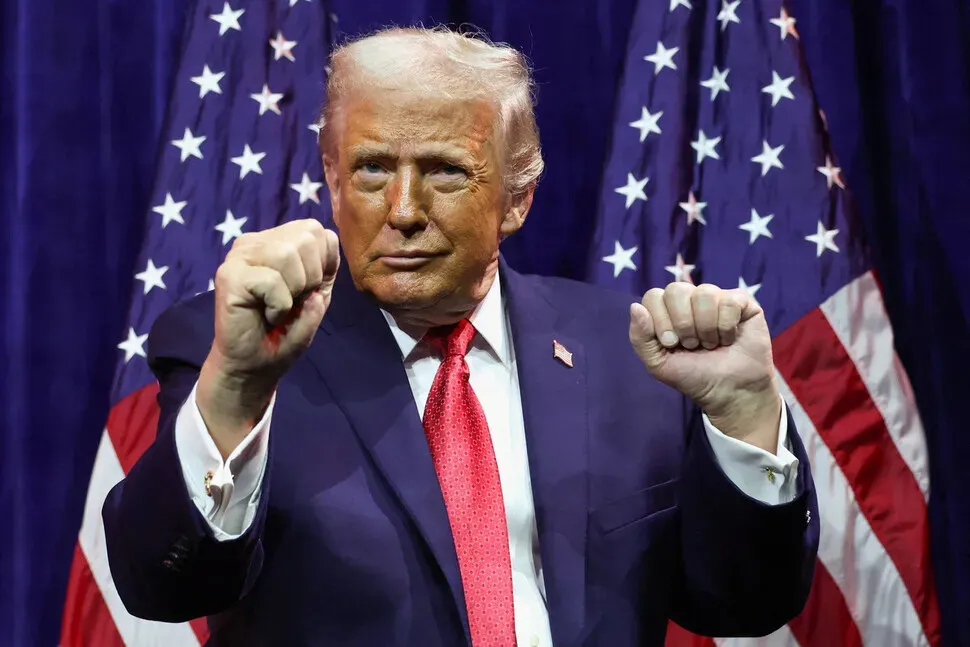
As we near the first anniversary of US President Donald Trump’s inauguration on Jan. 20, the biggest impact he has had on the world so far is his abandonment of the US-led liberal international order. In his second term, Trump has doubled down on his slogan of “America First.” Geopolitically speaking, that means primacy over the Western Hemisphere — exerting dominion over all of North and South America through coercion and physical force.
Those trends were on full display during the US’ military operation in Venezuela over the weekend and the Trump administration’s hints about using military force to acquire Greenland on Tuesday.
“President Trump has made it well known that acquiring Greenland is a national security priority of the United States, and it’s vital to deter our adversaries in the Arctic region. The President and his team are discussing a range of options to pursue this important foreign policy goal, and of course, utilizing the US Military is always an option at the Commander in Chief’s disposal,” White House Press Secretary Karoline Leavitt said in response to an inquiry from the Hankyoreh on Tuesday.
That came shortly after seven European countries (the UK, France, Germany, Italy, Poland, Spain and Denmark) released a joint statement in which they declared that “Greenland belongs to its people. It is for Denmark and Greenland, and them only, to decide on matters concerning Denmark and Greenland.”
Leavitt’s remarks suggest the Trump administration has adopted an even tougher stance in response.
Free rein has now been given to what some have nicknamed the “Donroe Doctrine,” with the US president overseeing a 21st-century resurrection of gunboat diplomacy and a willingness to use military force to undertake attacks and coercion.
“The Monroe Doctrine is a big deal, but we've superseded it by a lot. By a real lot. They now call it the ‘Donroe Document.’ [sic] [. . .] Under our new National Security Strategy, American dominance in the Western Hemisphere will never be questioned again,” Trump told reporters.
Speaking at a news conference Saturday on the arrest of Venezuelan President Nicolás Maduro, Trump said that Venezuela’s actions had been “in gross violation of the core principles of American foreign policy dating back more than two centuries.”
“All the way back — it dated to the Monroe Doctrine,” he said.
The Monroe Doctrine is a principle for US foreign policy stated in 1823 by then-President James Monroe, who declared that the US would not interfere with European affairs and insisted that the major powers of Europe should not interfere with affairs on the American continent. It amounted to a declaration of US hegemony over the American continent.
The Monroe Doctrine remained a consistent part of US policy, as seen with the 1989 invasion of Panama and the arrest of its military leader and de facto ruler, Manuel Noriega, early the following year. After the end of the Cold War in 1991, it was shifted to the back burner.
But after placing an emphasis on restoring US influence over Central and South America during his first term, Trump adopted an overt stance of prioritizing America’s dominance in the Western Hemisphere upon taking office for his second, as he argued for US territorial control over Greenland, the Panama Canal, and Canada. The New York Post referred to this as the “Donroe Doctrine,” a portmanteau of Trump’s name and Monroe’s.
The first National Security Strategy of the second Trump administration, which was released on Dec. 4 of last year, declared the “Trump Corollary” to the Monroe Doctrine, which shifted the priorities of foreign policy from the Indo-Pacific region to the Western Hemisphere.
In the early 20th century, then-President Theodore Roosevelt used the “Roosevelt Corollary” — a continuation of the Monroe Doctrine — to legitimize gunboat diplomacy toward Central and South American countries, including a confrontation with Germany over Venezuela. This is the approach emulated by Trump.
In the strategy document, Washington announced its intent to “restore American preeminence in the Western Hemisphere, and to protect our homeland and our access to key geographies throughout the region.” To this end, it said it would “deny non-Hemispheric competitors the ability to position forces or other threatening capabilities, or to own or control strategically vital assets, in our Hemisphere.”
The invasion of Venezuela showed that Trump’s corollary to the Monroe Doctrine is a matter of aggression and domination rather than defense of the Western Hemisphere.
This is particularly evident in his increasingly overt intent to make Greenland into a US territory.
Trump said in an interview with The Atlantic published Sunday that the US “absolutely needed Greenland “for defense.”
The same day, he told reporters on the presidential aircraft, “Let’s talk about Greenland in 20 days.”
Stephen Miller, who spearheaded the invasion of Venezuela as US homeland security adviser and one of Trump’s closest associates, shared a chilling message, declaring, “Nobody’s going to fight the United States militarily over the future of Greenland.”
“We live in a world, in the real world [. . .] that is governed by strength, that is governed by force, that is governed by power. These are the iron laws of the world since the beginning of time,” he also stated.
Meanwhile, Trump recently alluded to talking about Cuba in the near future, while sharing a warning for Colombian President Gustavo Petro to “be careful.”
He has not shied away from threatening Mexico, the largest country in Central America. On Saturday, he told Fox News that cartels were “running Mexico” and that “something’s gonna have to be done with” the country.
The ripple effects of the freewheeling “Donroe Doctrine” are likely to have impacts that extend beyond the Americas, as they set a precedent where major powers are able to unilaterally draw a sphere of influence.
Russia and China — both allies of Venezuela — have been outspoken with their criticism of the US, but that criticism has remained pro forma to date. Some observers are contending that they have no choice but to sit on their hands regarding the Venezuela situation because they are already tacitly colluding with the US administration under Trump: Russia on the war with Ukraine and China with the Taiwan situation.
Since before taking office for a second time, Trump has fundamentally pursued Ukraine’s concession of the Donbas region — consisting of the oblasts of Donetsk and Luhansk — and a postwar Ukrainian security plan where Europe assumes responsibility.
He has also backed down on the Taiwan issue. Elbridge Colby, an adviser who has maintained that the confrontation with China is the US’ paramount security issue, said in March 2024 that Taiwan was “not existential for America” — meaning it was not something the US should be willing to risk a war for.
This lessens the burdens on China and Russia in terms of unilaterally carving out spheres of influence in the South China Sea and Central Asia. The Atlantic Council also commented on the potential for a recurrence of wars to expand the major powers’ influence in regions such as Africa and the Middle East, noting that other powers might remove regimes at any time and calling for collaboration to establish safeguards.
Already, Russia and China have been taking the West’s place following coups in countries in the Sahel region of West Africa.
Questions also remain over whether the “Donroe Doctrine” will translate into stability and stronger control for the US.
Military interventions in Central and South America during the 20th century led to chaotic and catastrophic outcomes. The 1954 overthrow of Guatemala’s popularly elected administration — with involvement by the CIA — touched off decades of civil war and instability. The 1961 Bay of Pigs invasion, which had the aim of toppling the socialist regime following Cuba’s revolution, ended up a miserable failure that triggered the later Cuban Missile Crisis.
A 1973 military coup carried out by Augusto Pinochet in Chile to topple the Salvador Allende government ushered in 17 years of dictatorship that saw the deaths of tens of thousands of people. During the 1980s, the Ronald Reagan administration intervened to overthrow Nicaragua’s Sandinista government, only to end up causing the Iran-Contra scandal and another civil war. In 1989, the George H. W. Bush administration invaded Panama and arrested Noriega on charges of drug smuggling, but the drug issue remained completely unresolved.
In addition to its repudiation of the very same rule-based global order that the US has pursued over the years, the “Donroe Doctrine” is also a potential trigger for worsening conflict in Central and South America and other regions.
Commenting Monday on the US’ designs on Greenland, Danish Prime Minister Mette Frederiksen warned, “If the United States decides to attack another NATO country, then everything would stop — that includes NATO and therefore post-World War II security.”
What appears to be looming now is a global order similar to the era of 19th-century imperialist powers that divided up the rest of the world.
By Jung E-gil, staff reporter
Please direct questions or comments to [english@hani.co.kr]

Editorial・opinion
![[Editorial] Trump’s baseless claim that Iran bombed girls’ school crosses line](https://flexible.img.hani.co.kr/flexible/normal/500/300/imgdb/original/2026/0309/4217730446901883.jpg "[Editorial] Trump’s baseless claim that Iran bombed girls’ school crosses line") [Editorial] Trump’s baseless claim that Iran bombed girls’ school crosses line
[Editorial] Trump’s baseless claim that Iran bombed girls’ school crosses line![[Correspondent’s column] JD Vance’s 67-hour disappearance](https://flexible.img.hani.co.kr/flexible/normal/500/300/imgdb/original/2026/0306/2517727866984907.jpg "[Correspondent’s column] JD Vance’s 67-hour disappearance") [Correspondent’s column] JD Vance’s 67-hour disappearance
[Correspondent’s column] JD Vance’s 67-hour disappearance- [Column] Withstanding Trump’s predatory hegemony
- [Editorial] US dragging Kurds into its war with Iran would be a disaster
- [Column] US allies in the Gulf are in flames. Can Korea avoid a similar fate?
- [Editorial] North Korea’s tough talk mustn’t deter Seoul’s efforts to rebuild trust
- [Editorial] Attack on Iranian girls’ school is an indefensible crime against humanity
- [Editorial] Trump’s unjustified war with Iran threatens chaos for us all
- [Column] What a Korean man’s foiled plan to seek assisted death in Switzerland reveals
- [Column] This is what accountability looks like
Most viewed articles
- 1Korea named as target of new Section 301 probe by US
- 2‘Made in USA’: Scraps of missile that killed Iranian children point to US responsibility
- 3[Editorial] No greater sign that South Korea must prioritize building its own defense abilities
- 4US may seek exit from Iran war by moving the goalposts of victory
- 5US Democrats say Trump’s investment pressure has ‘deeply unsettled’ alliance with Seoul
- 6[Column] Misconceptions about America’s war with Iran
- 765% of Korean men say gender equality has gone ‘far enough’; only 42% of women agree
- 8How much is the US willing to risk for the Strait of Hormuz?
- 9Coupang investors insinuate that US is planning Section 301 probe into Korea
- 10[News analysis] Air defense pullout signals new era of US strategic flexibility in Korea