hankyoreh
Links to other country sites 다른 나라 사이트 링크
[K-pop: To Love or Let Go] If my fave hits No. 1 on Billboard, then can she have a love life?
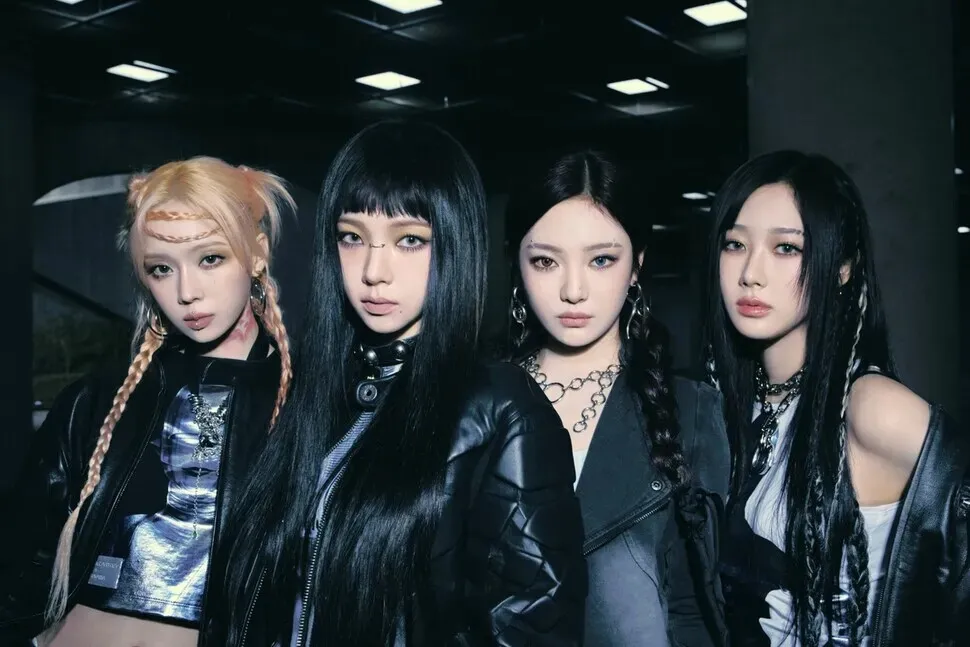
After taking a break from K-pop, I returned as a new kind of fangirl around the time that Korea’s girl groups reached their peak in what’s known as K-pop’s fourth generation, or the idols who have debuted after 2020. (While “fangirl” is typically a derogatory term for female fans of pop idols, I’d like to reclaim the word to mean a wholehearted devotee.)
The arrival of these girl groups meant a vacation from the boy bands I’d so long adored, as well as the genesis of a new world of infatuation. I was now enthralled with such groups as (G)I-dle, who blazed a trail for girl groups by writing and producing their own songs since arriving on the scene; Ive, who broke ground with their signature brand of self-confidence; Le Sserafim, who proclaimed that suffering and hardship only make them stronger; and NewJeans (NJZ), who embodied the “ride or die” mentality.
In retrospect, I’d always been a fan of the more feminine side of K-pop, even if I hadn’t been fully cognizant of the fact. Even when I’d idolized Donghae of SuperJunior fame, my MP3 playlist had always included tracks by Boa and Girls’ Generation. It was because of society’s obsession with heterosexuality that it took me so long to realize women, too, could drive me wild.
I thereby discovered the possibilities of a new kind of love as a feminist who loves K-pop. This love began emerging in earnest at the same time as a group of warriors known as Aespa appeared on the scene, each wielding their own weapon to fight the forces of evil, known as the “Black Mamba.” As someone who goes mad for girls who stand up for themselves, their core concept and outlook involving warriors fighting the Black Mamba in the digital realm known as the “Kwangya” beguiled me from the moment I saw them. It was enough to rekindle a passion for K-pop after having put my feelings on ice.
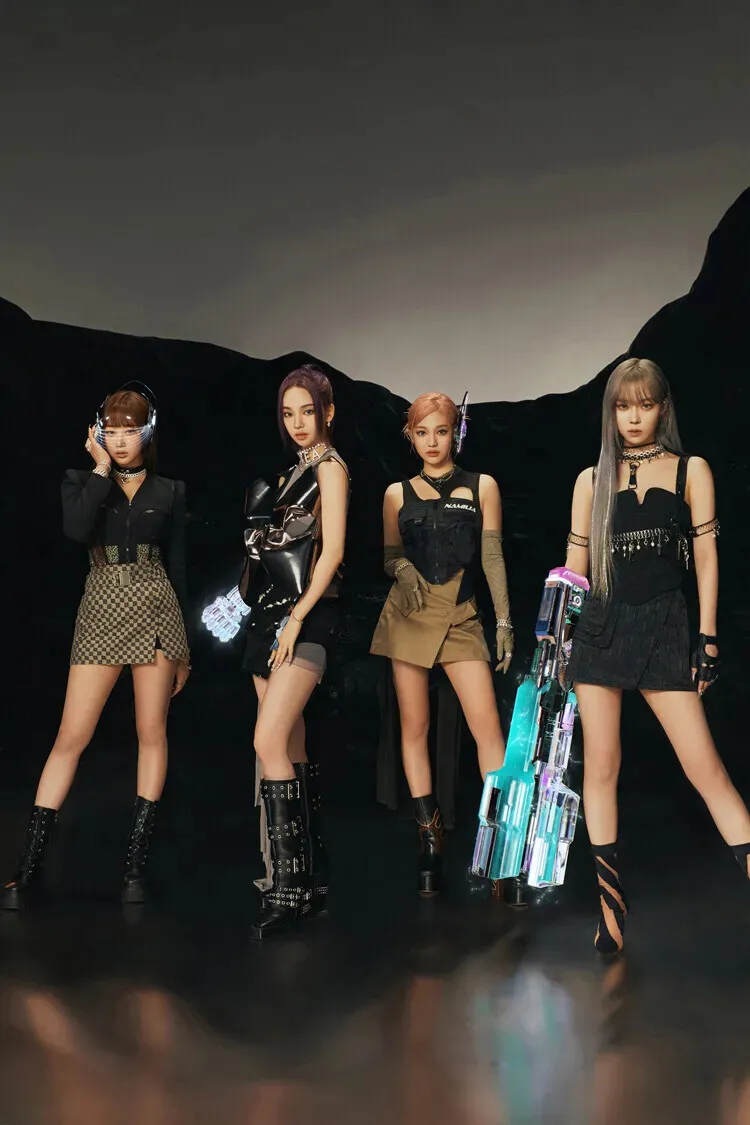
In the Kwangya, each member of Aespa wields a specific power. Karina’s power is the rocket punch gauntlet, a protective glove made of metal and leather; Winter is the armamenter with the power to wield swords, guns and a variety of weapons; Giselle possess xenoglossy, the ability to understand and speak any language; and Ningning is an E.D. hacker that can hack into all sorts of databases. In short, every member has their own killer move. Women who are always ready to take on a fight are my weakness. Watching a woman enter battle with a steely determination in her eyes will never not make me swoon.
That is why when I heard that Lee Soo-man, who was involved in Aespa’s early digital worldbuilding, left SM Entertainment, I got worried that Aespa would lose the woman warrior worldview that had drawn me to them in the first place. Grandiose backstories and universes are rare in the world of girl groups, and I was sad to think that this one would disappear. But above anything else, I wanted to continue to see Aespa fight their battles. But with the release of “Armageddon,” the group’s first full-length album in four years, my worries proved entirely unfounded.
Aespa stood at the cusp of Armageddon, climbed immovable steel grating, and leaped out of their previous universe. Exiting the Kwangya, Aespa was now able to go anywhere. The worldview and concept they’d used before were simply tools to serve Aespa’s music. Everything they show the world is their worldview. They have unveiled Aespa’s music —neither “easy” listening nor abstruse noise.
But as with everything, there are ups and downs — even with the things we enjoy. The love I have for these women was no exception. The worldview I’d gone crazy for was just a strategy designed and presented by SM Entertainment, and Aespa was simply executing that strategy. Their strength was just an image that operated within the bounds set by the industry.
When an idol group’s worldview is reduced to a two-dimensional image, even diehard fans lose interest. A group’s subjectivity and strength are not created through imagery. In the way they proactively express their opinions about concert planning and choreography, in their ruminations over what Aespa’s music is, in the magnanimity that allows them to laugh in the face of obstacles, in the way they greet their fans from the stage — this is where I see the heart of what Aespa really is.
There’s never not some sort of scandal or incident in the K-pop scene. But when I think about the moment I heard reports of Karina being in a whirlwind romance last year, I still feel conflicted. Biting, vulgar comments were flung at Karina nonstop, and the sentiment among fans veered in an unexpected, nasty direction. I couldn’t agree with anything people were saying.
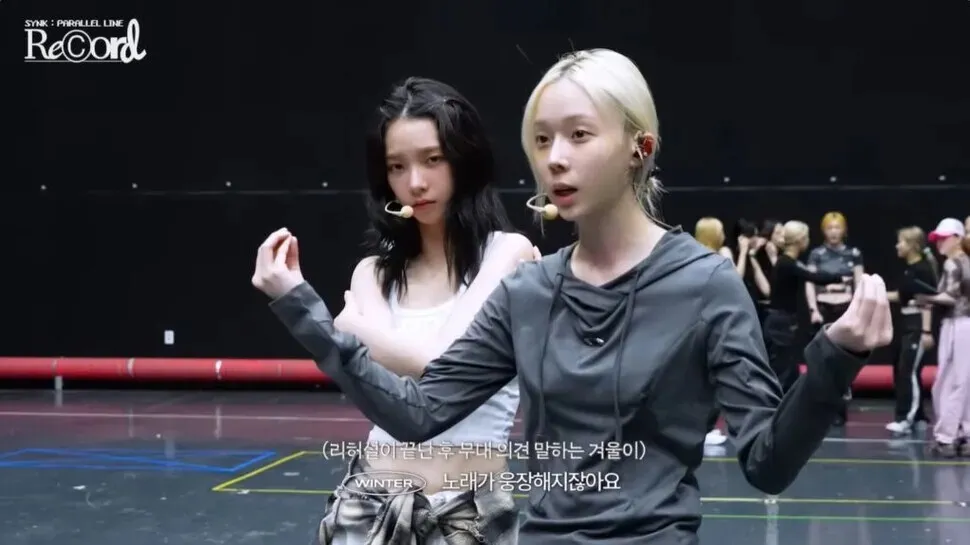
I was so worried that Karina would see the comments that I saw, would be subject to all sorts of criticism on Bubble (a communication platform for K-pop fans), would be unable to eat or would be brought to tears, that I’d spend whole days stewing in anxiety. I knew I couldn’t reach out to her, but I wanted to tell her that even if we may drift apart and one day I may no longer be her diehard fan, her relationship would never be the reason.
Aespa has a high proportion of women fans, but that doesn’t mean their fans have feminist inclinations. That’s because feminism is not something that’s just given, but is something that is practiced through actions large and small. What happened with Karina opened my eyes to this in new ways. Whenever an idol is rumored to be dating, disgruntled fans always say something like, “Do you know how much money I’ve spent on you so far?” I’m so sick of these kinds of sentiments. So what? This type of consumerist thinking doesn’t benefit fans or idols; it only enriches the entertainment agencies. Idols and fans are drained so that agencies can reap the profits.
The amount of money one spends cannot be the bar by which one determines their devotion as a fan. Excluding fans who do not have the means to consume or fans who reject an industry that encourages excessive consumption ultimately amounts to playing into the entertainment industry’s hands. What could be more horrible than the right to speak only being granted to people who spend money on K-pop, an industry rife with objectification and exploitation?
There’s no denying that fans consume idols in certain forms. But that doesn’t mean that consumption is the only thing we do.
Some people said that Karina’s love life would ruin Aespa’s career. There are so many girl groups these days, they said, that if Karina dating means that Aespa loses out on the top spot, if the group fails to secure itself in the top-grade category, what then? But does a member having a personal life really ruin Aespa’s career? Isn’t it the thought that having a love life ruins idols’ careers that would ruin Aespa’s career?
Am I the only one who dreams of a world where women don’t lose their jobs or have their careers cut short for falling in love, getting married, having kids or raising them? If being in a relationship is enough to derail a person’s life, that says something about the state of our world.
But more importantly, it’s impossible for fans to know what exactly idols want. We can only draw our conclusions about what they really want in life outside their career in the spotlight. It’s entirely possible that what they want out of life isn’t some fancy-shmancy award given out at a grand ceremony, but rather spending time with the people that they like or love. Maybe what they really want is the ability to like someone without having their fans turn their backs on them for it.
Yet many fans take it for granted that idols need to put their personal lives on the back burner for the sake of the group “objective” — all while supposedly wishing for their happiness. Fans try to control idols for the sake of their “success.” So, if they end up No. 1 on the Billboard charts, is it OK for them to be in a relationship? Of course not. Even if they claim the top spot on the rankings, the same fans will still oppose their faves dating. One could say that behind what many fans call “love” is a type of violence.

Once known as a “Bubble girl” — a type of idol who commits herself to dialogue with fans and reflecting their feedback — Karina was attacked by fans for not being “devoted” or “authentic” enough. Fans question an idol’s authenticity when he or she fails to live up to their expectations. They demand a public apology. Even in “self-made” content that supposedly shows an idol’s everyday life, everything is still a show being produced by their agencies, and people ultimately only see what they want to see. The same goes for normal relationships between average, non-idol people.
While I’m critical of these sorts of views held by fans, I truly don’t mean to pass judgments about fans themselves. As a devoted K-pop fangirl of two decades, I know where people are coming from when they say these sorts of things.
Fans are often ridiculed as “fangirls,” and every time something like this happens, the general reaction seems to be “Who told you to be so obsessed with an idol?” There are many ways to express one’s devotion as a fan, so I know that money isn’t the only thing these sorts of fans have invested in their faves. We can calculate money and time in figures, but we cannot measure the depth of a fan’s emotions. No doubt, all fans are well aware of this. We know that money is not the only way to prove our love.
I’m still torn between two opposing desires: the desire to reject K-pop industry entirely and the desire to see things through to the end. Fortunately, no matter how low the K-pop industry sinks, it still needs to go through the filter of the fan. The industry cannot sustain itself on the mainstream public alone — it needs fans. That means it’s up to us to decide how we will put our fanhood into action.
I emphatically reject the industry’s method of using money as a standard for this. I’m practicing the act of quitting. I am searching for a way to be a fan outside the grammar of capitalism (not that I have the money to anyway). Some may ask what kind of fan that makes me. Their doubts, however, are not my concern.
When we understand idols to be workers like us; when we keep tabs on the industry’s working conditions; when we aren’t easily fooled by the polished finish of capital; when the industry’s immense capital, most of which goes to a select few, is redistributed to people who perform unknowable labors; when everyone who contributes to the making of a music video is listed in the credits; when idols no longer have to issue apologies for simply living the way they want to — that is when fans and idols will learn to love each other in a way that does not drain both of us.
I want to love with all my heart while still constantly questioning how it is that I act on that love. I want to exist here while resonating with the fans and clashing with them. The love of a K-pop fangirl is no small matter, and a K-pop stan is not someone to be trifled with either. I will continue to remain here as a force to be reckoned with, someone who does not give in to the methods of the industry.
By Il Seok, a feminist who still loves K-pop despite all the pain it brings her, and the woman behind the My Not-So-Objective K-pop of the Month newsletter
Many Koreans grew up with K-pop. While they were gravitating first toward one favorite group and then another, K-pop was expanding into a dominant genre in the global music industry and a cultural juggernaut often mentioned in the context of Korea’s national interest.
But it’s uncertain whether it will be possible to keep viewing K-pop through such rose-tinted glasses. Music labels are obsessed with profit, and fans are sick of being milked for labor under the guise of showing their support. The genre has also had its share of incidents and scandals.
In our feature series “K-pop: To Love or Let Go,” we will tackle questions that are as uncomfortable as they are essential and discuss ways to make K-pop more sustainable.
This series is brought to you by the Hankyoreh in collaboration with Women With K-pop and Field Fire.
Please direct questions or comments to [english@hani.co.kr]

Editorial・opinion
![[Column] NATO is not the model Asia should aspire to](https://flexible.img.hani.co.kr/flexible/normal/500/300/imgdb/original/2026/0102/131767330721743.jpg "[Column] NATO is not the model Asia should aspire to") [Column] NATO is not the model Asia should aspire to
[Column] NATO is not the model Asia should aspire to![[Column] Korea needs a new approach to negotiations with Trump’s America](https://flexible.img.hani.co.kr/flexible/normal/500/300/imgdb/original/2026/0102/4917673197362462.jpg "[Column] Korea needs a new approach to negotiations with Trump’s America") [Column] Korea needs a new approach to negotiations with Trump’s America
[Column] Korea needs a new approach to negotiations with Trump’s America- [Column] Time for Korea to stop letting the US be the master of our fate
- [Column] China’s still fighting the Sino-Japanese War
- [Correspondent’s column] Coupang’s game in Washington follows familiar pattern
- [Editorial] Coupang’s attempt to hide behind US won’t win back Korean consumers
- Coupang under fire for possible obstruction of investigation into its customer data leak
- [Editorial] Coupang founder’s contempt for workers, customer security knows no bounds
- [Column] Confessions of a Coupang-holic
- [Editorial] Kim Bom-suk’s arrogance on full display in boycott of Coupang leak hearing
Most viewed articles
- 1[Column] NATO is not the model Asia should aspire to
- 2[Column] Korea needs a new approach to negotiations with Trump’s America
- 3US voices ‘significant concerns’ about new Korean regulations on digital platforms
- 4[Column] Time for Korea to stop letting the US be the master of our fate
- 5The reality behind the ‘28,500 US troops in Korea’ number
- 6ICT Ministry refutes Coupang’s claim that only 3,000 users were affected by data breach
- 7‘What have we done to deserve this?’ Korean workers decry ‘degrading’ treatment in ICE detention
- 8Lee shares vision for ‘great transformation’ to peace and stable growth in 2026
- 9Seoul plans for ‘meaningful discussion’ of Korean denuclearization with Beijing at summit, says secu
- 10Former bodyguard’s dark tale of marriage to Samsung royalty