hankyoreh
Links to other country sites 다른 나라 사이트 링크
[Column] NATO is not the model Asia should aspire to
 Add as preferred source on Google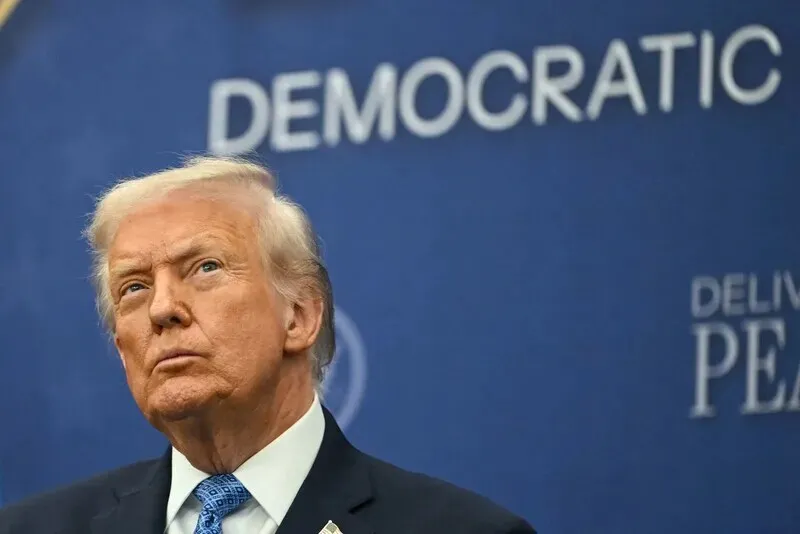
By Chung-in Moon, James Laney Distinguished Professor at Yonsei University
On Dec. 5, the White House published the National Security Strategy document, or NSS, which offers overarching guidelines in the areas of foreign policy, economy, and military affairs for the second Trump administration. The document represents a dramatic departure from the past.
The new NSS embraces extreme realism, consciously dispensing with the pretense and idealistic affectation about achieving the universal values the US has traditionally pursued. The document declares that the US will no longer prop up the world order and that the US’ primary goal is pursuing its national interest under the banner of “America First.”
The national interest chiefly concerns economic wealth and military power. The document thus outlines a vision of restoring America’s wealth to achieve genuine strength and using that strength to build peace. This looks like an amalgam of Hamilton’s mercantilism and Reagan’s concept of “peace through strength.”
Another striking feature of the new NSS is its recognition of the limits of national strength and its presentation of a new geopolitical arrangement.
The NSS published in Trump’s first term, in 2017, presented China and Russia as revisionist powers, declaring what amounted to a rebooted Cold War against them. That statement was predicated on a US-led unipolar order.
But now, the US, China and Russia recognize three spheres of power and are focusing on the balance of power and strategic stability. That signifies a massive change in strategic thinking.
We’re also witnessing a major shift in the priorities of the US’ foreign policy and national security. The current emphasis is on stopping illegal migrants, combating cartels, safeguarding “MAGA” values, building peace through summit diplomacy, and maximizing economic values.
In addition, the priority assigned to each region is undergoing a sea change.
Under the updated NSS, establishing regional hegemony over the Western Hemisphere (North and South America) through security in the continental US and the restoration of the Monroe Doctrine is a primary interest, with the Indo-Pacific area, and the related goal of containing China, becoming a secondary concern.
Europe — traditionally the US’ chief concern — has been relegated to a distant third, while the Middle East and Africa receive only scant attention.
In apparent reflection of Trump’s transactional mindset, the NSS asserts that the costs of international security should be shared with (or offloaded on) American allies and partners because of the US’ limited capabilities.
Surprisingly, the NSS makes little mention of the Korean Peninsula. The only issues discussed are burden-sharing and cooperation with South Korea and other allies and partners on containing China. While the North Korean nuclear issue was mentioned a remarkable 17 times in the 2017 document, it doesn’t come up even once in the latest version.
These changes have several major implications for South Korea.
First, they suggest the ROK-US alliance is less of a priority in the second Trump administration and that, consequently, we should not be overconfident in that alliance.
And given the new security document’s emphasis on the principle of avoiding military interventions, we should not take it for granted that the US would automatically intervene in a crisis on the Korean Peninsula. That’s all the more reason to shore up the foundation of defense independence by swiftly filling in gaps in our conventional forces.
It’s also critical that we secure strategic autonomy through rapidly recovering wartime operational control (OPCON) of Korean forces. In the end, we need a military that can fight on its own.
A second takeaway is that the North Korean nuclear threat cannot be handled with conventional forces alone. It’s essential that we have extended deterrence from the US.
Therefore, we must redouble diplomatic efforts to ensure the US continues to guarantee extended deterrence through the implementation of the 2023 Washington Declaration. Without such a guarantee, it will be impossible to quell demands for domestic nuclear armament, which would almost certainly tip over the nuclear dominoes in Northeast Asia.
Third, it’s essential that our diplomats work overtime to prevent the formation of Cold War-esque regional blocs and ensure we don’t get entangled in undesired regional conflicts.
While some call for an Asian version of NATO to counter Chinese adventurism and American isolationism, that would be extremely undesirable. Bloc thinking presents a perennial security dilemma that is difficult to avoid.
A better option is framing an Asian version of the Organization for Security and Co-operation in Europe. It makes more sense to explore the issue of safe sea lanes (including in the first island chain) through multilateral security cooperation.
Plus, given the policy line taken by the Trump administration — which doesn’t want an ideological conflict posing North Korea, China and Russia against South Korea, the US and Japan — I think this kind of regional multilateral security cooperation should be feasible.
Finally, we need not be discouraged that the North Korean nuclear issue wasn’t addressed in the updated NSS.
The document leaves a lot of latitude for Trump on foreign policy. That is to say, Trump could reach a surprising breakthrough with North Korea through his signature “deal-making” while cutting through the red tape.
It’s worth remembering that the North Korean nuclear program and peace on the Korean Peninsula remain unresolved issues for Trump. That gives reason to hope he will exercise his leadership on them.
In that sense, the NSS isn’t all bad news.
Please direct questions or comments to [english@hani.co.kr]

Editorial・opinion
![[Column] The unspoken deal that made China a nation led by engineers](https://flexible.img.hani.co.kr/flexible/normal/500/300/imgdb/original/2026/0821/381787301627593.jpg "[Column] The unspoken deal that made China a nation led by engineers") [Column] The unspoken deal that made China a nation led by engineers
[Column] The unspoken deal that made China a nation led by engineers![[Column] Does the US deserve allies’ trust?](https://flexible.img.hani.co.kr/flexible/normal/500/300/imgdb/original/2026/0818/8417870405925049.jpg "[Column] Does the US deserve allies’ trust?") [Column] Does the US deserve allies’ trust?
[Column] Does the US deserve allies’ trust?- [Column] No, tactical nukes aren’t practical for real-world use
- [Column] ‘The Odyssey’: Finally, a good chamber drama
- [Column] How will the US uphold deterrence when it runs out of weapons?
- [Column] US isn’t pulling out of the Middle East — it’s being kicked out
- [Editorial] Will shift in US nuclear strategy reintroduce tactical nukes to Korea, Japan?
- Why does the USFK commander keep butting heads with Seoul?
- [Guest essay] Futures thinking in science fiction
- [Editorial] New US envoy must stick to her diplomatic mission
Most viewed articles
- 1[Reportage] US looks to Korean experience to ease its critical mineral reliance on China
- 2[Exclusive] SK Hynix to build memory fab in Japan’s Miyagi
- 3Last time they met, Kim Jong-un needed Trump. Have the tables turned?
- 4The bill for America’s superpower status is coming due
- 5[News analysis] Is Trump about to undo US policy on North Korea’s denuclearization?
- 6[Column] ‘The Odyssey’: Finally, a good chamber drama
- 7North Korea calls reports of more troops for Russia ‘invented’ by Kyiv
- 8[News analysis] Truncated military drills: Bad for OPCON transfer, good for peace?
- 9North Korea ridicules South as ‘puppet army’ of US over canceled military drills
- 10[Column] The unspoken deal that made China a nation led by engineers