hankyoreh
Links to other country sites 다른 나라 사이트 링크
‘I’ll celebrate it quietly’: Han Kang’s first reaction to winning a Nobel Prize
 Add as preferred source on Google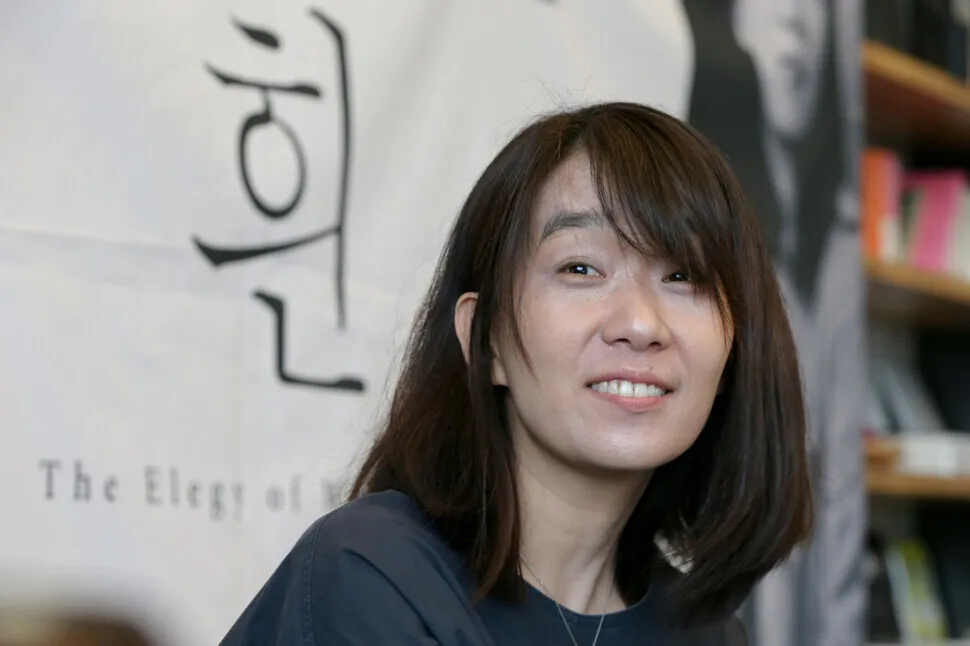
The Swedish Academy called Han Kang at 8 pm Korean Standard Time on Thursday to capture her first reactions after being named a Nobel laureate for literature. She’d just finished having dinner with her son. Han said that it’d been a “peaceful evening,” adding, “I didn’t work today, just read a bit and took a walk.”
The Swedish Academy asked her: “You’re the first literature laureate from South Korea, how does that feel?”
Han said the news left her “so surprised” and “honored.”
“I grew up with books. Since when I was a child, I grew up with books in Korean and translated as well. So I can say I grew up with Korean literature, which I feel very close to. So I hope this news is nice for Korean literature readers, and my friends, writers,” she said.
For non-Korean readers approaching Han's work for the first time, she recommended “We Do Not Part,” her most recent book, as a good place to start. Regarding her earlier work, “The Vegetarian,” Han remarked, “I wrote it for three years, and those three years were kind of difficult years for me for some reasons. So I think I was struggling to find the images of this protagonist, people who are surrounding her, and the image of trees and sunlight and everything was so vivid in those three years.”
Han did not specify any writers that have inspired her. Instead she described all writers as having been “collective” and that they “are searching meanings in life,” adding, “Sometimes they are lost, and sometimes they are determined and all their efforts and strengths have been my inspiration.”
The Swedish Academy’s representative remarked that she had read somewhere that Swedish writer Astrid Lindgren was among the writers that served as inspiration. Han replied that she enjoyed “The Brothers Lionheart” but insisted that it was “very difficult” to single out particular authors that inspired her.
In a previous piece reminiscing on the creative process behind her book “Human Acts,” which is based on the May 18 Gwangju Democratic Uprising of 1980, Han once wrote that she read “The Brothers Lionheart” in 1983, three years after the events in Gwangju, and that the book impacted her greatly.
“It was classified as a children's book, but it starts by talking about death,” Han recalled, remarking that the book reminded the reader of the symbiotic relationship between love and despair, dignity and suffering.
“Perhaps we experience encounters in nearly impossible ways sometimes,” Han wrote.
When the Swedish Academy asked how she was going to celebrate, she answered: “After this phone call I’d like to have tea — I don’t drink — I’m going to have tea with my son and I’ll celebrate it quietly tonight.”
By Im In-tack, staff reporter
Please direct questions or comments to [english@hani.co.kr]

Editorial・opinion
![[Editorial] It’s time to pump the brakes on AI’s development](https://flexible.img.hani.co.kr/flexible/normal/500/300/imgdb/original/2026/0914/8517893740697601.jpg "[Editorial] It’s time to pump the brakes on AI’s development") [Editorial] It’s time to pump the brakes on AI’s development
[Editorial] It’s time to pump the brakes on AI’s development![[Guest essay] What North Korea’s learned from six months of the Iran war](https://flexible.img.hani.co.kr/flexible/normal/500/300/imgdb/original/2026/0914/2617893746751526.jpg "[Guest essay] What North Korea’s learned from six months of the Iran war") [Guest essay] What North Korea’s learned from six months of the Iran war
[Guest essay] What North Korea’s learned from six months of the Iran war- [Column] Sending troops to Hormuz is nothing like sending them to Iraq
- [Editorial] A deployment to Hormuz would be neither justified nor beneficial for Korea
- [Guest essay] The troubling video-gamification of the Korean War
- [Editorial] Now it’s the US’ turn to hold up its end of the bargain
- [Editorial] When it comes to troop deployments, too much caution is never enough
- [Column] A Trump-Kim summit may happen. A deal is another matter
- [Correspondent’s column] AOC’s star is rising — as are hopes for a different America
- [Column] A costly war and a debt crisis… is a ‘Trump shock’ on its way?
Most viewed articles
- 1[Guest essay] What North Korea’s learned from six months of the Iran war
- 2[Exclusive] Seoul will need 16% rate of return on US investments to recoup principal
- 3[Editorial] It’s time to pump the brakes on AI’s development
- 4‘Resounding victory’: Iran’s axis of resistance cuts off Saudi oil exports
- 5K-12 suicides in South Korea hit record high last year
- 6Three firms dominate the memory market. Is CXMT about to change that?
- 7[Reporter’s notebook] Shincheonji’s appeal to young S. Koreans
- 8[Exclusive] US scraps safeguard for Korea’s $200 billion investment in America
- 9‘We must slow the pace’: Tech execs issue warning about pace of AI development
- 10Yong Hye-in becomes Lee administration’s 4th Cabinet pick to withdraw from consideration