hankyoreh
Links to other country sites 다른 나라 사이트 링크
Han Kang becomes Korea’s first Nobel laureate in literature
 Add as preferred source on Google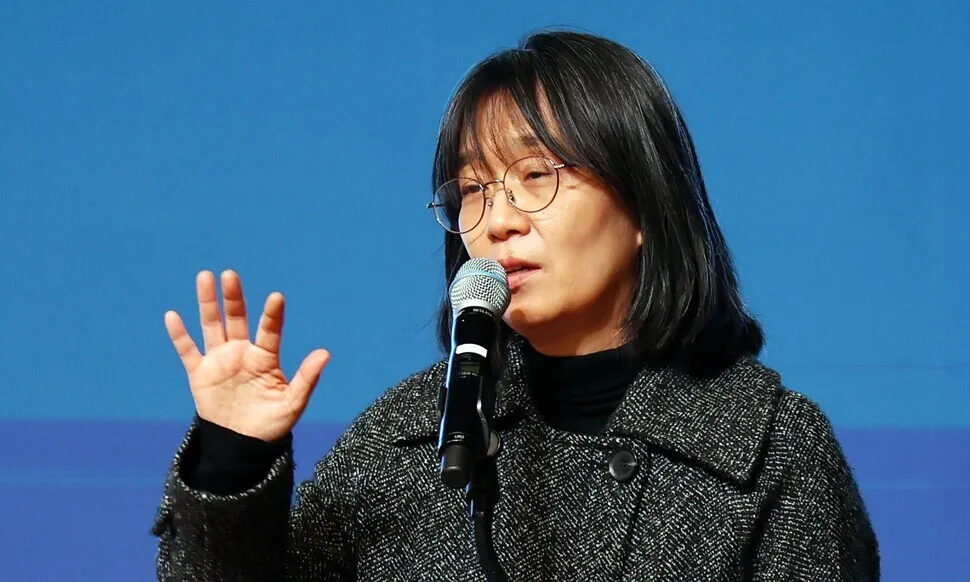
“For her intense poetic prose that confronts historical traumas and exposes the fragility of human life.”
The author Han Kang has won the 2024 Nobel Prize in literature, becoming the first South Korean author to become a Nobel laureate in literature. While poet Ko Un had been mentioned as a contender for the prize a few times, almost no one expected the 53-year-old author of “The Vegetarian” to be awarded the prize.
The Swedish Academy, the body that chooses the laureates for the annual Nobel Prize in literature, announced Han as the winner of the Nobel Prize on Thursday at 8 pm (KST), explaining that Han was nominated for how she “confronts historical traumas and invisible sets of rules and, in each of her works, exposes the fragility of human life. She has a unique awareness of the connections between body and soul, the living and the dead, and in her poetic and experimental style has become an innovator in contemporary prose.”
Han, whose father is the novelist Han Seung-won, was born in 1970 in Gwangju and moved to Seoul at the age of 9. After studying Korean literature at Yonsei University, she gained experience working for a publishing company. She made her literary debut in 1993 with a series of poems and made her short story debut with a story, “Red Anchor,” the following year.
Han has long been one of the most notable authors in the Korean literary world since she won the Yi Sang Literary Award in 2005 with her short story “Mongolian Mark,” making her the youngest-ever recipient of that prize. She gained the attention of an international audience after her 2007 novel “The Vegetarian” (trans. Deborah Smith) won the Man Booker International Prize in May 2016.
“We Do Not Part” (translated into French as “Impossibles Adieux” by Choi Kyung-ran and Pierre Bisiou), a novel focusing on the atrocious events of the Jeju April 3 incident, won the Prix Medicis award for translated fiction, a French literary prize, in November 2023 and the Émile Guimet Prize for Asian Literature in March 2024.
The judging panel of the French prize recognized that Han is considered to be the “greatest” South Korean author of today, and that the publishing of her books is “not only a major event in South Korea, but a landmark event internationally.”
Following her first short story collection, “Love of Yeosu,” published in 1995, Han’s notable works include “Your Cold Hands,” published in 2002, “Greek Lessons,” published in 2011, “Human Acts,” published in 2014, “The White Book,” published in 2016, “We Do Not Part,” published in 2021, and “I Put Dinner in the Drawer,” a poetry collection published in 2013.
During a press conference held to commemorate her winning the Prix Medicis for foreign literature in 2023, Han commented, “‘Human Acts’ and ‘We Do Not Part,’ which I wrote over the span of nine years, can be seen as a pair — a very cold pair. I wish to say goodbye to winter and turn to spring. I hope to stop writing about historical events and write more personal stories about life.”
By Im In-tack, staff reporter
Please direct questions or comments to [english@hani.co.kr]

Editorial・opinion
![[Editorial] It’s time to pump the brakes on AI’s development](https://flexible.img.hani.co.kr/flexible/normal/500/300/imgdb/original/2026/0914/8517893740697601.jpg "[Editorial] It’s time to pump the brakes on AI’s development") [Editorial] It’s time to pump the brakes on AI’s development
[Editorial] It’s time to pump the brakes on AI’s development![[Guest essay] What North Korea’s learned from six months of the Iran war](https://flexible.img.hani.co.kr/flexible/normal/500/300/imgdb/original/2026/0914/2617893746751526.jpg "[Guest essay] What North Korea’s learned from six months of the Iran war") [Guest essay] What North Korea’s learned from six months of the Iran war
[Guest essay] What North Korea’s learned from six months of the Iran war- [Column] Sending troops to Hormuz is nothing like sending them to Iraq
- [Editorial] A deployment to Hormuz would be neither justified nor beneficial for Korea
- [Guest essay] The troubling video-gamification of the Korean War
- [Editorial] Now it’s the US’ turn to hold up its end of the bargain
- [Editorial] When it comes to troop deployments, too much caution is never enough
- [Column] A Trump-Kim summit may happen. A deal is another matter
- [Correspondent’s column] AOC’s star is rising — as are hopes for a different America
- [Column] A costly war and a debt crisis… is a ‘Trump shock’ on its way?
Most viewed articles
- 1[Guest essay] What North Korea’s learned from six months of the Iran war
- 2[Exclusive] Seoul will need 16% rate of return on US investments to recoup principal
- 3[Editorial] It’s time to pump the brakes on AI’s development
- 4‘Resounding victory’: Iran’s axis of resistance cuts off Saudi oil exports
- 5K-12 suicides in South Korea hit record high last year
- 6Three firms dominate the memory market. Is CXMT about to change that?
- 7[Reporter’s notebook] Shincheonji’s appeal to young S. Koreans
- 8[Exclusive] US scraps safeguard for Korea’s $200 billion investment in America
- 9‘We must slow the pace’: Tech execs issue warning about pace of AI development
- 10Yong Hye-in becomes Lee administration’s 4th Cabinet pick to withdraw from consideration