hankyoreh
Links to other country sites 다른 나라 사이트 링크
[Column] Dawn of the age of fascism

By Shin Jin-wook, professor of sociology at Chung-Ang University
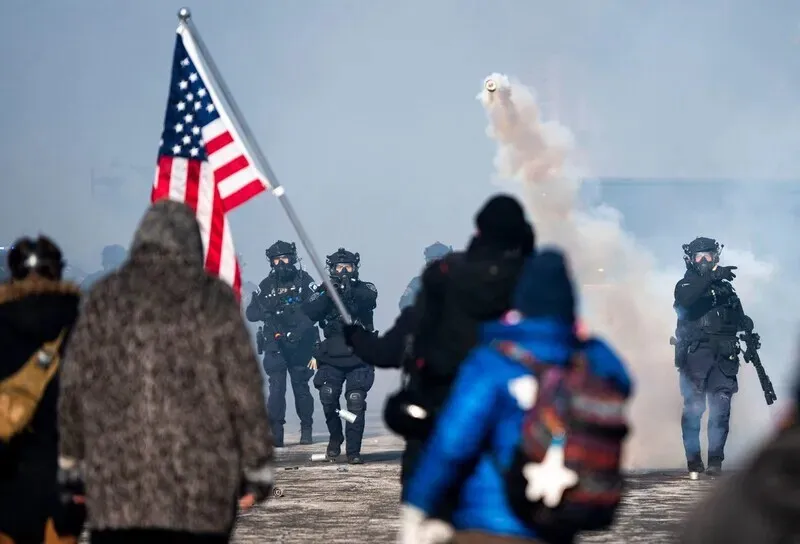
Tragedies continue to unfold in the United States due to the tyranny of the Donald Trump administration. In Minnesota, ordinary people were killed one after another, gunned down by federal agents. Masked law enforcement officers continue to conduct indiscriminate stop-and-frisk searches and arrests to boost their performance, while immigrants are dying from illness in squalid detention facilities. Some were shot dead while fleeing a stop-and-frisk, and one disabled man died after his father, who was his caretaker, was arrested. Barbaric violence is everywhere you look.
While large-scale protests condemning the Trump regime erupt daily across the US, the problem extends far beyond Trump himself. Underlying these recent events is the vast system of fascism, driven by a massive far-right network that has infiltrated the US government and society, along with supporters comprising up to 40% of the electorate.
The organized network of the far-right propping up the Trump regime is of a massive scale. Its core forces include the MAGA coalition, centering Trump, the White House, the government, and loyal Republicans; policy and lobbying groups like the Heritage Foundation and the American First Legal Foundation; religious networks such as evangelical churches, various family associations, and youth organizations like Turning Point USA; a movement and media cluster featuring culture war leaders such as Steve Bannon and Tucker Carlson, alongside far-right figures such as Nick Fuentes; and paramilitary groups like the Oath Keepers, the Proud Boys, and the Patriot Front.
These groups are loosely connected through a decentralized network but coalesce when fighting their common enemy, which they have labelled “communists” or “terrorists.” Mainstream far-right groups distance themselves from paramilitary organizations but want them to carry out overt violence on their behalf. Movements on the far-right fringe denounce the mainstream far-right’s “reformist” stance, but join forces with them to oppose the Democratic Party and progressives. The people attempting to defend American democracy are not merely fighting Trump now; they are confronting the monster that spawned him.
Many scholars describe the reality we now live in as one overtaken by fascism. While authoritarianism, nationalism, and violence are often cited as indicators of fascist movements, these are also found in various nondemocratic regimes such as military dictatorships or one-party states.
A fascist regime is characterized by the following elements: a spontaneous and action-oriented populus; intense fervor and fear; the destruction of democracy using the democratic apparatus itself; a contradictory blend of revolution and counter-revolution; anti-elitism and hatred for the vulnerable; and an ideology of anti-equality, discrimination, and exclusion.
The most terrifying aspect of such fascism is the ubiquity of evil. The state amplifies, absorbs, condenses and releases the energy of violence permeating society. State violence from above combines with violence from below.
As these attributes of fascism resurface, they are rekindling memories from a century ago. Yet crucial differences exist.
First, in contrast to the 20th century, there isn’t a powerful leftist movement nor the prospect of revolution. Today’s fascism is not the product of a bourgeois crisis, but an attack waged within the context of a society-wide rightward shift.
Second, while the democracies a century ago were considered “immature,” having emerged after the first wave of global democratization, today’s fascist outburst stands on the historical foundation of an aging democracy that has experienced three waves of democratization. This is why today’s fascists are well-versed in the language of democracy and liberation, and use it to advance their ideology.
Third, the integration of science and technology with governing institutions has grown stronger. The US government has established systems to collect, analyze and control population data. It governs by “targeting” certain populations.
This latest form of fascism is a global phenomenon, though there are differences by region.
In Western Europe, parties labeled “far-right” or “right-wing populist” have also mobilized public anxiety and hatred by inciting anti-immigrant, anti-refugee sentiment, and Islamophobia. However, since the 2000s, they have distanced themselves from overtly racist, anti-democratic, and anti-human rights platforms, and tend to moderate their stance, especially after gaining power. For instance, Italy’s Prime Minister Giorgia Meloni, once labeled a direct descendant of the country’s fascist past, banned fascist parties under the constitution after taking office. She also expelled young party members who engaged in fascist actions. Europe’s radical right is dominated by politicians who waver in the gray zone.
What about Korea? After the attempted coup on Dec. 3, 2024, our society witnessed the formation of a Korean fascism, combining a military coup from above and mass actions from below in support.
The insurrectionist forces mobilized elite troops and over 4,000 military police officers, planning large-scale arrests, detentions, torture, and executions. Had the coup succeeded, we would be living in a nation more similar to Iran than to the US. Korean fascism is not very ideologically sophisticated, with an unstable popular base and party politics, but the legacy of Japanese colonial rule and military dictatorships means the risk of state violence is extremely high.
Yet Korean society also possesses a resilient democracy. From anti-dictatorship struggles to candlelight demonstrations, Korea has historically accumulated a culture of resistance and social capital bolstering democracy. This is why, in times of crisis, there are reserve forces that can surge forth from civil society’s trenches, rushing to the National Assembly and public squares.
However, the culture of solidarity and community in everyday life remains weak. Korea’s democratic civil society isn’t particularly powerful; it’s just that the far-right is so boorish. It is a third-rate far-right characterized by servility to foreign powers, demagoguery sans ideology, and corrupt vested interests. Yet, if they seize power and control the state, the potential for violence is terrifying.
This era of barbarism will endure. It may not merely mark the end of liberal hegemony in international relations, but the crisis of the long liberal century that began in the 1700s. For the first time, humanity faces an era without a liberal democratic superpower. During fascism’s previous rise and the two world wars, authoritarian states like Germany, Italy, and Japan challenged the liberal West represented by Britain and America. Now, America is openly dismantling modern-day universal values and norms. Now, each nation has no choice but to defend its own democracy, human rights and peace.
South Korea must navigate this storm and sail into the unknown. We must consolidate the democratic forces in politics and society, decentralize power structures that could threaten democracy, and dismantle privileged military groups with political ambitions to completely depoliticize the military.
Resources must be concentrated on policies that alleviate the anxieties that could become fertile ground for fascism and solidify democracy’s foundation across society. Society must clearly condemn actions that incite hate and mock human dignity, leaving them no foothold.
The message now being conveyed to the world is grim. The age of fascism has arrived. We must make preparations and overcome.
Please direct questions or comments to [english@hani.co.kr]

Editorial・opinion
![[Editorial] Trump’s baseless claim that Iran bombed girls’ school crosses line](https://flexible.img.hani.co.kr/flexible/normal/500/300/imgdb/original/2026/0309/4217730446901883.jpg "[Editorial] Trump’s baseless claim that Iran bombed girls’ school crosses line") [Editorial] Trump’s baseless claim that Iran bombed girls’ school crosses line
[Editorial] Trump’s baseless claim that Iran bombed girls’ school crosses line![[Correspondent’s column] JD Vance’s 67-hour disappearance](https://flexible.img.hani.co.kr/flexible/normal/500/300/imgdb/original/2026/0306/2517727866984907.jpg "[Correspondent’s column] JD Vance’s 67-hour disappearance") [Correspondent’s column] JD Vance’s 67-hour disappearance
[Correspondent’s column] JD Vance’s 67-hour disappearance- [Column] Withstanding Trump’s predatory hegemony
- [Editorial] US dragging Kurds into its war with Iran would be a disaster
- [Column] US allies in the Gulf are in flames. Can Korea avoid a similar fate?
- [Editorial] North Korea’s tough talk mustn’t deter Seoul’s efforts to rebuild trust
- [Editorial] Attack on Iranian girls’ school is an indefensible crime against humanity
- [Editorial] Trump’s unjustified war with Iran threatens chaos for us all
- [Column] What a Korean man’s foiled plan to seek assisted death in Switzerland reveals
- [Column] This is what accountability looks like
Most viewed articles
- 1Korea named as target of new Section 301 probe by US
- 2‘Made in USA’: Scraps of missile that killed Iranian children point to US responsibility
- 3[Editorial] No greater sign that South Korea must prioritize building its own defense abilities
- 4US may seek exit from Iran war by moving the goalposts of victory
- 5US Democrats say Trump’s investment pressure has ‘deeply unsettled’ alliance with Seoul
- 6[Column] Misconceptions about America’s war with Iran
- 765% of Korean men say gender equality has gone ‘far enough’; only 42% of women agree
- 8How much is the US willing to risk for the Strait of Hormuz?
- 9Coupang investors insinuate that US is planning Section 301 probe into Korea
- 10[News analysis] Air defense pullout signals new era of US strategic flexibility in Korea