hankyoreh
Links to other country sites 다른 나라 사이트 링크
[Column] Welcome to the age of corridors
By Slavoj Žižek, Global Eminent Scholar at Kyung Hee University
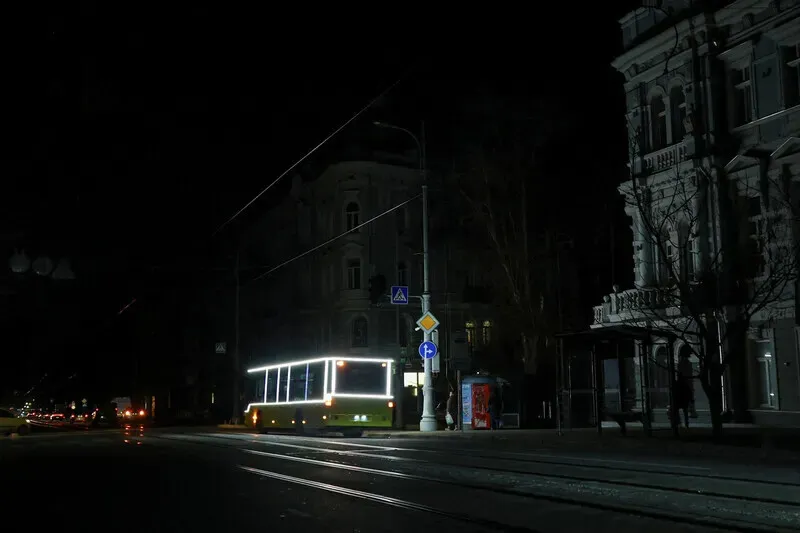
In mid-December 2025, Russia announced that it was “opening the Odesa corridor.” In this momentous announcement, largely ignored by our big media, “opening” stands for its exact opposite: Odesa is Ukraine’s main port through which most of its exports (grain, sunflowers, etc.) leave, and to “open” a corridor to Odesa means that all ships leaving Odesa and going there will have to pass through this corridor tightly controlled by Russia, enabling it to reject the passage or to seize them. Since this corridor will pass through international waters, its imposition amounts to a pure exercise of power that violates international laws.
Russia is not alone here. Is Trump not doing the same with Venezuela — controlling access to it? Will China do the same with Taiwan, opening a corridor to its ports? And is Israel not doing the same with Gaza, controlling access to it and seizing ships that approach it in international waters? When Israel opened up its own corridor to Gaza to deliver humanitarian help to the starving people there, it did it in a way that, at some points, even worsened the humanitarian situation there. When a big power attacks a small country, the terms used are “humanitarian help,” “opening up the space for human rights,” as Russia says of its war in Ukraine.
But what really depressed me is how some big Western “leftists” (Yanis Varoufakis, Richard Wolff, John Mearsheimer, etc.) reacted to the announcement of the opening of the Odesa corridor by celebrating it as an adequate response to the Western imperialist control over transport infrastructure. We were so used to this Western domination that we accepted it as the normal “open” space of commerce, although it was based on a set of obstacles and exclusions, from tariffs to direct military interventions. Russia thus didn’t simply break a neutral international transport network; it just did explicitly what the West was doing implicitly all along and thus rendering palpable the lie of the neutrality of the transport infrastructure.
Much more important than just targeting Ukraine, the Russian act potentially undermined the entire structure of the Western transport domination — this act will open new perspectives to the Third World countries that had to satisfy their needs for food and industrial products by passing through the transport network dominated by the West. Third World countries will now be able to deal directly with Russia, China, India, etc., vastly broadening their choices.
As a leftist, I am totally opposed to this reading. First, it is a military intervention that potentially closes the world market to Ukraine, the greatest exporter of grain to Third World countries. It will not only hit Ukraine hard (making it even more dependent on Western financial support), but it will also make food imports more expensive for Third World countries. Instead of opening the markets, it will make the choice of where to buy products dependent on the brutal power of political feuds.
Yes, there are many things false in the West-dominated transport infrastructure, but Russia’s act makes things even worse. We should be wary of rhetoric about the “anti-imperialist” nature of Russia’s act, lest we forget that, during World War II, fascists in Germany and in Japan also widely used the anti-imperialist rhetoric, presenting themselves as the liberators of the nations they occupied from the British-French-American imperialism (most directly Japan in Indonesia and the Philippines).
The “leftists” justify their understanding of Russia’s opening of the Odesa corridor with another “Marxist” argument. They remind us of the standard Marxist thesis that wars are never just a matter of military power, politics and ideology. While the anti-Russian West focuses only on these aspects (Russia’s desire to reestablish its lost imperial domain), it neglects what Russia understood clearly: wars are really decided by their economic base, by the economic strength and the social power grounded in this strength. This is how, without firing a shot, Russia undermined a key moment of European economic strength, laying bare Europe’s vulnerability and impotence.
No wonder, then, that the same “leftists” also show great understanding for how Russia reacted to the threat that Europe would seize Russian money frozen in Brussels and give it to Ukraine. When Russia announced that it would begin to seize the property of Western banks and companies still operating there and that it would demand from buyers of its national resources (oil, above all) to pay in rubles or Chinese yen, the “leftist” critics celebrated these acts as an adequate heavy blow to the global imperialist financial infrastructure.
When Europe nonetheless refused to directly seize the Russian financial reserves in Brussels, these same “leftist” critics again dismissed this refusal as proof that the EU is afraid to act in a consistent way, and that it prefers to oscillate between helping Ukraine and its own egotistic interest of not disturbing the world order too much. There is a strong moment of truth in this reproach. However, I think a less critical interpretation of what Europe did is possible. I tend to agree with the notion that it’s significant that the EU decided to go into debt to ensure that Ukraine wouldn’t collapse, and that it showed that Europe is willing to act independently of the US on the war.
Yes, European money hopefully ensures that Ukraine won’t collapse, because Europe is fully aware that without this money, Russia will take all of Ukraine. For Ukraine, losing the war means ceasing to exist as a nation. This is why, although the “leftist” critics pretend to analyze the situation in a cold, neutral way (and still speak of the Russian attack on Ukraine), the implicit but unmissable joy in their jumping on Europe’s dead body, their repetitive praising of how Russia gave a lesson to Western imperialism, clearly falsifies their neutrality. To cut a long story short, in the global conflict that is gradually approaching its point of no return, they are obviously on the side of Russia and China.
The new power blocs that are emerging around the world are just versions of new fascism with no ideological foundation — just think about the axis of Russia-Iran-Venezuela. Europe should be here an exception: the only place of fidelity to the emancipatory Enlightenment. Will the proclamation of European independence happen? No, in all probability — but its lack will be felt all around the world.
The sad but inevitable conclusion is that sometimes we have to decide and choose between the Europe that still pretends to be faithful to its Enlightenment legacy, the Europe inclusive of all its weaknesses and betrayals, and actual neo-fascism.
In World War II, Western “imperialists” joined hands with communists and together they defeated fascism. Will the forthcoming World War III be like a repetition of World War II, but with changed partners, a war in which “leftists” and neo-fascists will fight together against old “imperialist” powers?
Please direct questions or comments to [english@hani.co.kr]

Editorial・opinion
![[Editorial] Trump’s baseless claim that Iran bombed girls’ school crosses line](https://flexible.img.hani.co.kr/flexible/normal/500/300/imgdb/original/2026/0309/4217730446901883.jpg "[Editorial] Trump’s baseless claim that Iran bombed girls’ school crosses line") [Editorial] Trump’s baseless claim that Iran bombed girls’ school crosses line
[Editorial] Trump’s baseless claim that Iran bombed girls’ school crosses line![[Correspondent’s column] JD Vance’s 67-hour disappearance](https://flexible.img.hani.co.kr/flexible/normal/500/300/imgdb/original/2026/0306/2517727866984907.jpg "[Correspondent’s column] JD Vance’s 67-hour disappearance") [Correspondent’s column] JD Vance’s 67-hour disappearance
[Correspondent’s column] JD Vance’s 67-hour disappearance- [Column] Withstanding Trump’s predatory hegemony
- [Editorial] US dragging Kurds into its war with Iran would be a disaster
- [Column] US allies in the Gulf are in flames. Can Korea avoid a similar fate?
- [Editorial] North Korea’s tough talk mustn’t deter Seoul’s efforts to rebuild trust
- [Editorial] Attack on Iranian girls’ school is an indefensible crime against humanity
- [Editorial] Trump’s unjustified war with Iran threatens chaos for us all
- [Column] What a Korean man’s foiled plan to seek assisted death in Switzerland reveals
- [Column] This is what accountability looks like
Most viewed articles
- 1Korea named as target of new Section 301 probe by US
- 2‘Made in USA’: Scraps of missile that killed Iranian children point to US responsibility
- 3[Editorial] No greater sign that South Korea must prioritize building its own defense abilities
- 4US may seek exit from Iran war by moving the goalposts of victory
- 5US Democrats say Trump’s investment pressure has ‘deeply unsettled’ alliance with Seoul
- 6[Column] Misconceptions about America’s war with Iran
- 765% of Korean men say gender equality has gone ‘far enough’; only 42% of women agree
- 8How much is the US willing to risk for the Strait of Hormuz?
- 9Coupang investors insinuate that US is planning Section 301 probe into Korea
- 10[News analysis] Air defense pullout signals new era of US strategic flexibility in Korea