hankyoreh
Links to other country sites 다른 나라 사이트 링크
[Column] Atlas the robot and the A-bomb

By Ryu Yi-geun, director of the Hankyoreh Economy and Society Research Institute and editorial writer
In August 1945, atomic bombs nicknamed “Little Boy” and “Fat Man” were dropped on Hiroshima and Nagasaki, Japan. Later that year, scientists who contributed to the creation of the world’s first atomic weapons, including Albert Einstein, Robert Oppenheimer, and scientists at the University of Chicago, came together to create what we now know as the Bulletin of the Atomic Scientists.
Two years later, artist and designer Martyl Langsdorf, who happened to be the wife of Manhattan Project physicist Alexander Langsdorf, Jr., designed the cover of the magazine. Wishing to convey a sense of urgency regarding the possibility of a nuclear conflict, she chose a clock for her design. This clock is known today as the “Doomsday Clock.” The clock Langsdorf designed was set to seven minutes before midnight.
As nuclear weapons proliferated around the world, the time left on the clock ticked away. Since 2007, climate change has been added to the list of variables that determine how close we are to the end of the world. Since 2024, the potential threats presented by AI have been reflected as well.
This year, the clock has moved four seconds closer to doomsday, putting us at 85 seconds before midnight. AI was listed as one of three major threats that could potentially end humankind; the other two are atomic weapons and climate change.
Looking at the stock market, however, you would think the opposite. Perusing the ETFs listed on the Korean market alone, you’ll find over 90 that have something to do with AI.
These days, AI is a buzzword that’s used synonymously with “the future.” AI is the future, and the future is AI.
Everyone seems to be viewing the immense changes that will be effected by AI through rose-colored glasses. Whether it’s individuals or companies, or even nations, people are going all in on AI to secure a competitive advantage.
Amid such hype, it’s difficult for people warning about the dangers of AI to gain much traction. In the AI era, voices calling for human rights and personal data protections, for safety nets and measures to prevent weakening of labor rights, are often cast as coming from the right place, but naïve nonetheless.
Two years ago, Hollywood film workers staged a strike over AI and the capital behind it. Speaking to a Hankyoreh reporter, they spoke passionately about how AI adopted by firms looking to cut costs was threatening their livelihoods. The message they were sending to us from across the Pacific was clear: “You could be next.”
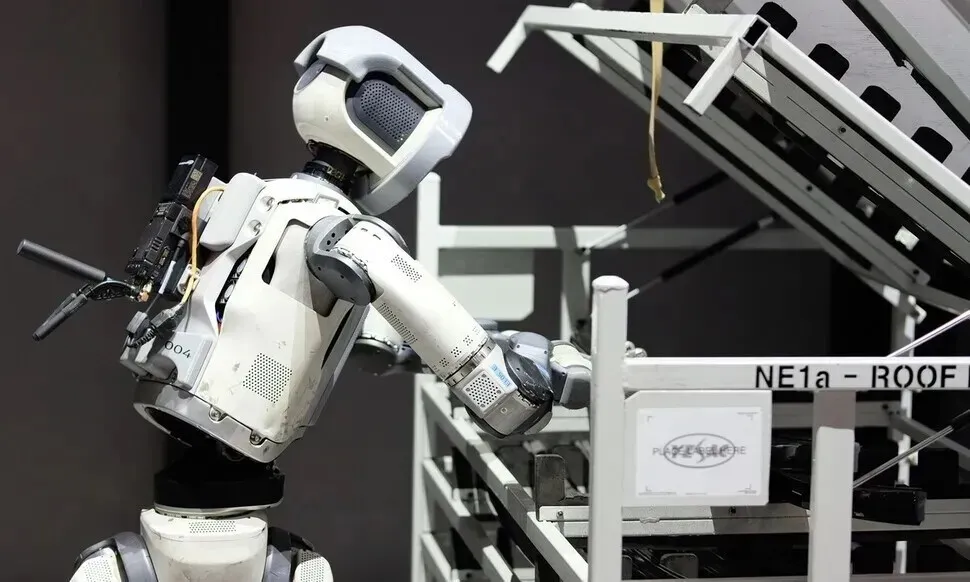
Earlier this month, the CES trade show, billed as the “most powerful tech event in the world,” was held in Las Vegas, just a few hours’ drive from LA. The talk of the event was a humanoid robot called “Atlas.” Named after the figure in Greek mythology condemned to hold up the heavens, the robot symbolizes the power to replace human labor with automation.
Expectations of the robots being deployed to factories within two years sent share prices skyrocketing for Hyundai Motor Group — the parent company of Boston Dynamics, which designed and manufactures Atlas.
The stock surge calmed down once Hyundai’s labor union, a branch of the Korean Metal Workers’ Union, which is itself under the umbrella of the Korean Confederation of Trade Unions, unexpectedly issued a statement. The union declared that it wouldn’t allow a single robot into the company’s work sites without a formal agreement between the firm and the union.
This could be viewed as employees of conglomerates who get paid generous salaries fighting the tide of the times, but the threat they feel is existential.
In anticipation of job disruption caused by the utilization of robots in manufacturing facilities, the union wrote the following in its newsletter.
“Based on the average annual salary of 100 million won [around US$69,700], labor costs amount to 300 million won [3 workers] for every 24 hours of operating a facility. Robots, while having an initially high cost, only incur maintenance costs once they’re purchased. It is therefore in the interests of investors seeking the maximization of profits in the long term to use robots,” the union wrote. “AI-driven robots in the workforce are becoming a reality.”
After Hollywood workers, it may be Korea’s automotive industry workers whose jobs AI comes for next — or it could be you, the reader of this article, and your family.
During the Industrial Revolution in 19th-century England, there was a revolutionary movement of workers in the textile industry, opposed to certain automated machinery, who called themselves “Luddites.” Just as their movement failed, there will come a moment when AI crushes unions’ resistance and replaces their labor.
The real problem is that voices critical of AI are increasingly dying down and fading away. Just two to three years ago, the world’s intelligentsia and leading figures were calling for putting the brakes on AI, warning that if we didn’t, humanity could face an immense threat. Computer scientist Geoffrey Hinton, who has been called “the godfather of AI,” has consistently warned about AI bringing about the end of humanity. Now, one hardly hears any sort of call for restraint.
AI is a double-edged sword for humanity. While it may assist some in their work, it will threaten the jobs of others. While it may contribute to prosperity, some view it as potentially disastrous for our communities.
In an interview with CNBC on Jan. 13, Warren Buffett, a legendary investor and one of the richest men in the world, said that “the genie is out of the bottle” when it came to AI, comparing the phenomenon to nuclear weapons. Buffett acknowledged that it’s impossible to put the AI genie back into the bottle, but pointed out that even industry leaders don’t know where the technology is heading.
Perhaps AI will destroy humanity before nuclear weapons do; perhaps it’ll be the other way around. Such a horrific thought may become a reality even sooner if we give up on trying to think critically about the dangers that AI really poses to our lives.
Please direct questions or comments to [english@hani.co.kr]

Editorial・opinion
![[Editorial] Trump’s baseless claim that Iran bombed girls’ school crosses line](https://flexible.img.hani.co.kr/flexible/normal/500/300/imgdb/original/2026/0309/4217730446901883.jpg "[Editorial] Trump’s baseless claim that Iran bombed girls’ school crosses line") [Editorial] Trump’s baseless claim that Iran bombed girls’ school crosses line
[Editorial] Trump’s baseless claim that Iran bombed girls’ school crosses line![[Correspondent’s column] JD Vance’s 67-hour disappearance](https://flexible.img.hani.co.kr/flexible/normal/500/300/imgdb/original/2026/0306/2517727866984907.jpg "[Correspondent’s column] JD Vance’s 67-hour disappearance") [Correspondent’s column] JD Vance’s 67-hour disappearance
[Correspondent’s column] JD Vance’s 67-hour disappearance- [Column] Withstanding Trump’s predatory hegemony
- [Editorial] US dragging Kurds into its war with Iran would be a disaster
- [Column] US allies in the Gulf are in flames. Can Korea avoid a similar fate?
- [Editorial] North Korea’s tough talk mustn’t deter Seoul’s efforts to rebuild trust
- [Editorial] Attack on Iranian girls’ school is an indefensible crime against humanity
- [Editorial] Trump’s unjustified war with Iran threatens chaos for us all
- [Column] What a Korean man’s foiled plan to seek assisted death in Switzerland reveals
- [Column] This is what accountability looks like
Most viewed articles
- 1Korea named as target of new Section 301 probe by US
- 2‘Made in USA’: Scraps of missile that killed Iranian children point to US responsibility
- 3[Editorial] No greater sign that South Korea must prioritize building its own defense abilities
- 4US may seek exit from Iran war by moving the goalposts of victory
- 5US Democrats say Trump’s investment pressure has ‘deeply unsettled’ alliance with Seoul
- 6[Column] Misconceptions about America’s war with Iran
- 765% of Korean men say gender equality has gone ‘far enough’; only 42% of women agree
- 8How much is the US willing to risk for the Strait of Hormuz?
- 9Coupang investors insinuate that US is planning Section 301 probe into Korea
- 10[News analysis] Air defense pullout signals new era of US strategic flexibility in Korea