hankyoreh
Links to other country sites 다른 나라 사이트 링크
[Correspondent’s column] Risks and opportunities in Xi’s gesture to Korea

By Lee Jeong-yeon, Beijing correspondent
China’s summit diplomacy went into overdrive this month.
This month, Chinese President Xi Jinping invited three national leaders to meet him in Beijing. Both South Korean President Lee Jae Myung and Irish Prime Minister Micheál Martin paid state visits to China on Monday, and Canadian Prime Minister Mark Carney is set to visit China this upcoming Wednesday.
Xi’s diplomatic schedule this month reveals the intentions and direction of his foreign strategy for the year. It’s no coincidence that the visits of the Korean, Irish and Canadian leaders all came at this time of year.
It has become clear that the US-China rivalry is no fleeting phenomenon but rather a systemic and chronic issue, and US President Donald Trump and his administration are rattling the world order.
Xi’s back-to-back summits suggest he means to create more room for China’s diplomatic activities. Thus, they seem to be deliberately chosen strategic moves reflecting definite priorities.
The leaders invited and the timing of their visits are highly suggestive. Xi has invited countries that are of considerable strategic value or have had rocky relations with China to visit around the same time.
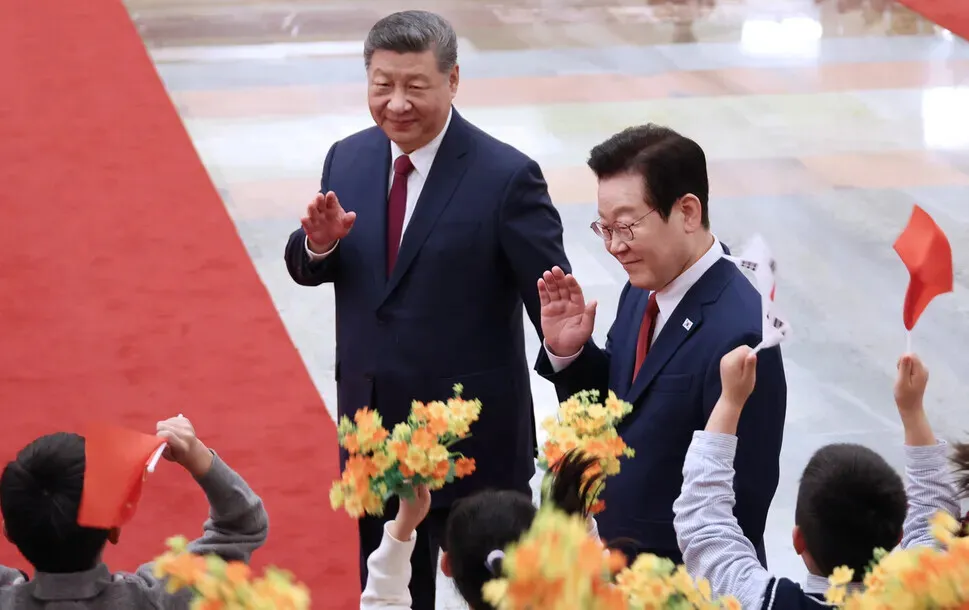
Lee Jae Myung’s state visit to China was an opportunity to readjust and fully restore Korea-China relations, which had been damaged by conflict over national security and “values diplomacy” under Korea’s previous administration.
Micheál Martin’s visit to China comes before Ireland assumes the presidency of the Council of the European Union in the second half of the year. In effect, China has secured an important bridgehead for managing relations with Europe.
Mark Carney’s visit was arranged at a time when Canada-China relations have been strained for years over the arrest of Meng Wanzhou, then deputy chairperson of Chinese tech firm Huawei. The last time a Canadian leader visited China was in 2017.
The fact that Xi is bringing all these leaders to Beijing at the same time sends the message that China can reset its relations with American allies or Western countries close to the US when the circumstances are right and their interests align.
From the Chinese perspective, Xi’s summit diplomacy carries several meanings. First, China seems determined to mitigate inter-bloc conflict through strategic communication with the leaders of US-aligned countries while also avoiding a head-on confrontation with the US.
By playing up confidence in the Chinese economy and its potential, Xi is downplaying concerns about risk while emphasizing that China can be a reliable partner in such areas as supply chains, trade and investment. There are political benefits, too: Xi can show domestic and foreign audiences that China is expanding its presence on the diplomatic stage with other major countries.
China’s actions represent both risks and rewards for Korea. Lee and Xi have confirmed their determination to restore bilateral relations and, going beyond that, to strengthen mutual trust. That raises hopes that bilateral relations will not soon revert to the troubles of the past despite continuing challenges.
Furthermore, the restoration of people-to-people exchange, and economic and technological cooperation is likely to have meaningful benefits for Korea.
But there are also evident risks. China will keep testing to see how much it can distance Korea from the US. If Korea tilts too far in either direction, it could undermine our international strategy.
It’s important for Korea to make strategic use of China’s gestures for restoring the bilateral relationship while making sure that relationship does not lead to Korea being coerced into making certain choices.
Lee and Xi’s meeting shouldn’t be seen as China flinging open the door. It’s more accurate to say that China has opened the door a crack and is watching Korea’s response.
At a time of rapid change around the world, one cannot assume that open doors always lead to something good. After all, every opportunity has its own risks.
Please direct questions or comments to [english@hani.co.kr]

Editorial・opinion
![[Editorial] Trump’s baseless claim that Iran bombed girls’ school crosses line](https://flexible.img.hani.co.kr/flexible/normal/500/300/imgdb/original/2026/0309/4217730446901883.jpg "[Editorial] Trump’s baseless claim that Iran bombed girls’ school crosses line") [Editorial] Trump’s baseless claim that Iran bombed girls’ school crosses line
[Editorial] Trump’s baseless claim that Iran bombed girls’ school crosses line![[Correspondent’s column] JD Vance’s 67-hour disappearance](https://flexible.img.hani.co.kr/flexible/normal/500/300/imgdb/original/2026/0306/2517727866984907.jpg "[Correspondent’s column] JD Vance’s 67-hour disappearance") [Correspondent’s column] JD Vance’s 67-hour disappearance
[Correspondent’s column] JD Vance’s 67-hour disappearance- [Column] Withstanding Trump’s predatory hegemony
- [Editorial] US dragging Kurds into its war with Iran would be a disaster
- [Column] US allies in the Gulf are in flames. Can Korea avoid a similar fate?
- [Editorial] North Korea’s tough talk mustn’t deter Seoul’s efforts to rebuild trust
- [Editorial] Attack on Iranian girls’ school is an indefensible crime against humanity
- [Editorial] Trump’s unjustified war with Iran threatens chaos for us all
- [Column] What a Korean man’s foiled plan to seek assisted death in Switzerland reveals
- [Column] This is what accountability looks like
Most viewed articles
- 1Korea named as target of new Section 301 probe by US
- 2‘Made in USA’: Scraps of missile that killed Iranian children point to US responsibility
- 3[Editorial] No greater sign that South Korea must prioritize building its own defense abilities
- 4US may seek exit from Iran war by moving the goalposts of victory
- 5US Democrats say Trump’s investment pressure has ‘deeply unsettled’ alliance with Seoul
- 6[Column] Misconceptions about America’s war with Iran
- 765% of Korean men say gender equality has gone ‘far enough’; only 42% of women agree
- 8How much is the US willing to risk for the Strait of Hormuz?
- 9Coupang investors insinuate that US is planning Section 301 probe into Korea
- 10[News analysis] Air defense pullout signals new era of US strategic flexibility in Korea