hankyoreh
Links to other country sites 다른 나라 사이트 링크
[Column] The pretexts of the powerful
 Add as preferred source on Google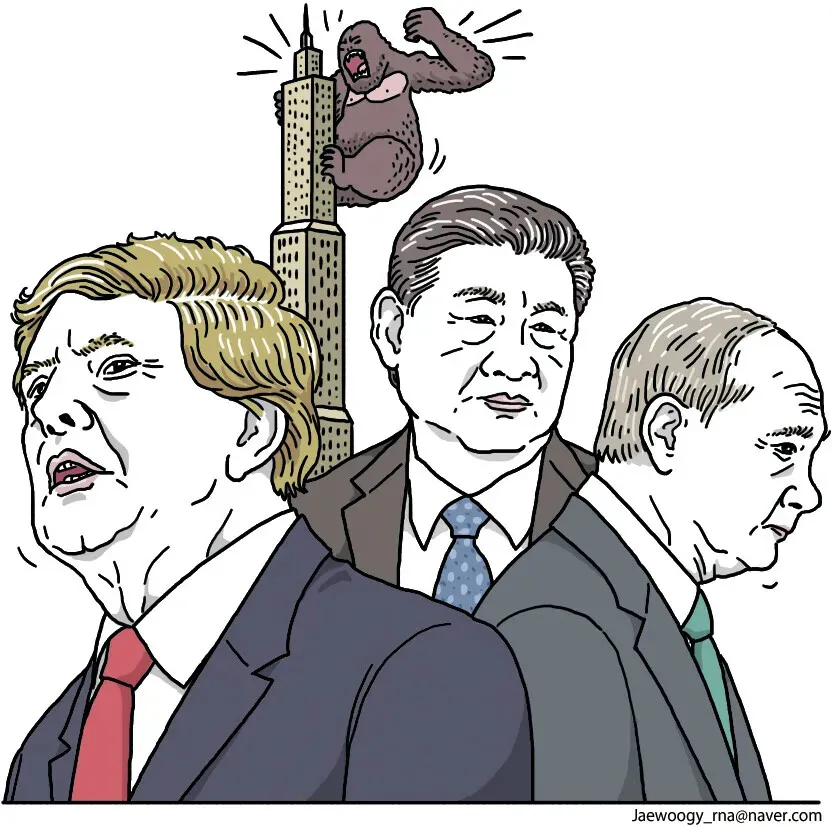
The first to articulate the brutal logic of the laws of the jungle in plain words were the powerful Athenians, as illustrated in Thucydides’ “History of the Peloponnesian War.”
After surrounding the isle of Melos with its hefty army in 416 BC, Athenians urged Melians to surrender, saying, “The strong do what they can and the weak suffer what they must.”
The Melians attempted to ameliorate the situation by responding, “You should not destroy what is our common protection, the privilege of being allowed in danger to invoke what is fair and right, and even to profit by arguments not strictly valid if they can be got to pass current.” Still, the logic behind “what is fair and right” was not enough to sway the logic of power.
After losing the war, all the grown Melian men the Athenians took were put to death, while the women and children were sold as slaves.
The logic employed by great powers became slightly more sophisticated as the centuries passed. After ushering out the Qing Empire from the Korean Peninsula to take over Joseon, Japan officially declared war in the name of the Meiji Emperor on Aug. 1, 1894.
In the declaration, Japan claimed that the war was to be held to procure “freedom” for Korea and to “maintain the peace of the East in general.”
“Korea is an independent state. She was first introduced into the family of nations by the advice and guidance of Japan. [. . .] Such conduct on the part of China is not only a direct injury to the rights and interests of this Empire, but also a menace to the permanent peace and tranquility of the Orient.”
Based on this logic, Japan vanquished the Qing Dynasty and later Russia before making Korea one of its colonies.
However, what was waiting after Japan supposedly cinched “peace and tranquility on the Orient” was a prolonged, brutal war involving the Mukden incident, the Sino-Japanese War and the Pacific War. After experiencing two horrific world wars, humanity pledged to solve international spats through peaceful methods.
The UN Charter designates that the use of force is justified only in instances of self-defense against military aggression and when the UN Security Council has authorized it.
That has prompted world powers to concoct all manner of strange justifications for aggression. While invading Ukraine on Feb. 24, 2022, Russian President Vladimir Putin called the move a “special military operation” for the purposes of protecting its people in the Donbas region.
After carrying out its decapitation operation against President Nicolás Maduro of Venezuela on Saturday, the US is now defending its actions as mere “law enforcement.” US Secretary of State Marco Rubio said on Sunday that the US had never recognized Maduro as the legitimate leader of Venezuela, and that because he had been indicted in a US court on drug charges, the operation had been an arrest raid, not an invasion — one that just happened to mobilize shocking state-of-the-art weaponry and elite special operations forces.
When China someday down the line conquers Taiwan, what do you bet that Beijing will say that it was merely carrying out reunification?
By Gil Yun-hyung, editorial writer
Please direct questions or comments to [english@hani.co.kr]

Editorial・opinion
![[Editorial] Seoul mayor risks losing office, but he’s already lost voters’ trust](https://flexible.img.hani.co.kr/flexible/normal/500/300/imgdb/original/2026/0723/2217847949281733.jpg "[Editorial] Seoul mayor risks losing office, but he’s already lost voters’ trust") [Editorial] Seoul mayor risks losing office, but he’s already lost voters’ trust
[Editorial] Seoul mayor risks losing office, but he’s already lost voters’ trust![[Column] Korea’s brave new world: Tanking employment and soaring home prices](https://flexible.img.hani.co.kr/flexible/normal/500/300/imgdb/original/2026/0723/1917847946266774.jpg "[Column] Korea’s brave new world: Tanking employment and soaring home prices") [Column] Korea’s brave new world: Tanking employment and soaring home prices
[Column] Korea’s brave new world: Tanking employment and soaring home prices- [Editorial] Korean Peninsula once again becomes the front line of a geopolitical rivalry
- [Editorial] Regulatory action needed after another preventable warehouse fire
- [Column] Seeking the Korean soldiers who showed mercy during Vietnam massacres
- [Reporter’s notebook] Trump’s White House windfall
- [Column] Will Lee’s NATO partnership end differently than Yoon’s support for Ukraine?
- [Editorial] For Korea’s disputes with the US, the only way out is through
- [Column] Trump’s war at home
- [Column] Another sign of an empire in decline
Most viewed articles
- 1[News analysis] Trump’s nuclear carrot for Saudis could further destabilize Mideast
- 2Peace, not denuclearization, now South Korea’s priority in policy toward North
- 3[Column] Trump’s war at home
- 4[Column] Korea’s brave new world: Tanking employment and soaring home prices
- 5SK Chairman and Roh tae-woo’s daughter expected to divorce
- 6Real-life heroes of “A Taxi Driver” pass away without having reunited
- 7A whole new China-North Korea alliance is taking shape, report argues
- 8Test-obsessed Korea reckons with smart glasses-powered cheating
- 9New MASGA hub marks next phase of Korea-US shipbuilding partnership
- 10After Iran war, North Korea’s nukes are an asset, not a burden, for China, says expert