hankyoreh
Links to other country sites 다른 나라 사이트 링크
[Cho Kuk writes from prison] Preventing the rehabilitation of Yoon Suk-yeol
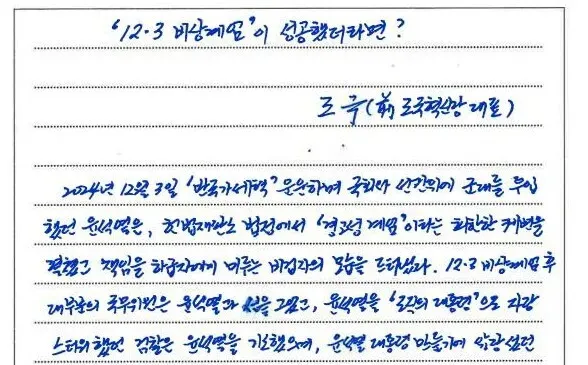
Editor’s note: Cho Kuk, the founder and former leader of the Rebuilding Korea Party, sent the Hankyoreh a guest essay on the behavior shown by President Yoon Suk-yeol during his impeachment trial, the tragedy the South Korean public would’ve faced if the Dec. 3 martial law declaration had been successful, and his stance on what the public and liberal parties should do once Yoon is dismissed from office. Cho is currently serving a prison sentence at the Seoul Nambu Detention Center.
Yoon Suk-yeol, who ordered the deployment of soldiers to the National Assembly and the National Election Commission (NEC) to punish “anti-state forces” on Dec. 3, 2024, has revealed his cowardice before the Constitutional Court by attempting to place the blame on his subordinates and blustering that the martial law was meant as a “warning.” Following the events of Dec. 3, most Cabinet members have distanced themselves from Yoon, and prosecutors who were once proud of one of their own for having become president have indicted him. Even the conservative media outlets that leapt at the opportunity to groom Yoon for the presidency have turned their backs on him. But that is not to say that the above parties now agree with or stand with the Rebuilding Korean Party, Democratic Party and others in the opposition camp, or that they want conservatives to lose their status as ruling party. They merely want to cut ties with Yoon, as his actions are blatantly unconstitutional and illegal, and his sorry attempts to save face elicit nothing but utter contempt.
As a former member — or should I say “agent”? — of the National Assembly whose name was included on the list of people Yoon specifically ordered to be arrested, I wish to pose a question. What would have happened if the Dec. 3 martial law had achieved its goals? What would have happened if the Korean people and lawmakers failed to lift martial law?
Lawmakers like myself, journalists and religious leaders would have been rounded up and forced to confess their involvement in “anti-state” activities. National Election Commission Chairperson Rho Tae-ak and his fellow NEC employees would’ve been bludgeoned with baseball bats specially prepared by Roh Sang-won, the former chief of the Defense Intelligence Command, until they admitted that there had been election fraud. Once such forced confessions were obtained, conservative news outlets would have a field day reporting on them. Outlets more critical of the government, such as the Hankyoreh and MBC, would’ve been subject to exhaustive investigations. Excruciatingly meticulous audits of corporate credit card records and accounting ledgers would’ve forced current executives out of their posts and into prison. Polling agency Flower CEO Kim Ou-joon would’ve been dragged off to a black site to be tortured.
With such atrocities taking place, would the prime minister and other members of the Cabinet be freely stating that the president’s declaration failed to meet the necessary conditions for martial law as they are now? I can confidently say that this would not have been the case. They would form a chorus echoing the logic of former Minister of the Interior and Safety Lee Sang-min, who (though he has since walked back the statement) at one point told the National Assembly that declaring martial law is “a legitimate act of rule by the president that is not subject to judicial review.” In this alternate reality, all various ministers that make up the government would be following the martial law decree and rushing to hold press conferences to lambaste the opposition camp and underscore the necessity of martial law.
Would the prosecution service have set up a special investigation headquarters into the martial law affair and investigated or indicted the key individuals who carried out martial law operations on Yoon’s orders? Of course not. It would have kowtowed to Yoon echoed the position it took after the Kim Young-sam administration took office, when calls were mounting for those who led the coups of Dec. 12, 1979, and May 17, 1980, to be brought to justice and punished — that is, that “a successful coup cannot be punished.” It would have set up a “special investigation bureau for anti-state forces” and launched no-stone-unturned investigations meant to suffocate the political opposition.
As sketched out in Roh Sang-won’s notebook, attempts to provoke North Korea into attacking the South around the NLL (Northern Limit Line) would’ve occurred, leading to limited war. Far-right YouTubers and far-right Christians would’ve ceaselessly incited anti-North Korea and anti-opposition violence while far-right gangs, such as the so-called “white skull corps” would be marauding through the streets.
Yoon would’ve dissolved the National Assembly, citing election fraud, and established an emergency legislative body to pass several unjust laws. He would’ve finally been able to realize the long-cherished dream he harbored since he appeared at the presidential candidate debate with the Chinese character for “king” written on his palm. The nation’s courts would’ve stayed mum throughout this entire process, parroting the age-old principle that the judiciary’s singular mission is to determine guilt in regard to criminal charges. However, they would have imposed heavy sentences on cases pursued by the prosecutors’ anti-state forces special investigation bureau.
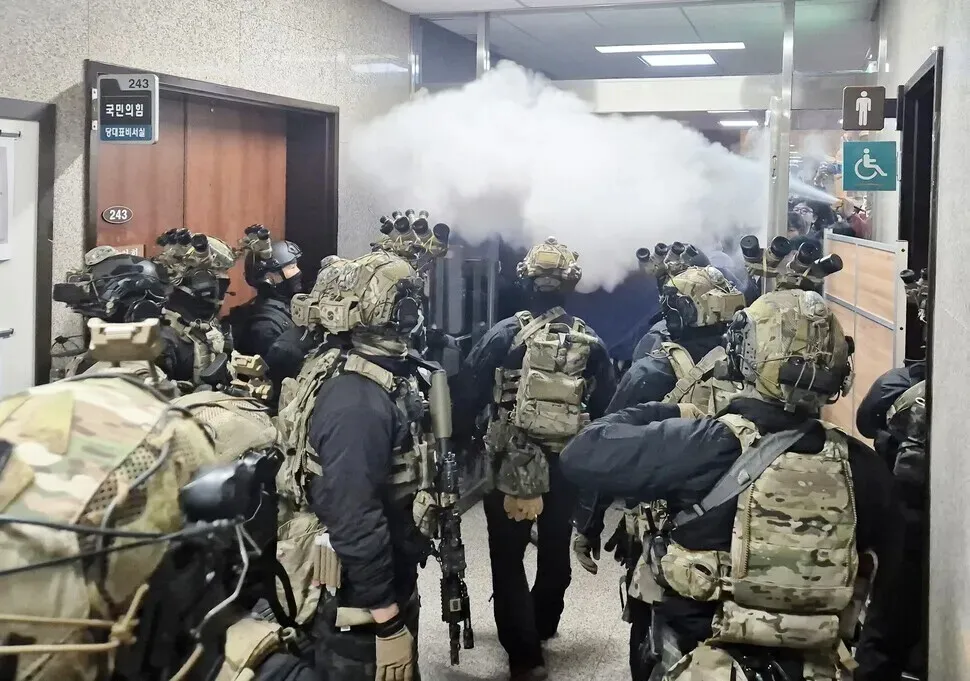
The determination and actions of the almighty Korean public stopped such a disaster from coming to pass. Before long, Yoon will be kicked out of office and get his just deserts. However, even once Yoon and his ilk are brought to justice, we will remain surrounded by obstinate and unrepentant forces who support them.
The forces that lauded Yoon as a hero during his prosecutor general days and aided him in his path to the presidency remain more united than ever before as they have one common goal: keeping conservatives in power. That goal has led them to adopt a false balance — they condemn the Dec. 3 insurrection attempt while also arguing that it was triggered by the opposition party’s tyrannical rule of the National Assembly. They continue to slam the opposition for besetting the Yoon administration with so many obstacles that Yoon had no choice but to unleash chaos. As if their politically targeted investigations of Lee Jae-myung, the leader of the biggest opposition party and Yoon’s primary opponent in the presidential election, they are doing all they can to demonize him. In the process, they are attempting to find a new person to take Yoon’s place that they can rally around so that they can hold onto the presidential office.
The sovereign public of Korea and the opposition need to band together like never before. Even when Yoon is ousted from office, those who hoisted him to that position and filled his administration remain. If they are given another shot at running the country, Yoon will be pardoned, released from prison and saunter through the rest of his life with the respectable title of “former president.”
It was the Korean public who brought down a military dictatorship in 1987 and impeached former President Park Geun-hye after removing influence-peddlers from power in 2017. The Korean people will emerge triumphant in the battle against Yoon and his cronies in 2024-25. But what happens after is of utmost importance. The polls currently underway about support for the various parties and their members are, in effect, polls about candidates for president.
Once a presidential election is called, we’ll see a quick rallying around each of the two political camps’ flags, resulting in a public divided 51:49. The splintered opposition, divided into the Kim Young-sam and Kim Dae-jung factions, allowed Roh Tae-woo, a key player in the 1979 military coup and the May 17, 1980, declaration of martial law, to win the Blue House. In 2012, the clearly incompatible coalition between Moon Jae-in and Ahn Cheol-soo saw Park Geun-hye win the election. The failed alliance between Lee Jae-myung and Sim Sang-jung let Yoon become president in 2022.
Before anything else, forces stalwartly opposed to the Dec. 3 insurrection and committed to restoring constitutional democracy should join forces. Those who have aided or abetted the Dec. 3 insurrectionists should be isolated. I hope liberal parties such as the Rebuilding Korea Party and the Democratic Party will be joined by the conservative Reform Party. A coalition will put us on the road to victory. We should not forget how, in Europe, liberal parties formed coalitions with centrist conservatives to protect their countries from far-right forces.
Following that, we need to discuss the direction South Korea should take following the next presidential election and construct common pledges. While each party will have differing wants and needs, I hope that they will be able to see eye-to-eye on establishing the seven common agendas of the Seventh Republic. The demands and dreams of the true owners of the country —the people — who have marched to the streets since Dec. 3, candles and light sticks in hand, must be included. This kind of coalition politics in South Korea will give birth to a “new majority,” which will then lead the country to a new beginning.
Please direct questions or comments to [english@hani.co.kr]

Editorial・opinion
![[Column] Trump destroys government](https://flexible.img.hani.co.kr/flexible/normal/500/300/imgdb/original/2025/1215/9417657891424423.jpg "[Column] Trump destroys government") [Column] Trump destroys government
[Column] Trump destroys government![[Column] A post-Western world approaches](https://flexible.img.hani.co.kr/flexible/normal/228/137/imgdb/original/2025/1214/2617656794205556.jpg "[Column] A post-Western world approaches") [Column] A post-Western world approaches
[Column] A post-Western world approaches- [Column] Offshore balancing, or carving out spheres of influence?
- [Column] Tu Anh deserved better than to die in fear of immigration raid
- [Editorial] Coupang’s founder can’t hide from the public forever
- [Editorial] Coupang data leak highlights need to expand Korea’s class action system
- [Editorial] Are US envoy and Trump on the same page about North Korea?
- [Editorial] All links between Korean politicians and Unification Church must be revealed
- [Reporter’s notebook] ‘Expose’ Coupang’s real leader
- [Column] How should Korea respond when Atlas cracks the whip?
Most viewed articles
- 1USFK sprayed defoliant from 1955 to 1995, new testimony suggests
- 2‘As the CEO of a global firm…’: Coupang founder says he’ll skip hearing on data breach
- 3South Korea signs on to US-led ‘Pax Silica’ pact for AI supply chain cooperation
- 4Railroading through an insurrection tribunal could backfire on Korea’s ruling camp
- 5Coupang’s insatiable hunger for growth is grinding workers to the bone
- 6What’s really driving the drastic depreciation of Korea’s won
- 7Former bodyguard’s dark tale of marriage to Samsung royalty
- 8Real-life heroes of “A Taxi Driver” pass away without having reunited
- 9[Column] A post-Western world approaches
- 10[Column] Trump destroys government