hankyoreh
Links to other country sites 다른 나라 사이트 링크
[Column] Offshore balancing, or carving out spheres of influence?
By Jung E-gil, senior international affairs writer
The three pillars of global geopolitics — the US, China and Russia — are currently busy expanding their reach. The US is threatening to invade Venezuela, interfering in Honduras’ presidential election, and seeking to strengthen its grip across the Caribbean. China is pressuring Japan over its remarks on Taiwan. Russia has been at war with Ukraine for nearly four years. All three powers are focused on solidifying their spheres of influence.
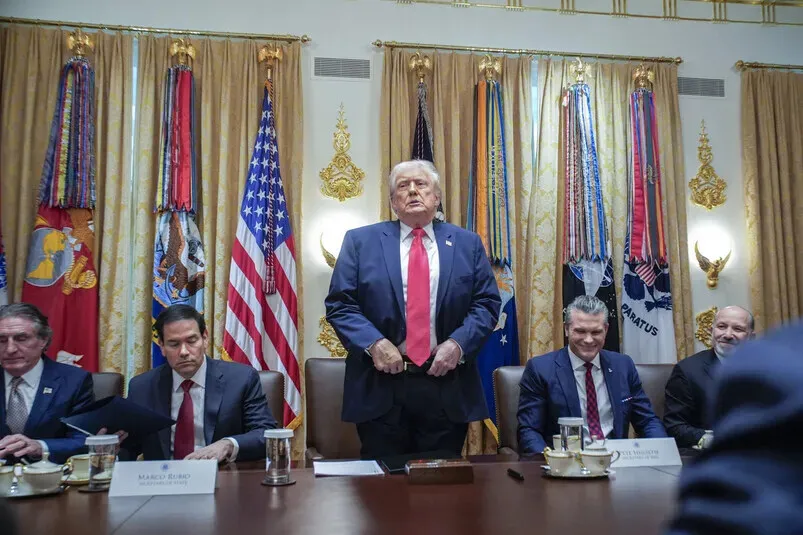
However, the advent of the Donald Trump administration has shifted things. If, in the past, the US would condemn certain actions as “aggressive,” “hegemonic” or “violating the rules-based order,” and provide material support to affected parties, now, such verbal or material interventions are either nonexistent or significantly reduced. The three nations are refraining from interfering in each other’s efforts to build up their influence in their respective regions.
Ever since Trump’s reelection, the US has pursued a peace plan that reflects Russia’s demands. When China lashed out after Japanese Prime Minister Sanae Takaichi made remarks implying that Japan’s Self-Defense Forces could be mobilized in a Taiwan contingency, Trump called Takaichi after a phone call with Chinese President Xi Jinping, advising her to refrain from provoking Beijing. China and Russia have remained silent even though the US is threatening to invade Venezuela, and have been reluctant to say even a word in support for Caracas.
This is due to the fact that Trump’s arrival in the White House marked the end of Washington’s original global strategy of designating Europe, the Middle East and East Asia as three vital regions. That strategy had entailed maintaining a permanent military presence and intervention in those regions. However, it came under fire for overstretching America’s power and sinking the country into a quagmire of constant intervention and conflict. Trump vowed to end these endless wars and declared that he would no longer maintain that global strategy.
Two realist thinkers, John Mearsheimer of Chicago University and Stephen Walt of Harvard University, sparked a significant debate in July 2016 by criticizing the grand strategy of the liberal international order with their Foreign Affairs article titled, “The Case for Offshore Balancing: A Superior US Grand Strategy.”
They advocated for offshore balancing, urging the US to refrain from making permanent military deployments and intervening in conflicts. Instead, they argued that it should empower allies in each region to maintain the balance of power. Only when existential threats were on the table should the US directly intervene to suppress adversaries and restore the balance of power. An example of offshore balancing is the UK’s “splendid isolation” policy, in which the nation distanced itself from continental European affairs and intervened only when the balance of power was at risk of collapse.
The US’ offshore balancing strategy relies on two conditions. First, the US needs to buck-pass: shift its responsibilities and burden onto its allies. Trump is now going beyond merely shifting responsibility to allies in terms of security and the economy; if anything, he is exploiting them.
Second, the US needs to maintain direct hegemony in the Western Hemisphere (the Americas), particularly in North America and the Caribbean. The US will only be able to retain the capacity to maintain an offshore balance in Eurasia by ensuring that the entire American continent remains a sturdy fortress.
Before and after his inauguration, Trump publicly declared his intent to make the Panama Canal, Canada and Greenland into US territories. Since September, he has mobilized the US military to crack down in the Caribbean. The Trump administration’s first National Defense Strategy, which is soon to be released, will reportedly shift the priority of US foreign policy from confrontation with China to strengthening the security of the US and its neighbors.
The US refused to acknowledge any other major powers’ spheres of influence under its liberal international order strategy, but an offshore balancing strategy necessitates compromises to the extent that they do not threaten its own superiority and hegemonic influence.
We can question whether the Trump administration is being deliberate and meticulous in its pursuit of offshore balancing, as it is currently lacking the respect and consideration essential for managing alliances under such a strategy. Instead, Trump is abandoning the US’ obligations and responsibilities as a hegemonic power that upholds the liberal international order to focus on maintaining its status as a powerful country that puts itself before anything else.
While compromises on spheres of influence implied a division of spheres among great powers in the imperialist 19th century, this is not the case in offshore balancing. However, if the Trump administration wants the US to become a protectionist superpower, it will mean spheres of influence being divvied up between international powers.
Whether through an offshore balancing compromise over spheres of influence or a direct division of spheres of influence by great powers, the implications for South Korea are clear: Korea’s responsibility and role in East Asia will grow. Even if Korea wanted to remain a vassal state of the US, it would no longer be able to do so.
During the Roh Moo-hyun administration, there was talk of Korea becoming Northeast Asia’s balancing power. The theory evinced fierce criticism, with some arguing that Korea, as a subordinate ally of the US, was making presumptuous claims. Korea must now play a vital role in maintaining a positive balance of power in East Asia, and the conditions for doing so are being established. Korea must turn this situation into an opportunity.
Please direct questions or comments to [english@hani.co.kr]

Editorial・opinion
![[Editorial] Trump’s baseless claim that Iran bombed girls’ school crosses line](https://flexible.img.hani.co.kr/flexible/normal/500/300/imgdb/original/2026/0309/4217730446901883.jpg "[Editorial] Trump’s baseless claim that Iran bombed girls’ school crosses line") [Editorial] Trump’s baseless claim that Iran bombed girls’ school crosses line
[Editorial] Trump’s baseless claim that Iran bombed girls’ school crosses line![[Correspondent’s column] JD Vance’s 67-hour disappearance](https://flexible.img.hani.co.kr/flexible/normal/500/300/imgdb/original/2026/0306/2517727866984907.jpg "[Correspondent’s column] JD Vance’s 67-hour disappearance") [Correspondent’s column] JD Vance’s 67-hour disappearance
[Correspondent’s column] JD Vance’s 67-hour disappearance- [Column] Withstanding Trump’s predatory hegemony
- [Editorial] US dragging Kurds into its war with Iran would be a disaster
- [Column] US allies in the Gulf are in flames. Can Korea avoid a similar fate?
- [Editorial] North Korea’s tough talk mustn’t deter Seoul’s efforts to rebuild trust
- [Editorial] Attack on Iranian girls’ school is an indefensible crime against humanity
- [Editorial] Trump’s unjustified war with Iran threatens chaos for us all
- [Column] What a Korean man’s foiled plan to seek assisted death in Switzerland reveals
- [Column] This is what accountability looks like
Most viewed articles
- 1Coupang investors insinuate that US is planning Section 301 probe into Korea
- 2[Interview] Abandoning reunification is survival strategy for North Korea, expert says
- 365% of Korean men say gender equality has gone ‘far enough’; only 42% of women agree
- 4Korea’s Democrats expect a landslide in June elections — that overconfidence could hurt them
- 5‘Everything they have is gone’: Trump says war with Iran will be over ‘very soon’
- 6Party that gave rise to Yoon Suk-yeol distances itself from disgraced former president
- 7[Interview] Judith Butler: Repressive acts by anti-democratic regimes are ‘confessions’ of fear
- 8PPP’s Jang formally agrees to cut ties with Yoon amid dismal poll numbers, looming election
- 9[Interview] Is war in Iran the beginning of the end for nuclear nonproliferation?
- 10[Correspondent’s column] JD Vance’s 67-hour disappearance