hankyoreh
Links to other country sites 다른 나라 사이트 링크
Weeklong flurry of diplomacy in Asia seeks alternative to Trump’s ‘America First’ world order
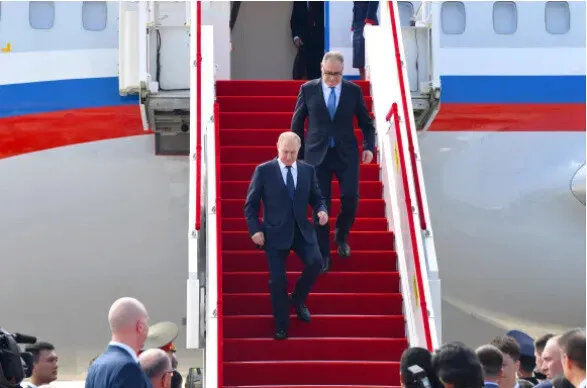
A flurry of high-profile diplomacy aimed at countering the Trump administration’s America First world order is set to take place this week, with a security summit, military parade and economic forum taking place in Russia and China. Observers are keenly watching to see whether China and Russia’s efforts to construct a multipolar world order hostile to, or at least excluding, the US will bear fruit during what could be a week of monumental change in East Asia.
Leaders and representatives from around 20 nations, including Russian President Vladimir Putin and Indian Prime Minister Narendra Modi, as well as the leaders of Iran and Turkey, joined Chinese President Xi Jinping at the Shanghai Cooperation Organisation security summit, which kicked off in Tianjin, China, on Sunday.
On Wednesday, Putin and Xi will be joined by North Korean leader Kim Jong-un and nearly two dozen other leaders at China’s “Victory Day” parade in Tiananmen Square, marking the Chinese victory in its “People’s War of Resistance against Japanese Aggression and the World Anti-Fascist War.” The parade will provide the backdrop for a historic moment in which the leaders of North Korea, China and Russia are seen together for the first time. The parade will also mark Kim’s first foray into multilateral diplomacy.
The biggest point of interest this week will be how North Korea and India each redefine their relationships with China and Russia.
Following Trump’s inauguration, conflict within the West over failed negotiations on the end of the war in Ukraine, deteriorating India-US relations following Trump’s tariff war, and the increasing congeniality between North Korea and Russia triggered by the Ukraine war, among other issues, have not only prompted a reconfiguring of the relationships between these countries, but led to a reestablishment of fraternity between North Korea, China and Russia.
This week’s schedule will provide the first opportunity for North Korea, China and Russia to test whether they can reinforce their coalition so as to counter the de facto South Korea-US-Japan alliance.
After South Korea-US-Japan relations were upgraded into a de facto trilateral alliance at the Camp David summit on Aug. 19, 2023, North Korea used the war in Ukraine as an opportunity to restore its military alliance with Russia. Now, it seems to be focusing on efforts to develop ties with China to explore a framework for a coalition between North Korea, China and Russia.
While no official schedule has been announced, many are interested to see whether any summits will take place between the leaders of North Korea, China and Russia. Chinese media reported that coordination is underway for a summit between Kim and Xi leading up to or following Wednesday’s V-Day parade.
Yuri Ushakov, an aide to Putin on foreign policy issues, also announced that Moscow is considering a summit between Putin and Kim.
What path India will plot going forward is another point of interest this week. During a summit Sunday with Xi, the Indian leader vowed to make progress on bilateral ties based on mutual trust and respect. After years of leaning toward the US, Modi is using this visit to China — his first in seven years — as an opportunity to return India’s foreign policy to its traditional equidistance between China and the US. India is furthermore fortifying its relationships with Russia and China in response to the 50% tariff on Indian goods entering the US that went into effect on Wednesday, imposed due to India’s purchases of Russian oil.
During his uncommonly long four-day visit to China, Putin will engage in bilateral talks with leaders of 10 countries in his most active spate of diplomacy since Russia invaded Ukraine in 2022. After returning from China, Putin will participate in the Eastern Economic Forum starting on Friday in Vladivostok, where he will continue to hold summits with representatives hailing from around 80 countries.
Riding the momentum of his Aug. 15 summit with Trump in Alaska, Putin is utilizing the energy he used to resume dialogue with the West to expand Russia’s influence in the Global South.
In a written interview with China’s state-run Xinhua News Agency on Saturday, Putin stated that he expected the forum to consolidate solidarity across the shared Eurasian space, writing, “All this will help shape a fairer multipolar world order.”
China, meanwhile, aims to expand friendly relations with Russia, improve relations with India, and reaffirm its closeness with North Korea at the security forum in Tianjin as it works to establish itself as leader of the Global South and gain enough influence to square up against the US. Both this year’s Shanghai Cooperation Organisation summit and the V-Day parade are the largest ever seen.
In a speech made before the summit in Tianjin, Xi declared the Shanghai Cooperation Organisation to have “grown into a significant force in promoting a new type of international relations.” This declaration indicates that China will use this organization, along with BRICS, the intergovernmental organization of non-Western states, to create a foundation for a multipolar system to counter the US-centric international order.
The state leaders attending the summit are to agree on the establishment of a center for countering security challenges and threats by signing the Tianjin Declaration. The center is to be based in Tashkent, the capital city of Uzbekistan.
By Jung E-gil, senior staff writer
Please direct questions or comments to [english@hani.co.kr]

Editorial・opinion
![[Editorial] Mockery of Gwangju at high school ball game shouldn’t be treated lightly](https://flexible.img.hani.co.kr/flexible/normal/500/300/imgdb/original/2026/0701/1817828951697517.jpg "[Editorial] Mockery of Gwangju at high school ball game shouldn’t be treated lightly") [Editorial] Mockery of Gwangju at high school ball game shouldn’t be treated lightly
[Editorial] Mockery of Gwangju at high school ball game shouldn’t be treated lightly![[Column] Does profit-driven investment by chaebol make them ‘national heroes’?](https://flexible.img.hani.co.kr/flexible/normal/500/300/imgdb/original/2026/0701/8317828953365056.jpg "[Column] Does profit-driven investment by chaebol make them ‘national heroes’?") [Column] Does profit-driven investment by chaebol make them ‘national heroes’?
[Column] Does profit-driven investment by chaebol make them ‘national heroes’?- [Column] Korea at a crossroads: ‘Yoon Again’ or real change?
- [Column] Stuck in Strait of Hormuz, US can no longer pivot to Asia
- [Column] The harder US pushes N.Korea to denuclearize, the greater the risk to S. Korea
- [Correspondent’s column] The new generation of ‘sewer socialists’ are in it to win it
- [Editorial] Who benefits from tug-of-war over jurisdiction in the DMZ?
- [Column] Inequality in Korea hits high not seen since colonial era
- [Editorial] Unity doesn’t mean embracing defenders of insurrection
- [Editorial] Stiff sentence for ex-justice minister shows abetting insurrection won’t go unpunished
Most viewed articles
- 1Korea on pace to record $1 trillion in exports in 2026, joining world’s top 4
- 2[Column] Korea at a crossroads: ‘Yoon Again’ or real change?
- 3Prosecution begins its investigation of bank sale to Lone Star
- 4Police refer Morse Tan to prosecutors on suspicion of defaming Korean president
- 5[Column] Does profit-driven investment by chaebol make them ‘national heroes’?
- 6After Starbucks, anti-Gwangju mockery rears its head at high school baseball game
- 7Student athletes suspended from competitive play after mocking Gwangju massacre
- 8‘All doors open if you knock long enough’: Lee vows to achieve peace with North Korea
- 9[News analysis] Can Lee and Moon’s push for unity get Democrats on the same page?
- 10US Republican lawmakers claim Korea’s NIS coerced Coupang