hankyoreh
Links to other country sites 다른 나라 사이트 링크
[Editorial] Seoul needs Beijing — thawing ties is a necessary start
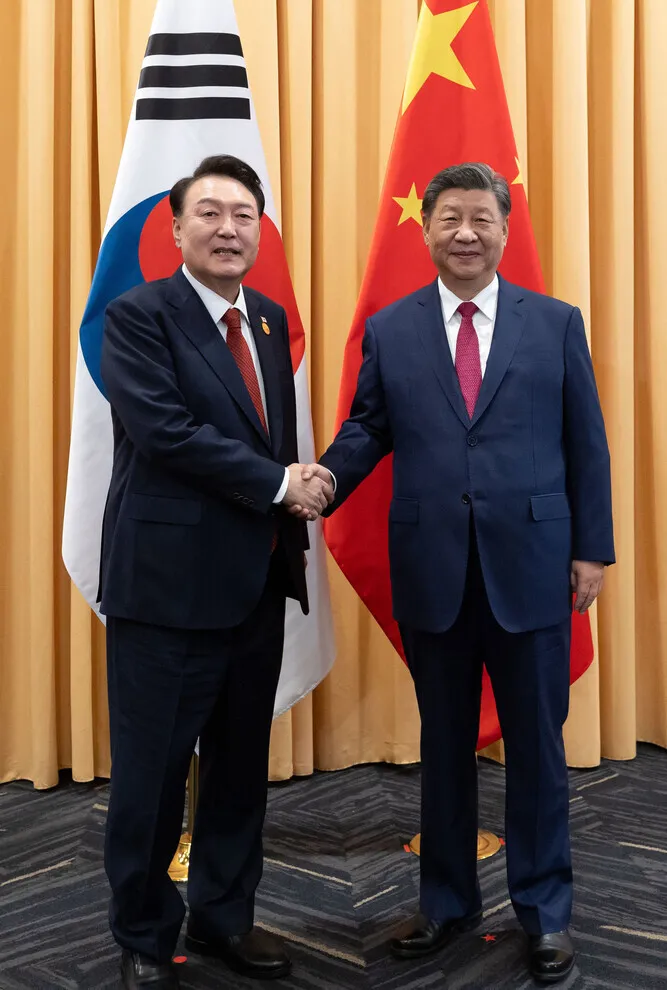
South Korean President Yoon Suk-yeol and Chinese President Xi Jinping held their first summit in two years. The two leaders used the Asia-Pacific Economic Cooperation (APEC) summit as an opportunity to hold a separate bilateral summit in Lima, Peru, on Friday (local time). Yoon and Xi agreed to “pool efforts and move toward regional peace and prosperity” and discussed mutual visits to each other’s countries.
Amid the drastically transforming international landscape evinced by North Korea-Russia military cooperation and the second Trump administration, South Korea desperately needs a high-level diplomatic strategy that proactively leverages China to bring peace to the Korean Peninsula.
The South Korean government needs to distance itself from the global hegemonic power struggle and approach its relations with China from the perspective of practical diplomacy that prioritizes our national interests.
During his summit with Xi, Yoon said that North Korea’s continued intercontinental ballistic missile launches, military provocations, and military cooperation with Russia are “inciting instability on the Korean Peninsula and in the region” and called for China to play a “constructive role” in regard to such concerns.
In response, Xi said that China also hopes for a deescalation of the situation in the region and does not want to see tensions on the Korean Peninsula, expressing hope that the “relevant parties will peacefully resolve their issues through dialogue and negotiation.”
South Korea and China have clear differences in their stances on military cooperation between North Korea and Russia. Yet neither country wants escalating inter-Korean tensions. With an incoming Trump administration that has pledged massive tariffs on Chinese goods and an overall decoupling from Chinese manufacturing, Beijing cannot avoid the need for cooperation with Seoul. South Korea needs to aggressively take advantage of China’s current situation and increase the range for potential cooperation.
Since Yoon’s inauguration, he has excessively pushed for a foreign policy strategy based on the complete overhaul of South Korea-US-Japan cooperation, justifying it under the label of “values diplomacy.” Yoon has basically volunteered to serve as a spearhead in the “new Cold War” world order that pits South Korea, the US and Japan against North Korea, China and Russia.
Obviously, South Korea relies on the US for its national security. However, it is the government’s job to walk the diplomatic tightrope so as not to exacerbate relations with China, Russia and other neighboring countries. This is not what the Yoon administration has done. All the while, inter-Korean relations have deteriorated to dismal conditions.
Faced with an incoming second Trump administration, the Yoon administration needs to thoroughly reevaluate the diplomatic strategy it has pursued thus far. As the second Trump administration is expected to wage a pressure campaign against China, South Korea needs to utilize the situation to our advantage by improving relations with China. It is likely that the Trump administration will call on South Korea to partake in its pressure campaign against China. The Yoon administration needs to draft countermeasures in advance. Seoul needs to aggressively take advantage of the leverage China presents to solve the current diplomatic crisis — if only for the sake of stability on the Korean Peninsula.
Please direct questions or comments to [english@hani.co.kr]

Editorial・opinion
![[Column] Xi Jinping exploits growing rift in Transatlantic alliance](https://flexible.img.hani.co.kr/flexible/normal/500/300/imgdb/original/2026/0408/1017756384434781.jpg "[Column] Xi Jinping exploits growing rift in Transatlantic alliance") [Column] Xi Jinping exploits growing rift in Transatlantic alliance
[Column] Xi Jinping exploits growing rift in Transatlantic alliance![[Column] Trump’s war boomerangs on US hegemony and alliances](https://flexible.img.hani.co.kr/flexible/normal/500/300/imgdb/original/2026/0407/6417755465363376.jpg "[Column] Trump’s war boomerangs on US hegemony and alliances") [Column] Trump’s war boomerangs on US hegemony and alliances
[Column] Trump’s war boomerangs on US hegemony and alliances- [Column] Negotiating with bombs
- [Column] What the debate over Atlas and robots in factories missed
- [Editorial] There’s no more relying on US after Iran war
- [Column] A year on from ‘Liberation Day,’ is America any greater?
- [Editorial] US threat to ‘reexamine’ NATO shows Korea can’t delay defense self-reliance
- [Column] Was Seoul’s choice to pursue dialogue, not war, in 1994 a ‘strategic error’?
- [Column] Is the PPP’s far-right shift a path to self-destruction
- [Column] Putin, Trump and Netanyahu: All tactics, no strategy
Most viewed articles
- 1[Column] Xi Jinping exploits growing rift in Transatlantic alliance
- 2[News analysis] North Korea says it wants no clashes with South — but no talks either
- 3[Column] Iran, from Heidegger to Kant
- 4China, Russia veto UNSC resolution aimed at opening Strait of Hormuz
- 5Real-life heroes of “A Taxi Driver” pass away without having reunited
- 6North Korea welcomes South Korean leader’s expression of regret over civilian drone incursion
- 7US will halt attacks on Iran for 2 weeks, Trump says
- 8‘Korea didn’t help us’: Trump blasts allies for not coming to US’ aid in Strait of Hormuz
- 9Seoul spy agency calls Kim Jong-un’s daughter ‘heir apparent’
- 10[Column] Trump’s war boomerangs on US hegemony and alliances