hankyoreh
Links to other country sites 다른 나라 사이트 링크
For decades, Korea has been their home. On paper, they do not belong.
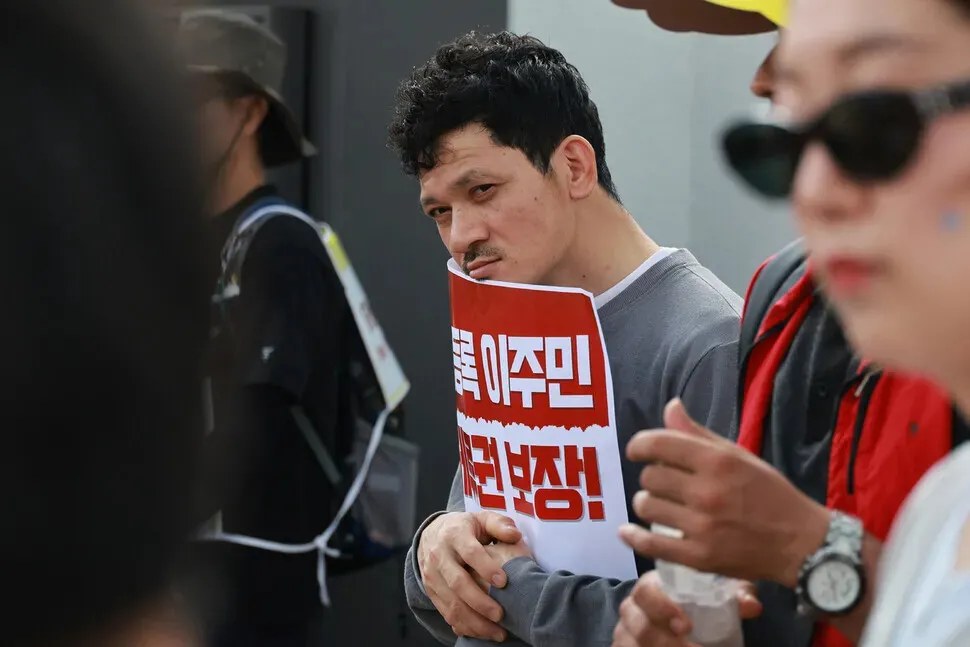
Editor’s note: The names of all undocumented migrants that appear in the following article are pseudonyms.
Amir, 49, left Karachi, Pakistan, and arrived at Gimpo Airport, Seoul, in 1999.
In the 27 years since then, he has transitioned from youth to middle age, and his children have become adults.
Amir has worked in Korea, made money, pursued his dreams, had children, survived illness, enjoyed success, and dealt with discouragement. In short, he has faced the high and low points of life, just like any Korean, but with one critical difference — he doesn’t have legal status here. He’s an undocumented migrant.
What does it mean to spend over two decades of one’s life as an undocumented member of a society? A report examining that experience was presented at Korea’s National Assembly on Monday.
Titled “The Lives of Long-Term Undocumented Migrants and Just Migration Policy,” the report was produced by MARCO, a research group consisting of migrant rights researchers and activists, with support from the Finance and Service Ubuntu Fund.
The report contains oral accounts from 10 migrants who have been undocumented in Korea for between 12 and 35 years.
Their accounts describe an existence that is nearly unimaginable for most Koreans. Many migrants refuse to ride buses or subways for fear of being nabbed by the authorities, spend the daytime hours holed up at home and work in bars after dark, and have to watch helplessly as their children’s health suffers and dreams are dashed.
These migrants have adapted to their lives and are no longer able to return home. But the threat of deportation always hangs over their head.
In partnership with experts, the Korean government has set up a comprehensive support task force for foreign workers that is supposed to develop measures for undocumented migrant workers. One idea under discussion is granting legal status to some portion of the undocumented migrant population.
Given the needs of domestic employers, many say the time has come to grant legal status to long-term undocumented migrants who have adapted to Korean society during decades of their precarious existence.
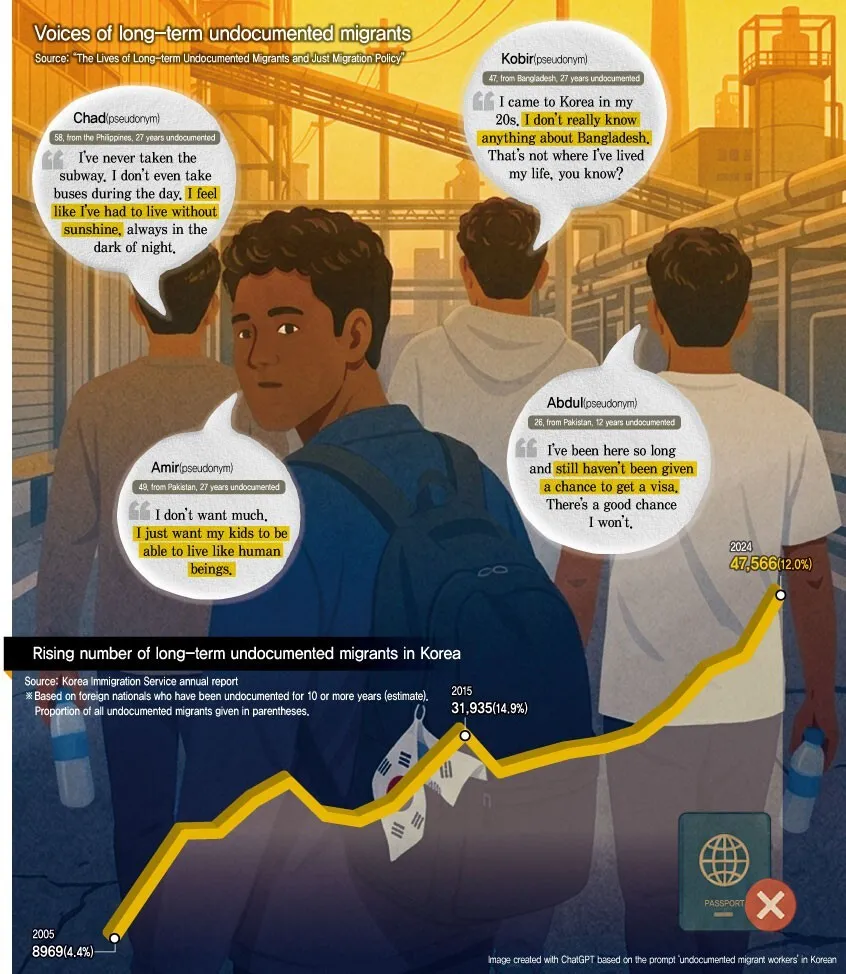
Through the oral accounts presented in the report and subsequent interviews, the Hankyoreh has reconstituted the lives of a few long-term undocumented migrants. As of 2024, there were 397,522 “illegal aliens” in Korea who have exceeded their permitted period of sojourn. It’s estimated that 47,566 of them have been in Korea for more than 10 years.
Young adulthood: Becoming an invisible man
Kobir, 47, came to Korea from Bangladesh in 1999, the same year as Amir.
“It was a rainy day, and I was feeling good,” he recalled. But his good mood had fizzled out by the time his three-month work visa ended. From that point until now, he has “always been scared.”
Kobir said that “it was 2002 or 2003” when his fears were materialized before his very eyes. He was living with nine other migrants when immigration officials burst into his home.
“They got Islam and Hiro,” said Kobir, who had been in the bathroom when the officers arrived and managed to escape notice.
During those youthful days when Kobir was anguished at the thought of being the sole survivor, he learned to run away.
Sometimes his destination was the woods. “I would always head for the hills. I probably hid in the woods three or four times a year.
At other times, he climbed up to the rooftop. “There were a lot of people who broke their arms or legs while clambering across rooftops,” he recalled.
Kobir learned the ins and outs of hiding. “When immigration officers were out in force, we wouldn’t go downtown and would stay at home after dark. We wouldn’t go to the doctor even when we were sick,” he said.
Kobir’s ability to fly under the radar for 27 years is nearly miraculous. In 2024 alone, 81,206 migrants (20% of the total undocumented population) were deported or were advised or ordered to leave the country.
But that miracle was not achieved without sacrifice.
For Chad, 58, from the Philippines, those sacrifices included public transportation and daytime activities. Chad has been undocumented for 27 years.
“I’ve never taken the subway. I don’t even take buses during the day. I feel like I’ve had to live without sunshine, always in the dark of night,” Chad said.
Migrants can live with guilt over arrested friends and give up daytime, outings and public transportation. But there’s one thing they can’t give up: their family.
Middle age: A father’s uphill climb
Amir welcomed his third daughter into the world in 2010.
“My wife was changing her diaper when she screamed for me. Rushing over, I saw that the baby’s anus was sealed shut. Why didn’t the doctors tell us? What if the baby had died?” he said
The operation cost 20 million won (US$13,250), but Amir’s family only had 2 million won at hand.
With health insurance, the family could have received a waiver for their baby girl’s rare condition and only paid a few hundred thousand won. But the girl was undocumented, just like her parents, and thus wasn’t enrolled in national health insurance.
In the midst of Amir’s desperation, a “very kind” doctor and people from a migrant center arranged for the surgery.
But continuing treatment was required, and Amir’s daughter needed health insurance.
“That was when somebody told me that if we applied for refugee status, we could get health insurance,” he said.
Once you’re a father, there are things that can’t be fixed by pulling a runner. So Amir made a risky decision.
Amir had his reasons for seeking refugee status. An unskilled foreign worker who wishes to live in Korea for more than 10 years has to receive a skilled worker visa (E-7-4) under the points system.
But that visa is issued on a limited basis to only 30,000 people a year. Besides, migrants who lost their legal status before the visa was created in 2017 aren’t eligible for it to begin with.
As of this year, permanent residency is only available to those earning around 100 million won a year (twice the gross national income, or GNI, per capita).
His lawsuit for refugee status — his last shot at gaining legal residency — ended in disappointment.
“I wanted to say so much in court. How I’ve lived since coming to Korea, how my family and children are doing, and things like that,” he said. “They only gave us 10 minutes. The judge spoke for five of those minutes, so we just had five.”
After spilling his guts on his decade of suffering during his five minutes, Amir saw his application for refugee status rejected in May 2016. He had spent millions of won in lawyer fees.
“You know the 63 Building in Seoul? I even looked at it and thought, ‘Should I just jump off of it?’ I was so crushed,” he said.
Nevertheless, he and his family could not leave Korea — not only because they had assimilated into Korean society, but also because the country itself wanted them here.
Later adulthood: Just an ordinary guy from the neighborhood
Kobir, originally from Bangladesh and now in his late 40s, is a skilled worker who is undocumented. Over the past 16 years, he has led the painting team at a furniture plant.
As a heavy sleeper, he often arrives late for work, but this is no big deal. He has also taken on the job of arguing with the boss over work assignments on behalf of his fellow employees.
“I’m good at my job these days, you know?” he said. “I’ve learned the skills, so that’s why I can speak up.”
Finding work has never been especially difficult for people like him given the chronic labor shortage in basic manufacturing. Workers who developed skills on their own over decades are rare.
“The basic reason an illegal market for foreign workers forms is because demand for foreign labor exists,” said Lee Kyu-yong, a senior research fellow at the Korea Labor Institute in Sejong.
Kobir’s relationships and life that began with his job ultimately transformed even his identity. He has been friends for 20 years with a Korean man he met as a factory manager, and even went on vacation to Gangwon Province with the owner of the neighborhood supermarket.
If an immigration crackdown occurs, his neighbors are the first to alert him. “They’ll say, ‘I saw the raid,’ ‘I saw an immigration vehicle,’ ‘Be careful.’ Like that,” he said.
Kobir is used to life with Koreans, but Bangladesh feels unfamiliar. “I came to Korea in my 20s. I don’t really know anything about Bangladesh,” he said. “That’s not where I’ve lived my life, you know?”
Kobir considers himself simply an ordinary guy from the neighborhood in Korea.
For the children of such people born or raised in Korea, words like “homeland” are even more confusing.
“Our children don’t know Pakistani culture. They can’t go to school. They have nothing. They can’t even eat,” Amir said, thinking of his children born in Korea.
Passing immigration dilemma down to next generation
Twelve years ago, at age 14, Abdul followed Amir to Korea from Karachi, Pakistan. Now 26, Abdul said his parents went to Korea with him but returned to Pakistan first, leaving him behind.
The reason is the same as for Amir’s children. “To be honest, that country is actually unfamiliar to me, and I can’t get a job in Pakistan,” he said. “The skills here don’t match those there.”
Abdul joined the ranks of the estimated 40,000 long-term undocumented migrants who preceded him. His legal status is in stark contrast to the lives of friends he spent his childhood with.
“Some of my close friends travel around Europe and others to China,” he said. “I’m a bit envious of that. I want to go, too.”
Laying low amid an immigration crackdown, he said he is unsure whether even dreaming in his state is safe. “I’ve been here so long and still haven’t been given a chance to get a visa. I wonder if something will happen,” he said. “There’s a good chance that I won’t.”
Abdul’s youth was shaped by decades of migration policy that never considered the possibility of a long-term stay and the life resulting from it. This process of resignation and confusion is like that affecting those before him.
“For most migrants, the path to legal residency is effectively closed,” said Choi Seo-ri, a senior research fellow at the Migration Research and Training Centre in Seoul. “We should grant residence permits for undocumented migrants through a screening process. It’s time for society to seriously consider who is eligible and to set related criteria.”
Amir’s third daughter has overcome her health issues and is now in her first year of high school. Her younger sibling, born shortly after her and in the third grade, wants to become a chef and often cooks Korean food at home, learning by watching YouTube videos.
Thanks to an amnesty by the Ministry of Justice granting “temporary” residency to the children of undocumented migrants, their right to stay is guaranteed for the time being.
But the future remains uncertain. “I don’t want much. I just want my kids to be able to live like human beings,” Amir said.
His life is a desperate struggle to break the cycle of passing on his status as a long-term undocumented resident to his children.
By Nam Ji-hyeon, staff reporter; Jang Hyeon-eun, staff reporter
Please direct questions or comments to [english@hani.co.kr]

Editorial・opinion
![[Column] Harari’s 2030s: A new age of repressive desublimation](https://flexible.img.hani.co.kr/flexible/normal/500/300/imgdb/original/2026/0927/7317904739856884.jpg "[Column] Harari’s 2030s: A new age of repressive desublimation") [Column] Harari’s 2030s: A new age of repressive desublimation
[Column] Harari’s 2030s: A new age of repressive desublimation![[Guest essay] This Chuseok, think of the seasonal workers who plant and pick your food](https://flexible.img.hani.co.kr/flexible/normal/500/300/imgdb/original/2026/0927/771790472388276.jpg "[Guest essay] This Chuseok, think of the seasonal workers who plant and pick your food") [Guest essay] This Chuseok, think of the seasonal workers who plant and pick your food
[Guest essay] This Chuseok, think of the seasonal workers who plant and pick your food- [Editorial] To build back public confidence, Lee must address issues affecting everyday Koreans
- [Column] Korea-Japan cooperation still has a long way to go
- Trump has taken a wrecking ball to America’s democratic institutions
- [Column] Sending troops to Hormuz would be a fatal miscalculation by Seoul
- [Guest essay] A tribute to Gloria Steinem and her legacy in Korea
- [Correspondent’s column] Korea has its own ‘red lines,’ too
- [Column] An open letter to Kim Jong-un and Donald Trump
- [Editorial] It’s time to pump the brakes on AI’s development
Most viewed articles
- 1[Column] Harari’s 2030s: A new age of repressive desublimation
- 2Not just Korea: Google leaked identifying info for sex crime victims across the world
- 3[Paris Olympics] An Se-young wins Korea’s first women’s badminton singles gold in 28 years
- 4Swedish IOC member’s adoptee wife seeking her birth parents
- 5June Huh becomes first mathematician of Korean descent to win prestigious Fields Medal
- 6Korea’s atrocities in Vietnam, in the words of those who saw and survived them
- 7Do Korea’s conservative frontrunners have what it takes to become president in 2030?
- 8South Korea’s president forgoes ‘denuclearization’ for ‘peninsula free from nuclear weapons’ in UN speech
- 9Korea a half century ago
- 10[Photo] Dismissed MBC journalists return to work