hankyoreh
Links to other country sites 다른 나라 사이트 링크
[Poll] 53.3% of Koreans want ruling liberal bloc to win on June 3
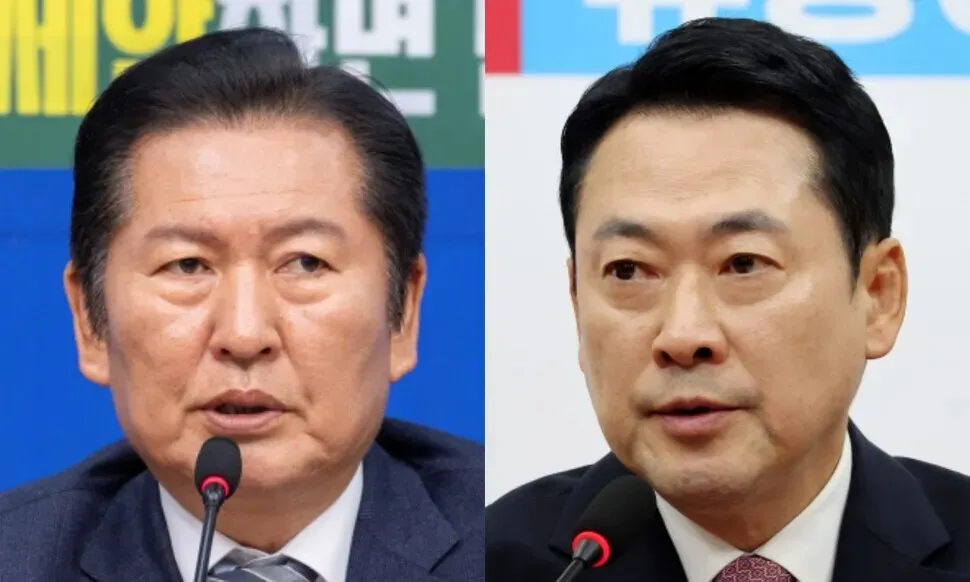
Over half of Korean voters believe that the ruling party bloc should win in the upcoming local elections on June 3 for the sake of stable governance, a new poll has found.
According to a voter panel survey commissioned by the Hankyoreh and the Korean Association of Party Studies, 53.3% respondents said that many candidates from the liberal ruling bloc should be elected in the upcoming election.
That compares to only 34.1% of respondents who reported wanting to see the opposition conservative bloc win and keep the administration in check, making for a margin of 19.2 points.
The survey was conducted May 6-10 with 1,701 respondents, 9.8% of whom stated that they did not have a strong opinion. The survey was conducted in part to commemorate the Hankyoreh’s 38th anniversary on Friday.
Support for the Democratic Party of Korea (48.9%) far surpassed that for the People Power Party (23.8%). Particularly notable is the Democratic Party’s 40.2% approval rating in the traditionally conservative Daegu and North Gyeongsang Province areas, besting the PPP, which trailed behind at 30.1%.
When asked which party’s candidate they would vote for in the mayoral or gubernatorial races in their own district, 51.3% respondents stated they would pick the Democratic Party candidate, more than double that of those who said they would vote for the PPP candidate (23.7%) — a gap of 27.6 points.
That made for a wider gap between support for the ruling party and opposition party in terms of voting intentions for local government heads than in the previous wave of the survey, which was conducted Dec. 17-21, 2025.
In the third wave, there was a 19.7 percentage point difference between the two parties, with 46.7% respondents saying they would vote for the Democratic Party and 27.0% for the PPP.
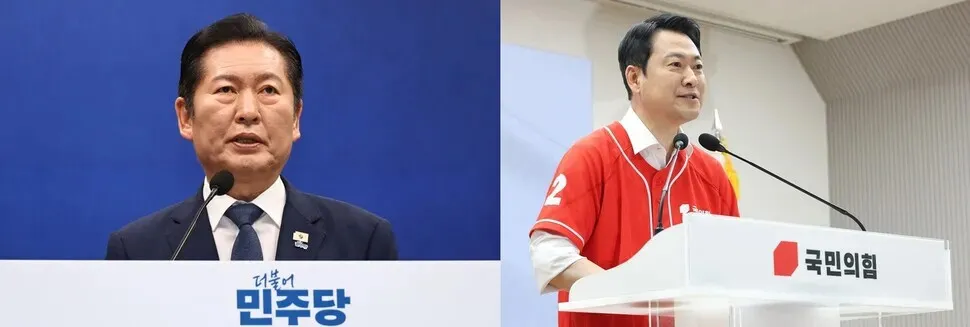
When asked to project who they thought would win the election, regardless of their own preference for a certain party, 65.4% respondents estimated that Democratic Party candidates would emerge victorious, three times the percentage of those who predicted that PPP candidates would win (19.0%).
These results seem to reflect the high approval rating enjoyed by President Lee Jae Myung. When asked if they believed that Lee was adequately fulfilling his duties as president, 66.9% respondents said that they thought he was doing a good job, more than twice the rate of those who stated that he was doing a poor job (28.7%).
Of those surveyed, 71.5% stated that they would definitely vote in the June 3 local elections, while 18.8% stated that they would make the effort to vote.
Survey methodology and summary
Wave 4 of the 2025-26 voter panel survey
Commissioned by: The Hankyoreh and the Korean Association of Party Studies
Survey organization: STI
Date: May 6-10, 2026
Sample: 1,701 voters from around South Korea
Methodology: Hybrid method involving a web-based survey accessible through mobile phones (99.6%) and telephone interviews (Mobile: 0.3%, landlines: 0.1%)
Respondent sampling method: Panel established by the survey organization (2020 of the 4,864 respondents recruited using landline and mobile RDD and telecom subscriber panels who had participated in the third wave)
Response rate: 88.3% (1,701 responses out of 1,926 contacted)
Margin of error: ±2.4 percentage points at 95% confidence
More details are available on the website of the National Election Survey Deliberation Commission.
By Ko Han-sol, staff reporter
Please direct questions or comments to [english@hani.co.kr]

Editorial・opinion
![[Column] The harder US pushes N.Korea to denuclearize, the greater the risk to S. Korea](https://flexible.img.hani.co.kr/flexible/normal/500/300/imgdb/original/2026/0628/2817826042176925.jpg "[Column] The harder US pushes N.Korea to denuclearize, the greater the risk to S. Korea") [Column] The harder US pushes N.Korea to denuclearize, the greater the risk to S. Korea
[Column] The harder US pushes N.Korea to denuclearize, the greater the risk to S. Korea![[Correspondent’s column] The new generation of ‘sewer socialists’ are in it to win it](https://flexible.img.hani.co.kr/flexible/normal/500/300/imgdb/original/2026/0626/8217824618600972.jpg "[Correspondent’s column] The new generation of ‘sewer socialists’ are in it to win it") [Correspondent’s column] The new generation of ‘sewer socialists’ are in it to win it
[Correspondent’s column] The new generation of ‘sewer socialists’ are in it to win it- [Editorial] Who benefits from tug-of-war over jurisdiction in the DMZ?
- [Column] Inequality in Korea hits high not seen since colonial era
- [Editorial] Unity doesn’t mean embracing defenders of insurrection
- [Editorial] Stiff sentence for ex-justice minister shows abetting insurrection won’t go unpunished
- [Column] Bridging the gap between pragmatic policies of North, South Korea
- The second China shock is here — and it’s bigger, broader and more global
- [Column] America declares its retreat from the Middle East
- [Column] North Korea’s economic boom
Most viewed articles
- 1[Column] The harder US pushes N.Korea to denuclearize, the greater the risk to S. Korea
- 2[Exclusive] US Congress calls for review of CCP’s ‘malign influence’ in South Korea
- 3[Reportage] Decoding the ‘Hefei model’: Four pillars of China’s tech ascent
- 4OPCON alarmism ignores how uncertain US wartime support for Korea already is
- 5Korean government to work with Samsung, SK to pour 2 quadrillion won into 3 ‘megaprojects’
- 6[Correspondent’s column] The new generation of ‘sewer socialists’ are in it to win it
- 7Outsourcing war to CFC has turned Korea’s military into a bureaucracy-first force
- 8Korean appeals court upholds 6-month sentence for Johnny Somali
- 9Police investigating 40 cases of assault at Olympic Park protests
- 10Former bodyguard’s dark tale of marriage to Samsung royalty