hankyoreh
Links to other country sites 다른 나라 사이트 링크
Korea’s Democrats expect a landslide in June elections — that overconfidence could hurt them

The Democratic Party is flying high, while the People Power Party is hitting new lows.
That’s the takeaway from current trends in Korean public opinion just three months before elections for local leaders, scheduled for June 3.
Let’s examine the National Barometer Survey, released on Feb. 26.
In the poll, the ruling Democratic Party enjoyed 45% of support, compared with 17% for the opposition People Power Party (PPP).
(All figures can be reviewed on the website of the National Election Survey Deliberation Commission.)
Considering that the Democratic Party stood at 41% and the PPP at 22% in the first week of February, the Democratic Party’s lead in support has jumped from double to nearly triple the PPP’s in the span of three weeks.
The PPP’s 17% support rating is a shocking figure. From Yoon Suk-yeol’s doomed martial law declaration in December 2024 until the presidential election on June 3, 2025, the PPP had maintained an approval rate in the 20%-39% range.
Support for the PPP during this period fell to its lowest-ever level of 16% in the National Barometer Survey in the first week of August, after former first lady Kim Keon-hee was called in for questioning in a special counsel probe. And now the party is nearing that level once again.
Broken down by region, Korea’s two major parties are only even in the traditional conservative stronghold of Daegu/North Gyeongsang Province; in every other part of the country, the Democratic Party has the advantage.
The Democratic Party polls at 39% in Busan/Ulsan/South Gyeongsang Province, while the PPP can only muster 23% of support there.
In addition, the Democratic Party outpolls the PPP in every age group. Even among those 70 years old and above, the Democratic Party holds the advantage 39% to 31%.
While these regional and age cohort figures are less reliable because of small sample sizes, the results are still meaningful.
That brings us to Gallup Korea’s regular survey, results for which were published on Feb. 27.
The Democratic Party held a commanding lead of 43%, against the PPP’s 22%. That was roughly similar to the breakdown two weeks earlier (44% to 22%).
Gallup reported the PPP as only holding the lead over the Democratic Party in Daegu/North Gyeongsang, 36% to 25%. Just as in the National Barometer Survey, the Democratic Party was up in every other region.
Notably, the Democratic Party outpolled the PPP 42% to 25% in Busan/Ulsan/South Gyeongsang.
By age group, the Democratic Party and the PPP had a similar showing among the 18-29 cohort, at 22% apiece. But the Democratic Party was ahead in every other cohort. Among those aged 70 and above, the Democratic Party beat out the PPP by 38% to 32%.
In the same poll, Gallup Korea asked whether respondents thought Yoon’s martial law declaration on Dec. 3, 2024, had been an insurrection. In that poll, 64% of respondents said it was an insurrection while 24% said it was not.
Answers to that question were closely correlated with party support and political identity. Only 21% of PPP supporters said the martial law declaration was an insurrection, with 68% saying it was not. That was similar to the responses for hardcore conservatives, of whom 22% said the declaration was an insurrection, while 70% said it was not.
Moderate conservatives were split on the question, with 47% describing the martial law declaration as an insurrection and 46% disagreeing. Among independents, 71% thought the declaration was an insurrection, compared to 17% who thought otherwise.
Combining the findings of the National Barometer Survey and the Gallup public opinion poll, we can draw two conclusions.
First, the PPP has been gradually shedding support until basically only hardcore conservatives remain in the fold.
The 68% of PPP supporters who told Gallup Korea that the martial law declaration was not an insurrection roughly corresponds to the 70% of hardcore conservatives who say the same thing.
In short, not only moderate conservatives but also independents are leaving the ranks of the PPP.
The second interesting conclusion is the decoupling of Daegu/North Gyeongsang and Busan/Ulsan/South Gyeongsang.
When the support for the Democratic Party and PPP are compared across Gallup Korea’s February poll results, Daegu/North Gyeongsang (26% to 38%) and Busan/Ulsan/South Gyeongsang (38% to 26%) were directly inverted.
In short, the support the PPP (and its predecessors) have reliably counted on from the southeast quadrant of the country since the merger of three major parties in 1990 is collapsing.
How will public sentiment influence June’s elections? Three months out, it’s too early to tell, as parties have yet to even name their nominees for the various offices Koreans will be voting on. However, we can attempt to make educated predictions.
The National Barometer Survey asked respondents about the nature of the upcoming elections. Over half (53%) said that the public should rally around the ruling party for the sake of government stability, while 34% saw them as a chance to strengthen the opposition in order to act as a check on the current administration.
Responses to the same question have changed over time — three weeks ago, 52% were in favor of rallying around the ruling camp, while 36% wanted to check the administration; five weeks ago, it was 47% to 40%. In short, public opinion has gradually shifted in favor of the ruling party in recent weeks.
So, where is this support for the Democratic Party coming from?
The party itself has been through many trials and tribulations in recent months: party leader Jung Chung-rae recently proposed a merger with the minor Rebuilding Korea Party, only to withdraw that proposal after facing fierce backlash from within his party and issued two official apologies after making controversial recommendations for candidates to serve as a special counsel to lead a comprehensive probe into allegations against Yoon Suk-yeol.
Disputes also surrounded a push by a group of lawmakers campaigning to have prosecutors drop indictments against the president from prior to his election and demanding a parliamentary probe of indictments made under the Yoon administration that they view as politically motivated.
Infighting broke out when hard-line lawmakers on the National Assembly’s Legislation and Judiciary Committee and floor leadership clashed over an amendment to the Criminal Act that would criminalize perversion of justice. Even with the local elections still a long way off, lawmakers and hard-line supporters locked in an ugly battle over who should be elected as the next party leader at the Democrats’ party convention in August.
The Democratic Party’s high approval ratings stem entirely from the Lee Jae Myung effect. “Pleasantly surprised” may be the best way to put how most Koreans feel about how Lee is doing in office. This is, in part, because of the low expectations many had harbored.
Lee was dogged by a series of controversies during his 2022 presidential campaign. If Yoon hadn’t plunged the country into crisis by declaring martial law, Lee may not have ever made it to the Blue House. Even after he won the presidential election, few expected him to truly excel.
However, Lee is steering state affairs remarkably well through pragmatic diplomacy focusing on Korea’s interests and his signature hands-on style of leadership. He may not yet have a full-fledged system in place, but he has succeeded in giving many public officials a rude awakening.
He is also winning the war on soaring housing prices. Putting his Bundang residence up for sale is, frankly speaking, an astonishing demonstration of his commitment and sincerity in tackling the issue.
Lee is also adept at managing conflicts within his party. The Democratic Party was practically in a state of civil war before the Lunar New Year holiday in mid-February. He has largely stayed out of the fray himself, but has been doing a good job of managing the party’s internal power struggles from a distance. This is likely due to the experience he has gained from two terms as party leader.
Luck seems to be on Lee’s side, too. The revision of the Commercial Act, which coincided with the semiconductor boom, propelled the KOSPI to its record high, crossing the 6,000 mark. Conservative news outlets were ready to slam the three judicial reform bills pushed by the Democratic Party, but had no choice but to fill their pages with articles about the consecutive smashing of stock market records.
Sun Tzu divided generals into three types: the brave general, the wise general, and the virtuous general. But even above these stands the fortunate general, who Lee is an embodiment of. If we borrow an expression from Machiavelli’s “The Prince,” Lee embodies the harmonious union of “virtù” and “fortuna.”
As for the PPP’s dwindling poll numbers, there’s only one person to blame: Yoon Suk-yeol. Feb. 20, the day after a Seoul court convicted Yoon of insurrection, marked a turning point, as PPP leader Jang Dong-hyuk declared that he and the party would not sever ties with the former president. Even the conservative Chosun Ilbo’s managing editor, Yang Sang-hoon, wrote a column in which he demanded that all party members “participate in a vote to see if the PPP is nothing more than the ‘Yoon Again’ party.”
In the run-up to the Lunar New Year holiday, the party was already coming apart at the seams. Now it finds itself on the brink of a full‑blown collapse.
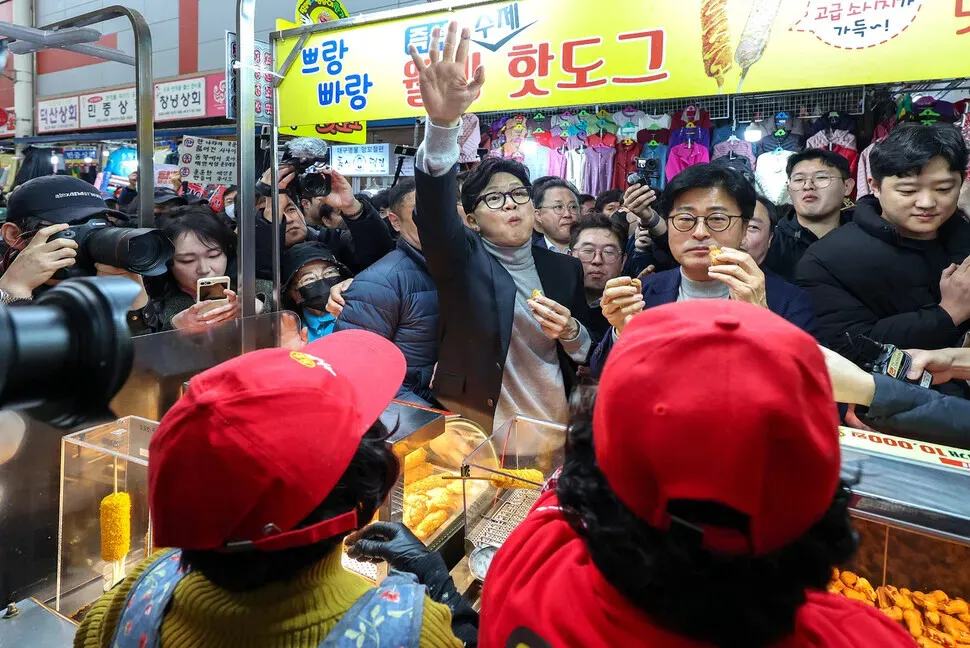
Onetime party leader Han Dong-hoon was recently accompanied by lawmakers Bae Hyun-jin, Park Jeong-hun, Woo Jae-jun, Jung Sung-guk, Kim Yea-ji, and Ahn Sang-hoon on a visit to Dageu’s Seomun Market. He was also joined by Kim Kyung-jin, head of the party members council for the Dongdaemun-B electoral district, Kim Chong-hyuk, former Supreme Council member, Shin Ji-ho, former lawmaker, and Park Sang-su, former spokesperson.
The PPP’s ethics committee has, in recent months, indiscriminately imposed severe disciplinary actions by expelling Han, urging Kim Chong-hyuk to leave the party, and suspending Bae Hyun-jin’s party membership for one year. If they really wanted to be consistent, they should expel everyone who went to Daegu to show support for Han.
However, expelling lawmakers en masse could lead to the formation of a party consisting of Han supporters. Proportional representatives lose their status as lawmakers if they leave the party voluntarily, but retain their seats if they are expelled. Will Jang Dong-hyuk and the head of the PPP’s ethics committee have the guts to let go of so many of their lawmakers?
Even taking all this into consideration, it is unusual for the public to be so heavily skewed in one direction three months before a nationwide election. Ahead of the 2020 general election, a Gallup Korea poll in the third week of January showed the Democratic Party at 39% and the Liberty Korea Party (the precursor of the PPP) at 22%.
Ahead of the June 2022 local elections, polls in the third week of March showed the PPP at 38% while the Democratic Party was 36%. Before the general election in 2024, polls in the second week of January showed the PPP at 36% and the Democratic Party at 34%.
Public sentiment today is quite similar to what it was in the lead-up to the local elections in June 2018. According to Gallup Korea in the first week of March 2018, support for the parties was as follows: 49% for the Democratic Party, 12% for the Liberty Korea Party, 6% for the Bareunmirae Party, 5% for the Justice Party, and 1% for the Party for Democracy and Peace. 27% identified as unaffiliated voters. The support for the Democratic Party was four times that of the Liberal Korea Party — likely due to the impeachment of former President Park Geun-hye and the subsequent snap election.
The election was a resounding victory for the Democratic Party. The Democratic Party saw 14 of its members nab spots as provincial governors, including Park Won-soon for Seoul, Park Nam-choon for Incheon, and Lee Jae Myung for Gyeonggi. Only two were from the Liberal Korea Party — Kwon Young-jin for Daegu and Lee Cheol-woo for North Gyeongsang. Won Hee-ryong, an independent conservative candidate, became the governor of Jeju Island.
Will the Democratic Party clinch another landslide victory in the upcoming election? If public sentiment keeps moving the way it has been, I believe it will. However, Korean politics can be quite capricious. Who knows what might happen over the next three months?
The president and the Democratic Party shouldn’t get cocky. Korea’s history shows that parties boasting of landslide victories rarely see those claims fulfilled. In the end, the side that stays sober, disciplined, and focused until the very last moment is the one that prevails.
What if stock prices enter a correction phase before June? What if real estate prices in Seoul skyrocket again? What if lawmakers actually initiate a probe aimed at getting prosecutors to drop the charges against Lee, and the prosecutors actually do drop them?
Governments can never afford to forget how quickly public anger can turn on them. As Confucius once said, “The ruler is the boat, and the people are the water.” Water is what enables a boat to float, but it is also that which could overturn it.
By Seong Han-yong, senior editorial writer
Please direct questions or comments to [english@hani.co.kr]

Editorial・opinion
![[Editorial] Trump’s baseless claim that Iran bombed girls’ school crosses line](https://flexible.img.hani.co.kr/flexible/normal/500/300/imgdb/original/2026/0309/4217730446901883.jpg "[Editorial] Trump’s baseless claim that Iran bombed girls’ school crosses line") [Editorial] Trump’s baseless claim that Iran bombed girls’ school crosses line
[Editorial] Trump’s baseless claim that Iran bombed girls’ school crosses line![[Correspondent’s column] JD Vance’s 67-hour disappearance](https://flexible.img.hani.co.kr/flexible/normal/500/300/imgdb/original/2026/0306/2517727866984907.jpg "[Correspondent’s column] JD Vance’s 67-hour disappearance") [Correspondent’s column] JD Vance’s 67-hour disappearance
[Correspondent’s column] JD Vance’s 67-hour disappearance- [Column] Withstanding Trump’s predatory hegemony
- [Editorial] US dragging Kurds into its war with Iran would be a disaster
- [Column] US allies in the Gulf are in flames. Can Korea avoid a similar fate?
- [Editorial] North Korea’s tough talk mustn’t deter Seoul’s efforts to rebuild trust
- [Editorial] Attack on Iranian girls’ school is an indefensible crime against humanity
- [Editorial] Trump’s unjustified war with Iran threatens chaos for us all
- [Column] What a Korean man’s foiled plan to seek assisted death in Switzerland reveals
- [Column] This is what accountability looks like
Most viewed articles
- 1Korea named as target of new Section 301 probe by US
- 2‘Made in USA’: Scraps of missile that killed Iranian children point to US responsibility
- 3[Editorial] No greater sign that South Korea must prioritize building its own defense abilities
- 4US may seek exit from Iran war by moving the goalposts of victory
- 5US Democrats say Trump’s investment pressure has ‘deeply unsettled’ alliance with Seoul
- 6[Column] Misconceptions about America’s war with Iran
- 765% of Korean men say gender equality has gone ‘far enough’; only 42% of women agree
- 8How much is the US willing to risk for the Strait of Hormuz?
- 9Coupang investors insinuate that US is planning Section 301 probe into Korea
- 10[News analysis] Air defense pullout signals new era of US strategic flexibility in Korea