hankyoreh
Links to other country sites 다른 나라 사이트 링크
Seoul struggles to set up meetings with Trump administration
 Add as preferred source on Google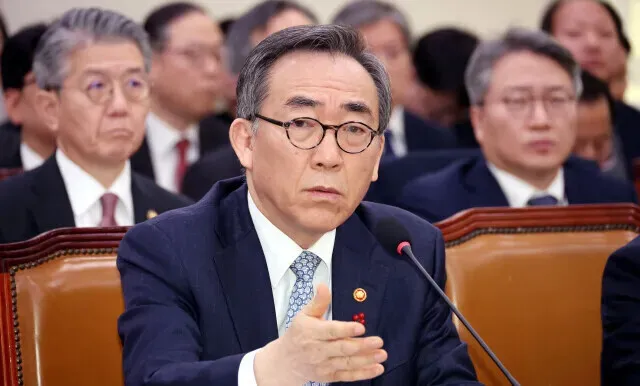
South Korean Minister of Foreign Affairs Cho Tae-yul is pursuing a visit to Washington, DC, next week to meet with US Secretary of State Marco Rubio. But no schedule has yet been finalized for the talks between the two countries’ top diplomats. The situation has fed growing fears that the vacuum in Seoul’s US diplomacy stemming from President Yoon Suk-yeol’s insurrection attempt on Dec. 3 may end up dragging into the long term.
Foreign affairs sources said Tuesday that continued efforts were being made to coordinate with the US on a plan for Cho to visit Washington next week for the first South Korea-US foreign minister talks under the second Donald Trump administration.
If Cho’s US visit is finalized, he may meet in Washington next week with figures including Rubio and US national security adviser Mike Waltz. But sources reported that no date had yet been nailed down.
The South Korean Ministry of Foreign Affairs had originally been pushing for Cho to visit the US as early as the recent extended Lunar New Year holiday in late January. But due to factors including Rubio’s scheduled visit to South America, the date for his visit has not yet been decided.
If a date cannot be scheduled next week, the first meeting between the South Korean minister of foreign affairs and the US secretary of state appears likely to take place at the Munich Security Conference, an annual international security forum that is being held this year from Feb. 14 to 16.
The situation is in stark contrast with Japan, which has been ramping up its diplomatic efforts with the US since Trump returned to office, including an agreement to hold a summit Friday between Trump and Japanese Prime Minister Shigeru Ishiba.
Meanwhile, Seoul has been unable to finalize a schedule even for a telephone conversation between Trump and acting President Choi Sang-mok. The lack of diplomatic contact between heads of state stands out even in comparison with the situation in 2017, when Hwang Kyo-ahn — who was serving as acting president after Park Geun-hye’s impeachment — did not speak with Trump by telephone until Jan. 30, some 10 days after the latter had been inaugurated.
Concerns about the paralysis of South Korea’s diplomatic activities have been mounting as the international order has been rocked by the second Trump administration’s initiation of a trade war upon taking office.
Trump fired the opening salvo by pressuring Canada, Mexico and China with planned tariffs in the range of 10%-25%, although the tariffs for Mexico and Canada have been postponed for a month after the countries pledged to step up policing of illegal immigration and narcotics.
In light of South Korea’s large trade surplus with the US, it has been talked about as a potential next target for Trump, which places it in a position where it needs to articulate its position to Washington and develop response measures.
On Tuesday morning, Choi spoke about the situation at a sixth roundtable on overseas economic issues that was held at the central government complex in Seoul with Cho and Minister of the Office of Government Policy Coordination Bang Ki-sun in attendance, among others.
“While the tariff measures against Mexico and Canada have been deferred for one month, the institution of tariffs and the responses of different countries could lead to growing uncertainty for South Korean exports and its entire economy, and we cannot rule out the possibility of US tariff measures being expanded in the future,” he commented.
The administration called for a systematic response considering every available means of minimizing the potential negative impact on the South Korean economy.
North Korea policy is another area that requires close coordination between South Korea and the US.
Trump’s remarks referring to North Korea as a “nuclear power” have been interpreted by some analysts as a signal that he is willing to begin negotiations without denuclearization as an explicit presumption.
For now, leader Kim Jong-un continues emphasizing his commitment to beefing up North Korea’s nuclear armament as the two sides continue feeling each other out.
Brian Hughes, the spokesperson for the White House National Security Council, announced that Trump would pursue the “complete denuclearization of North Korea,” but many still see it as likely that Trump could pursue a smaller scale deal, such as one involving nuclear disarmament or a nuclear freeze, to get North Korea to the negotiation table. Against this backdrop, it is expected that measures to ensure that Seoul’s position is reflected in Washington’s policy on Pyongyang, including any US-North Korea negotiations, will be a major agenda item when the top diplomats of the US and South Korea meet in the coming weeks.
By Park Min-hee, senior staff writer
Please direct questions or comments to [english@hani.co.kr]

Editorial・opinion
![[Editorial] Seoul mayor risks losing office, but he’s already lost voters’ trust](https://flexible.img.hani.co.kr/flexible/normal/500/300/imgdb/original/2026/0723/2217847949281733.jpg "[Editorial] Seoul mayor risks losing office, but he’s already lost voters’ trust") [Editorial] Seoul mayor risks losing office, but he’s already lost voters’ trust
[Editorial] Seoul mayor risks losing office, but he’s already lost voters’ trust![[Column] Korea’s brave new world: Tanking employment and soaring home prices](https://flexible.img.hani.co.kr/flexible/normal/500/300/imgdb/original/2026/0723/1917847946266774.jpg "[Column] Korea’s brave new world: Tanking employment and soaring home prices") [Column] Korea’s brave new world: Tanking employment and soaring home prices
[Column] Korea’s brave new world: Tanking employment and soaring home prices- [Editorial] Korean Peninsula once again becomes the front line of a geopolitical rivalry
- [Editorial] Regulatory action needed after another preventable warehouse fire
- [Column] Seeking the Korean soldiers who showed mercy during Vietnam massacres
- [Reporter’s notebook] Trump’s White House windfall
- [Column] Will Lee’s NATO partnership end differently than Yoon’s support for Ukraine?
- [Editorial] For Korea’s disputes with the US, the only way out is through
- [Column] Trump’s war at home
- [Column] Another sign of an empire in decline
Most viewed articles
- 1[News analysis] Trump’s nuclear carrot for Saudis could further destabilize Mideast
- 2Peace, not denuclearization, now South Korea’s priority in policy toward North
- 3[Column] Trump’s war at home
- 4[Column] Korea’s brave new world: Tanking employment and soaring home prices
- 5SK Chairman and Roh tae-woo’s daughter expected to divorce
- 6Real-life heroes of “A Taxi Driver” pass away without having reunited
- 7A whole new China-North Korea alliance is taking shape, report argues
- 8Test-obsessed Korea reckons with smart glasses-powered cheating
- 9New MASGA hub marks next phase of Korea-US shipbuilding partnership
- 10After Iran war, North Korea’s nukes are an asset, not a burden, for China, says expert