hankyoreh
Links to other country sites 다른 나라 사이트 링크
Trump plays up ceasefire talks while Iran responds with distrust
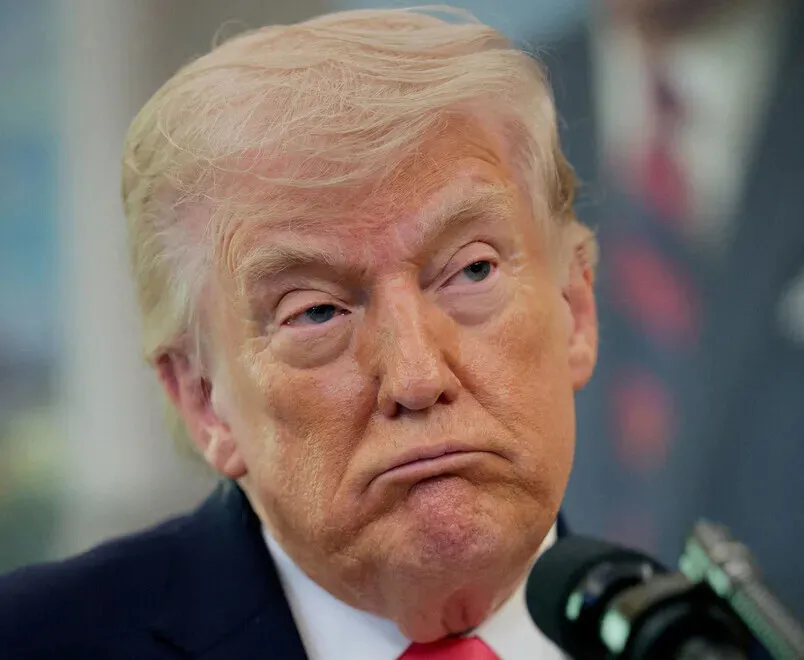
US President Donald Trump said the US received a “very big present” related to oil and gas from Iran, which he rated as a signal of its genuineness as a negotiation partner. But despite his optimistic pronouncement, observers said the likelihood of actual negotiations appeared limited, due to the large remaining differences in views between the two sides.
While intermediaries like Turkey, Egypt and Pakistan had been pursuing senior-level talks between the US and Iran in the coming days, Tehran had merely alluded to the possibility of dialogue without stating an official position.
Speaking at a White House ceremony on Tuesday to swear Markwayne Mullin in as the new secretary of homeland security, Trump said that Iran “gave [the US] a present, and the present arrived today.”
“And it was a very big present, worth a tremendous amount of money,” he continued.
Explaining that the gift in question “wasn’t nuclear-related” but rather “oil- and gas-related,” he explained that it had to do with the flow in the Strait of Hormuz, which is a key corridor for crude oil transportation.
The question of whether negotiations will come to pass remains uncertain. The Wall Street Journal reported that the US and intermediaries were waiting for a final response from Iran to hold the summit, but that Iran had put off giving a definite answer.
In a statement the same day, the Iranian ambassador to South Korea said that reports of ceasefire negotiations were “not true” and that there had “not been any negotiation or dialogue with the US in the 24 days since this war began.”
Ahead of the negotiations, Trump reportedly handed Iran a list of 15 demands for an end to the war. According to sources, these included a ban on uranium enrichment, abandonment of the stockpiling of highly enriched uranium, dismantling nuclear facilities, allowing UN inspections, reducing aid to proxies, and guaranteeing free passage through the Strait of Hormuz.
In a report on Wednesday, the Associated Press quoted officials in Pakistan as saying that Iran had received the 15-point list of demands from the US.
With no official position forthcoming from Tehran over the negotiations, analysts suggested it may be deliberately putting them off.
The BBC quoted Danny Citrinowicz of the Tel Aviv University-affiliated Institute for National Security Studies as saying, “From the Iranian side, they’re winning, not losing.”
“They control the bottleneck of the international economy — the Strait of Hormuz, one of the world's busiest oil routes — and they feel they have the upper hand in negotiations,” he concluded.
Distrust has also been named as an obstacle to negotiations. Iran has expressed distrust of the US, commenting that it was hit with strikes in June 2025 and February 2026 while it was engaging in diplomatic contacts with the administration in Washington.
Iran also sent letters to International Maritime Organization member countries in which it stated that it would permit passage by vessels from “non-hostile” states. This message appeared to signal that its control over the Strait of Hormuz remained firm despite US pressure and that the states in question should not side with Washington.
By Kim Won-chul, Washington correspondent
Please direct questions or comments to [english@hani.co.kr]

Editorial・opinion
![[Correspondent’s column] The new generation of ‘sewer socialists’ are in it to win it](https://flexible.img.hani.co.kr/flexible/normal/500/300/imgdb/original/2026/0626/8217824618600972.jpg "[Correspondent’s column] The new generation of ‘sewer socialists’ are in it to win it") [Correspondent’s column] The new generation of ‘sewer socialists’ are in it to win it
[Correspondent’s column] The new generation of ‘sewer socialists’ are in it to win it![[Editorial] Who benefits from tug-of-war over jurisdiction in the DMZ?](https://flexible.img.hani.co.kr/flexible/normal/500/300/imgdb/original/2026/0625/4817823767123335.jpg "[Editorial] Who benefits from tug-of-war over jurisdiction in the DMZ?") [Editorial] Who benefits from tug-of-war over jurisdiction in the DMZ?
[Editorial] Who benefits from tug-of-war over jurisdiction in the DMZ?- [Column] Inequality in Korea hits high not seen since colonial era
- [Editorial] Unity doesn’t mean embracing defenders of insurrection
- [Editorial] Stiff sentence for ex-justice minister shows abetting insurrection won’t go unpunished
- [Column] Bridging the gap between pragmatic policies of North, South Korea
- The second China shock is here — and it’s bigger, broader and more global
- [Column] America declares its retreat from the Middle East
- [Column] North Korea’s economic boom
- [Editorial] Trump’s defeat in Iran raises stakes for Korea
Most viewed articles
- 1UN Command pulls rank, contradicts Seoul on possible violation of armistice by North in DMZ
- 2[Column] Inequality in Korea hits high not seen since colonial era
- 3[Editorial] Unity doesn’t mean embracing defenders of insurrection
- 4[Exclusive] US Congress calls for review of CCP’s ‘malign influence’ in South Korea
- 5[World Cup] Frustrating defeat to South Africa leaves Korea’s fate up in the air
- 6The AI boom is making Taiwan rich. So why do its people feel poor?
- 7The future of work and learning in the AI era depends on human choices
- 8Shincheonji leader detained for alleged plot to have followers join PPP in droves
- 9[Editorial] Who benefits from tug-of-war over jurisdiction in the DMZ?
- 10Korean firms join forces with Nvidia for massive AI infrastructure build-out