hankyoreh
Links to other country sites 다른 나라 사이트 링크
US spearheads critical minerals trade bloc to check China’s dominance
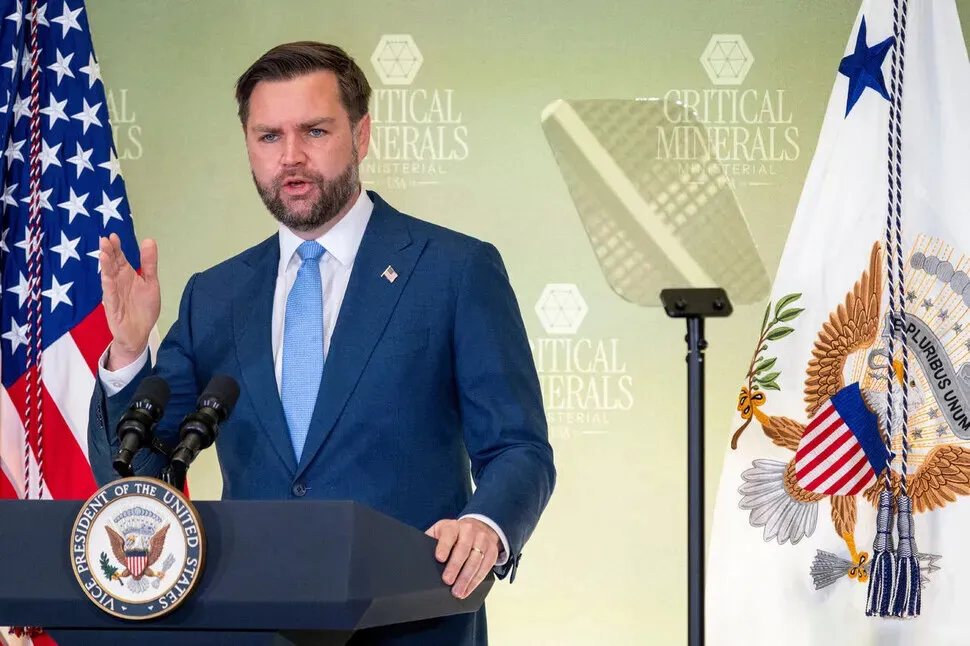
The US has unveiled plans to form a trade bloc aimed at breaking China’s stranglehold on the global critical minerals supply chain. By setting a limit on how low prices can go among deals with allied nations, utilized in parallel with tariffs, the proposed US-led bloc is designed to protect supply chains from cheap Chinese products flooding the market.
The formation of the bloc comes in response to China’s overt weaponization of key industrial resources last year, when it levied export controls on rare earth minerals.
In addition, the US State Department announced that South Korea, the current chair nation of the Minerals Security Partnership, will chair the Forum on Resource Geostrategic Engagement (FORGE) until June of this year. The forum will be the successor to the minerals partnership.
“I think a lot of us have learned the hard way, in some ways, over the last year how much our economies depend on these critical minerals,” US Vice President JD Vance during a ministerial meeting on critical minerals held the State Department on Wednesday, going on to formally state Washington’s plans to create a critical minerals trade bloc among America’s allies and partners.
Present at the meeting were representatives of 54 countries, including Australia, India, and Japan, as well as countries in Europe, Asia, Africa, and South and Central American countries, and the European Commission. Also present was South Korean Foreign Minister Cho Hyun.
“Now, we know that today, the international market for critical minerals is failing,” Vance said.
“It’s failing to create domestic markets or dignified jobs for our labor forces, and it’s failing to keep our nations safe. Supply chains remain brittle and exceptionally concentrated. Asset and commodity prices are persistently depressed, driven downward by forces beyond any individual country’s control,” he said.
As for the key mechanism behind the trade bloc, Vance described “reference prices for critical minerals at each stage of production” that will be “maintained through adjustable tariffs to uphold pricing integrity.”
Vance described a “pricing that reflects real-world, fair-market value” and stressed the need to “create alternative sources of supply and to protect every single stage of production — from mining to refining and processing to manufacturing, all of these things — protecting them from non-market disruption.”
The vice president said that US allies and partners within the trading bloc will receive “immediate and durable” benefits, noting, “Regardless of how much material flows into the global market, prices within the preferential trade zone will remain consistent.”
“We’re all on the same team; we’re all rowing in the same direction,” Vance declared.
“Together, we want members [of the preferential trade zone for critical minerals] to form a trading bloc among allies and partners, one that guarantees American access to American industrial might, while also expanding production across the entire zone,” he said.
At a press conference immediately following the meeting, Secretary of State Marco Rubio said, “We have 55 partners that we’re hoping to enter into collaboration with; many have already signed on.”
China was quick to issue a response on the new critical minerals trade bloc.
“China opposes any country setting up exclusive blocs to disrupt international economic and trade order,” Foreign Ministry spokesperson Lin Jian said Thursday. “All parties have the responsibility to play a constructive role in keeping the global industrial and supply chains on critical minerals stable and secure.”
By Kim Won-chul, Washington correspondent
Please direct questions or comments to [english@hani.co.kr]

Editorial・opinion
![[Editorial] Trump’s baseless claim that Iran bombed girls’ school crosses line](https://flexible.img.hani.co.kr/flexible/normal/500/300/imgdb/original/2026/0309/4217730446901883.jpg "[Editorial] Trump’s baseless claim that Iran bombed girls’ school crosses line") [Editorial] Trump’s baseless claim that Iran bombed girls’ school crosses line
[Editorial] Trump’s baseless claim that Iran bombed girls’ school crosses line![[Correspondent’s column] JD Vance’s 67-hour disappearance](https://flexible.img.hani.co.kr/flexible/normal/500/300/imgdb/original/2026/0306/2517727866984907.jpg "[Correspondent’s column] JD Vance’s 67-hour disappearance") [Correspondent’s column] JD Vance’s 67-hour disappearance
[Correspondent’s column] JD Vance’s 67-hour disappearance- [Column] Withstanding Trump’s predatory hegemony
- [Editorial] US dragging Kurds into its war with Iran would be a disaster
- [Column] US allies in the Gulf are in flames. Can Korea avoid a similar fate?
- [Editorial] North Korea’s tough talk mustn’t deter Seoul’s efforts to rebuild trust
- [Editorial] Attack on Iranian girls’ school is an indefensible crime against humanity
- [Editorial] Trump’s unjustified war with Iran threatens chaos for us all
- [Column] What a Korean man’s foiled plan to seek assisted death in Switzerland reveals
- [Column] This is what accountability looks like
Most viewed articles
- 1Korea named as target of new Section 301 probe by US
- 2‘Made in USA’: Scraps of missile that killed Iranian children point to US responsibility
- 3[Editorial] No greater sign that South Korea must prioritize building its own defense abilities
- 4US may seek exit from Iran war by moving the goalposts of victory
- 5US Democrats say Trump’s investment pressure has ‘deeply unsettled’ alliance with Seoul
- 6[Column] Misconceptions about America’s war with Iran
- 765% of Korean men say gender equality has gone ‘far enough’; only 42% of women agree
- 8How much is the US willing to risk for the Strait of Hormuz?
- 9Coupang investors insinuate that US is planning Section 301 probe into Korea
- 10[News analysis] Air defense pullout signals new era of US strategic flexibility in Korea