hankyoreh
Links to other country sites 다른 나라 사이트 링크
South Korea signs on to US-led ‘Pax Silica’ pact for AI supply chain cooperation
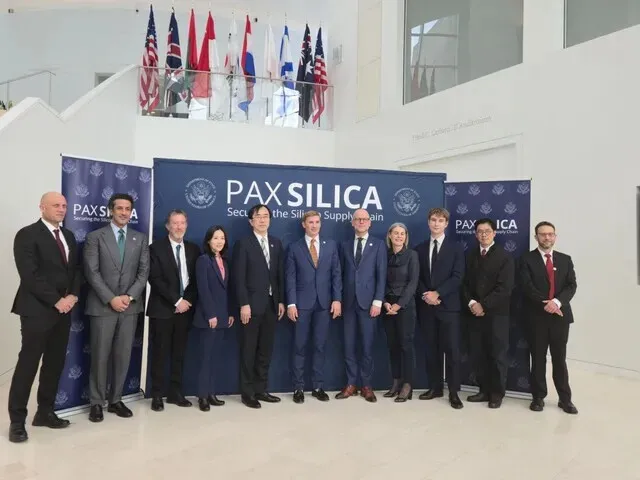
The United States on Friday launched its “Pax Silica” initiative for artificial intelligence supply chain cooperation, with nine countries participating, including South Korea and Japan.
With China having established powerful controls over key supply chains in rare-earth elements and other areas, the US has taken action to rally major allies to establish an AI supply chain ecosystem under its own leadership.
On Friday, the US State Department held an inaugural Pax Silica summit in Washington, DC, with representatives of South Korea, Japan, Singapore, the Netherlands, the UK, Israel, the United Arab Emirates and Australia.
Seven of the participating countries — not including the UAE and Netherlands — signed a declaration representing the points of agreement from their summit. The name “Pax Silica” combines the Latin word “pax,” meaning “peace,” and “silica,” a key material in semiconductors.
According to the declaration text shared by the South Korean Ministry of Foreign Affairs on Saturday, the participating countries stated that they “recognize that a reliable supply chain is indispensable to our mutual economic security.”
“We encourage efforts to partner on strategic stacks of the global technology supply chain,” they also said. As areas for stronger collaboration, the document mentioned software applications and platforms, data infrastructure, semiconductors, mineral refining and processing, and energy.
The declaration also emphasized the importance of establishing a fair market order.
“We believe that true economic security requires reducing excessive dependencies and forging new connections with reliable partners and suppliers committed to fair market practices,” it read.
The declaration further stated that the participating countries “understand the importance of addressing non-market practices that undermine innovation and fair competition” and “believe that coordination is essential to protect private investment from the market distortions of overcapacity and unfair dumping practices.”
While the document did not mention China directly, the references to “non-market practices,” “overcapacity,” and “unfair dumping practices” were understood as effectively meant to place curbs on Beijing.
The declaration also said the countries sought to “build and deploy trusted information networks, including information and communication technology systems, fiberoptic cables, and data centers.”
The summit was presided over by Jacob Helberg, who serves as the US undersecretary of state for economic growth, energy, and the environment. Helberg characterized the Pax Silica summit as a new partnership where countries with the world’s most advanced technology could come together to discuss ideas for achieving stronger economic security. He also proposed that countries with similar positions leverage their capabilities to work toward building a reliable cooperation network across all areas of the high-tech industry value chain, including AI and semiconductors.
South Korea’s senior representative at the summit was Kim Jin-a, the second vice minister of foreign affairs, who stated a commitment to contributing to supply chain stability based on the capabilities of South Korean businesses whose strengths lie in areas such as batteries, semiconductors, and energy. The ministry further quoted Kim as emphasizing the need for cooperation to ensure that the initiative endeavors to create favorable environments for companies in the participating countries.
Going forward, the participating countries plan to establish working groups in subareas to coordinate on concrete tasks for cooperation. Seoul plans to take part in follow-up discussions toward achievements in areas such as joint investment, research, and workforce exchange that take advantage of South Korean companies’ strengths.
But the possibility remains that participating countries could differ in their position on Washington’s strategic aim of reining in Beijing. Some have voiced concerns that they could face a growing burden if the US demands they take part in more aggressive policies that target China directly, including export controls.
By Park Min-hee, senior staff writer
Please direct questions or comments to [english@hani.co.kr]

Editorial・opinion
![[Editorial] Trump’s baseless claim that Iran bombed girls’ school crosses line](https://flexible.img.hani.co.kr/flexible/normal/500/300/imgdb/original/2026/0309/4217730446901883.jpg "[Editorial] Trump’s baseless claim that Iran bombed girls’ school crosses line") [Editorial] Trump’s baseless claim that Iran bombed girls’ school crosses line
[Editorial] Trump’s baseless claim that Iran bombed girls’ school crosses line![[Correspondent’s column] JD Vance’s 67-hour disappearance](https://flexible.img.hani.co.kr/flexible/normal/500/300/imgdb/original/2026/0306/2517727866984907.jpg "[Correspondent’s column] JD Vance’s 67-hour disappearance") [Correspondent’s column] JD Vance’s 67-hour disappearance
[Correspondent’s column] JD Vance’s 67-hour disappearance- [Column] Withstanding Trump’s predatory hegemony
- [Editorial] US dragging Kurds into its war with Iran would be a disaster
- [Column] US allies in the Gulf are in flames. Can Korea avoid a similar fate?
- [Editorial] North Korea’s tough talk mustn’t deter Seoul’s efforts to rebuild trust
- [Editorial] Attack on Iranian girls’ school is an indefensible crime against humanity
- [Editorial] Trump’s unjustified war with Iran threatens chaos for us all
- [Column] What a Korean man’s foiled plan to seek assisted death in Switzerland reveals
- [Column] This is what accountability looks like
Most viewed articles
- 1Korea named as target of new Section 301 probe by US
- 2‘Made in USA’: Scraps of missile that killed Iranian children point to US responsibility
- 3[Editorial] No greater sign that South Korea must prioritize building its own defense abilities
- 4US may seek exit from Iran war by moving the goalposts of victory
- 5US Democrats say Trump’s investment pressure has ‘deeply unsettled’ alliance with Seoul
- 6[Column] Misconceptions about America’s war with Iran
- 765% of Korean men say gender equality has gone ‘far enough’; only 42% of women agree
- 8How much is the US willing to risk for the Strait of Hormuz?
- 9Coupang investors insinuate that US is planning Section 301 probe into Korea
- 10[News analysis] Air defense pullout signals new era of US strategic flexibility in Korea