hankyoreh
Links to other country sites 다른 나라 사이트 링크
Japan’s incoming PM wants an Asian NATO, Japanese troops stationed in Guam
 Add as preferred source on Google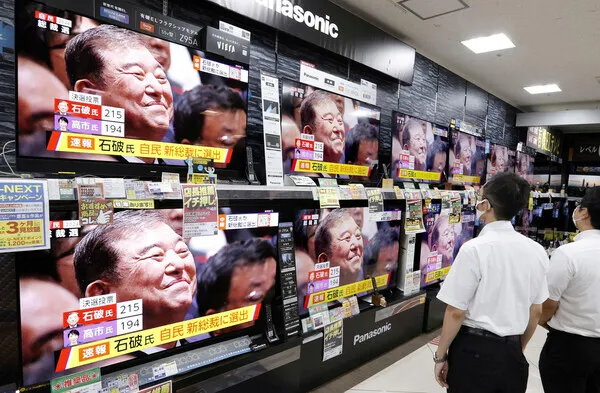
Shigeru Ishiba, the newly elected leader of Japan’s Liberal Democratic Party (LDP) who will step into the role of prime minister of Japan starting Tuesday, is calling for the establishment of an “Asian NATO” and to consider the sharing of US nuclear assets in the region. Ishiba has also argued that elevating the Japan-US alliance to the same level as the US-UK alliance would allow the stationing of Japan Self-Defense Forces on US territory, namely Guam.
On Friday (local time), the right-wing think tank Hudson Institute uploaded a translation of Ishiba’s take on the future of Japan’s foreign policy. In the piece, Ishiba claims that “the absence of a collective self-defense system like NATO in Asia means that wars are likely to break out because there is no obligation for mutual defense. Under these circumstances, the creation of an Asian version of NATO is essential to deter China by its Western allies.”
“Currently, in addition to the US-Japan alliance, Japan has quasi-alliance relationships with Canada, Australia, the Philippines, India, France, and the United Kingdom,” Ishiba wrote, while noting that Japan and the US are “deepening security cooperation with South Korea.”
“If these alliances are upgraded,” he argues, “a hub-and-spoke system, with the Japan-US alliance at its core, will be established, and in the future, it will be possible to develop the alliance into an Asian version of NATO.”
He emphasized the enactment of a basic law on national security, which has been discussed at length within the LDP, and the revision of Japan’s constitution, which limits the country’s military to self-defense, would provide a legal base for the establishment of such a security system.
Under the government of Shinzo Abe in 2014, Japan interpreted its constitution to allow for self-defense during a cabinet meeting. At the end of 2022, Prime Minister Fumio Kishida’s administration approved three national security documents allowing Japan’s acquisition of “counterstrike capabilities,” which alludes to the possibility of attacking enemy bases. However, such amendments are criticized as being at odds with the current Japanese constitution, leading the LDP to push for a revision to the document.
Ishiba also maintained that the Japan-US alliance should be revised to put the two countries on equal footing. The current Japan-US security treaty is structured around the US’ obligation to defend Japan while Japan is obligated to provide bases to the US. Ishiba says, “The time is ripe to change this ‘asymmetrical bilateral treaty.’”
“It is my mission to raise the Japan-US alliance to the level of the US-UK alliance,” he wrote, saying that he would make the US and Japan “equal partners,” and that conditions are ideal to “revise the Japan-US Security Treaty into a treaty between ‘ordinary countries.’”
A revision to the Japan-US Security Treaty and Status of Forces Agreement could “allow the Self-Defense Forces to be stationed in Guam to strengthen the deterrence capabilities of Japan and the US,” he added. He concluded his statement by writing, “Japan must have its own military strategy and become independent in terms of security until it is willing to share its own strategy and tactics on equal terms with the US.”
Japan’s Asahi Shimbun reported that Ishiba sent this response to the Hudson Institute’s Japan chair on Thursday, the day before being elected as the new leader of the LDP. While it seems that Ishiba did not make these calls while hoping to become the next prime minister of Japan, it demonstrates his usual rhetoric about Japan’s national security policy and strengthened independence.
During his campaign, Ishiba argued for a security regime where the US would share its nuclear weapons capacity with Japan.
Since Washington’s response to this argument has been lukewarm, many are saying this proposal is unlikely to go through. During a press briefing on Friday, Deputy Pentagon Press Secretary Sabrina Singh said, “We look forward to working with the new government [and] to further deepening our cooperation.” Singh did not specifically address any of Ishiba’s proposals.
The Mainichi Shimbun criticized Ishiba’s push for an Asian NATO.
“As the US and China continue to clash, how many nations can be expected to participate in an international organization that will intensify that clash?” the paper asked.
“Even the US seems to be of the position that it’s too early for an Asian equivalent to NATO,” the paper concluded.
By Hong Seock-jae, Tokyo correspondent
Please direct questions or comments to [english@hani.co.kr]

Editorial・opinion
![[Editorial] It’s time to pump the brakes on AI’s development](https://flexible.img.hani.co.kr/flexible/normal/500/300/imgdb/original/2026/0914/8517893740697601.jpg "[Editorial] It’s time to pump the brakes on AI’s development") [Editorial] It’s time to pump the brakes on AI’s development
[Editorial] It’s time to pump the brakes on AI’s development![[Guest essay] What North Korea’s learned from six months of the Iran war](https://flexible.img.hani.co.kr/flexible/normal/500/300/imgdb/original/2026/0914/2617893746751526.jpg "[Guest essay] What North Korea’s learned from six months of the Iran war") [Guest essay] What North Korea’s learned from six months of the Iran war
[Guest essay] What North Korea’s learned from six months of the Iran war- [Column] Sending troops to Hormuz is nothing like sending them to Iraq
- [Editorial] A deployment to Hormuz would be neither justified nor beneficial for Korea
- [Guest essay] The troubling video-gamification of the Korean War
- [Editorial] Now it’s the US’ turn to hold up its end of the bargain
- [Editorial] When it comes to troop deployments, too much caution is never enough
- [Column] A Trump-Kim summit may happen. A deal is another matter
- [Correspondent’s column] AOC’s star is rising — as are hopes for a different America
- [Column] A costly war and a debt crisis… is a ‘Trump shock’ on its way?
Most viewed articles
- 1[Guest essay] What North Korea’s learned from six months of the Iran war
- 2[Exclusive] Seoul will need 16% rate of return on US investments to recoup principal
- 3[Editorial] It’s time to pump the brakes on AI’s development
- 4‘Resounding victory’: Iran’s axis of resistance cuts off Saudi oil exports
- 5[Reporter’s notebook] Shincheonji’s appeal to young S. Koreans
- 6[Exclusive interview] Could Coupang be the first case handled by KFTC’s new ‘grim reaper’ team?
- 7K-12 suicides in South Korea hit record high last year
- 8Three firms dominate the memory market. Is CXMT about to change that?
- 9Yong Hye-in becomes Lee administration’s 4th Cabinet pick to withdraw from consideration
- 10[Column] Sending troops to Hormuz is nothing like sending them to Iraq