hankyoreh
Links to other country sites 다른 나라 사이트 링크
[Editorial] Asia Future Forum brings bright minds together to envision democracy’s future
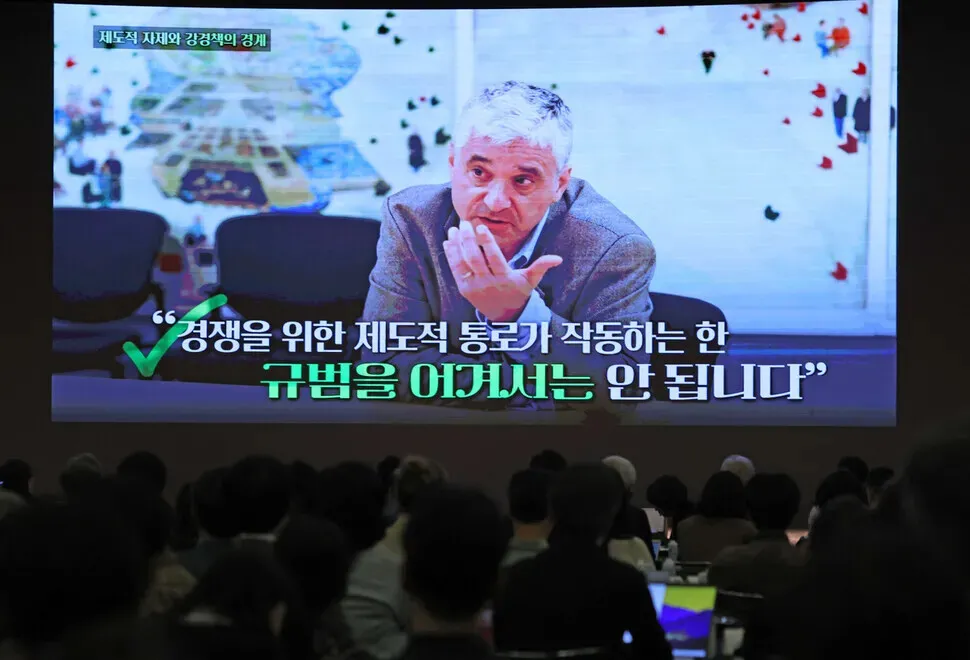
After martial law was declared on Dec. 3, 2024, many Koreans likely could not shake the feeling that their democracy was far more fragile than they would have ever thought.
Martial law was lifted through the power of ordinary Koreans and the National Assembly, and we managed to protect our democracy by impeaching the leader of the insurrection who attempted to dismantle our democratic constitution. However, dangers to democracy still lurk in the shadows.
As political polarization grows worse with each passing day, far-right forces fueling radical hate have infiltrated South Korea’s biggest opposition party, which staunchly opposed Yoon’s impeachment. The far right’s influence in politics is exacerbating political conflict. It now falls to us to firmly uphold and fortify democracy so that extremist forces can never again threaten our community.
The 16th Asia Future Forum, hosted by the Hankyoreh Media Group on Thursday, provided a platform for participants to brainstorm and discuss methods to address the pressing issues related to the future of our democracies.
Steven Levitsky, a professor of political science at Harvard University known for his monumental work in democracy studies with the book “How Democracies Die,” stated, “Democracies can’t defend themselves. Constitutions are just pieces of paper that have to be made to work by people,” emphasizing that democracy grows stronger when the nation, politicians and civic society strive to fulfil their given roles.
In “How Democracies Die,” Levitsky identified mutual toleration and institutional forbearance as the two key norms in a democracy. In Thursday’s lecture, he proposed three solutions to protect democracy against palpable dangers such as coup d'états. While he lauded South Korea for quashing former President Yoon Suk-yeol’s self-coup as being a successful example of militant democracy, he also quipped, “The key is learning from the crisis, being able to step back and develop a new way of doing politics. I am less sure that’s happened, at least yet in South Korea.” The comment highlights how South Korean society ought to strive to ensure that democratic norms and approaches, such as the importance of dialogue, compromise and willingness to concede defeat, take root.
Daniel Markovits, a professor of law at Yale Law School and author of “The Meritocracy Trap,” warned that the dogma of meritocracy would further fuel inequality and extremism and push democracy to the brink of collapse. This argument is one we should take to heart in Korea, where the dream of pulling oneself up by one’s bootstraps is less feasible by the day.
South Korean President Lee Jae Myung stated during his congratulatory address that an “‘expanded democracy,’ based on compassion and trust and in which people participate enthusiastically, knowing that their voices will be heard, is the solution to conflict and divisions within our society.” The future of democracy can shine brightly when the nation, politicians and ordinary people become aware of their roles and strive to fulfill them.
Please direct questions or comments to [english@hani.co.kr]

Asia Future Forum
Article 16Editorial・opinion
![[Column] Even after Trump’s gone, the good old days aren’t coming back](https://flexible.img.hani.co.kr/flexible/normal/500/300/imgdb/original/2026/0319/7017739093246651.jpg "[Column] Even after Trump’s gone, the good old days aren’t coming back") [Column] Even after Trump’s gone, the good old days aren’t coming back
[Column] Even after Trump’s gone, the good old days aren’t coming back![[Editorial] Korea must rally nations to unite against Trump’s bullying](https://flexible.img.hani.co.kr/flexible/normal/500/300/imgdb/original/2026/0318/5317738209168584.jpg "[Editorial] Korea must rally nations to unite against Trump’s bullying") [Editorial] Korea must rally nations to unite against Trump’s bullying
[Editorial] Korea must rally nations to unite against Trump’s bullying- [Editorial] Korea must say no to sending soldiers into Trump’s war
- [Column] What do norms mean in times of war?
- [Column] The megalomanic dictator with tariffs in one hand, missiles in the other
- [Editorial] Korea can’t let US trade probes strong-arm it into concessions
- [Editorial] Trump’s baseless claim that Iran bombed girls’ school crosses line
- [Correspondent’s column] JD Vance’s 67-hour disappearance
- [Column] Withstanding Trump’s predatory hegemony
- [Editorial] US dragging Kurds into its war with Iran would be a disaster
Most viewed articles
- 1‘Golden’ acceptance speech interruption draws criticism over ‘disrespect’ at Oscars
- 2Former bodyguard’s dark tale of marriage to Samsung royalty
- 3[Column] Even after Trump’s gone, the good old days aren’t coming back
- 4Is Trump trying to use reverse psychology to get allies to support Iran war?
- 5Trump adviser causes stir by suggesting Israel might nuke Iran
- 6[Editorial] Korea must rally nations to unite against Trump’s bullying
- 7All study and no play makes Korean teens less physically active than their grandparents
- 8Energy facilities become latest targets in intensifying Middle East war
- 9BTS taps into history of ‘Arirang’ in teaser for new album
- 10Trump inflates USFK numbers, pressures Seoul to ‘defend’ US in Strait of Hormuz