hankyoreh
Links to other country sites 다른 나라 사이트 링크
Korean stock market course corrects amid heightened external uncertainties
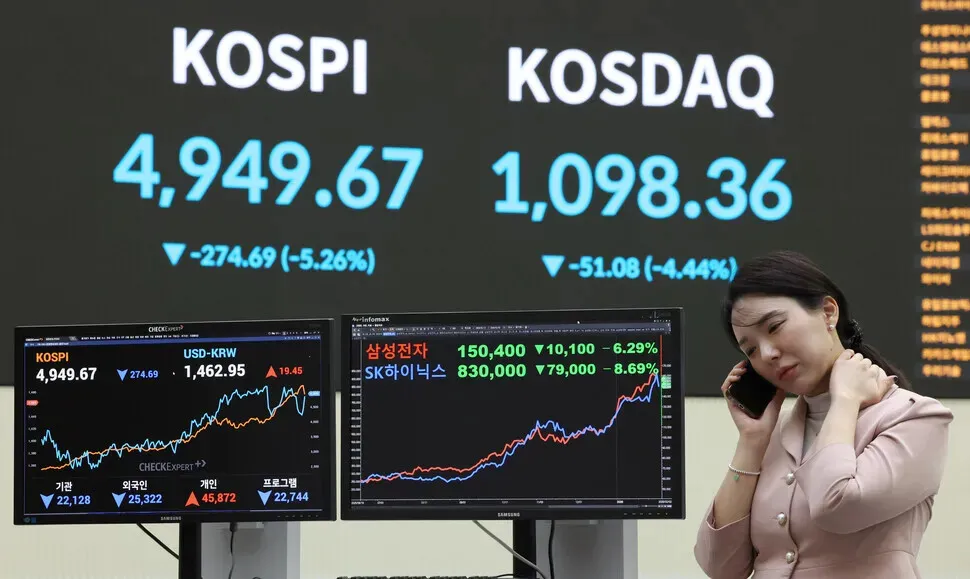
Markets reacted to US President Donald Trump’s nomination of Kevin Warsh to become the next chair of the Federal Reserve with volatility, sending Korean stocks and the won tumbling as asset markets across the world experienced turbulence on Monday.
Increased skepticism surrounding artificial intelligence wiped out short-lived gains in the domestic stock market, driven primarily by chipmakers.
On Monday, shares listed on the KOSPI Market dipped 5.26%, the largest decrease amid all stock markets in Asia.
Japan’s Nikkei slipped 1.25%; China’s Shanghai Composite dipped 2.48%; Hong Kong’s Hang Seng diminished by 2.32%; and Taiwan’s Taiex went down by 1.37%. In short, losses in the Korean market were much greater.
As risk-averse investors dumped their shares, some analysts have suggested that the domestic stock market saw the biggest dive in part because it had seen the biggest surge. In other words, the market correction was felt to a greater degree in Korea precisely because fears of an AI bubble resurfaced amid a historic surge of its stock market in recent weeks, led primarily by chipmakers.
A drop in the value of futures traded on the Nasdaq amplified the KOSPI’s tumble. The trading price of the Nasdaq 100 Futures (for March 2026) as of 3 pm on Feb. 3 fell 1.6% compared to the previous trading day.
Foreigners sold off 2.5 trillion won (US$1.73 billion) in domestic shares on the KOSPI market on this day, in what some see as a desperation to cut losses. Foreign investors also dumped over 1.5 trillion won in KOSPI 200 Futures (US$1.04 billion) on the same day. Some analysts say that amid drops in gold and silver that put investors at risk of a margin call (forced liquidation or injection of additional funds), foreign investment firms that had raked in Asian stocks at a relatively lower price dumped relevant shares to generate urgently needed cash.
Samsung Securities projected that “while the stock market may see corrections following the recent short-term increases, it is still stable in terms of valuation,” adding that “excessive concerns will gradually subside.”
External risks are expected to weigh on the market for the time being, with Trump’s Fed chair nomination only adding to tariff headaches.
Markets seemed to dial in on Warsh’s hawkish nature and preference for austerity measures — a contrast to Trump, who has called for lowering interest rates. Financial market positions that have bet on lower interest rates and a weakening dollar are exhibiting a major U-turn at the moment.
Gold and silver, considered safe assets, and crypto, often viewed as an alternative to the US dollar, both exhibited historic downturns. On Jan. 30, the international price of gold slipped 9.8%; the price of silver plummeted by 27.7%, and Bitcoin fell below US$80,000.
Some analysts are focusing on Warsh’s background and his recent changes in his positions. Since the beginning of Trump’s second term, Warsh has called for lower interest rates. He said that the current interest rate is too restrictive and called for it to be lowered. Warsh also argued that the impact of tariffs on inflation is ephemeral, aligning with the Trump administration’s position.
Warsh’s key argument is that lower interest rates must be accompanied by quantitative tightening, meaning the Fed should reduce liquidity by shrinking its balance sheet.
Morgan Stanley stated that while it is true that Warsh is less of a “quantitative easing” guy than the market expected, his recent remarks about lowering interest rates seem to indicate that he will work to lower rates ahead of the US midterm elections in November.
If this so-called “Warsh effect” is amplified while the US maintains high interest rates amid the continued strength of the dollar, it could weigh heavily on Korea.
If uncertainty concerning monetary policy and volatility in the forex market both worsen, this may lead to more pressure that drives up the prices of consumer goods and the won-dollar exchange rate.
“Warsh is mildly dovish and understands the dangers of austerity and easing,” assessed Cho Byung-hyun, a strategist at Daol Securities. “At the very least, there seems to be no need to be concerned about higher interest rates and dramatically hawkish stances.”
By Kim Hoe-seung, senior staff writer; Kim Won-chul, Washington correspondent
Please direct questions or comments to [english@hani.co.kr]

Editorial・opinion
![[Editorial] Trump’s baseless claim that Iran bombed girls’ school crosses line](https://flexible.img.hani.co.kr/flexible/normal/500/300/imgdb/original/2026/0309/4217730446901883.jpg "[Editorial] Trump’s baseless claim that Iran bombed girls’ school crosses line") [Editorial] Trump’s baseless claim that Iran bombed girls’ school crosses line
[Editorial] Trump’s baseless claim that Iran bombed girls’ school crosses line![[Correspondent’s column] JD Vance’s 67-hour disappearance](https://flexible.img.hani.co.kr/flexible/normal/500/300/imgdb/original/2026/0306/2517727866984907.jpg "[Correspondent’s column] JD Vance’s 67-hour disappearance") [Correspondent’s column] JD Vance’s 67-hour disappearance
[Correspondent’s column] JD Vance’s 67-hour disappearance- [Column] Withstanding Trump’s predatory hegemony
- [Editorial] US dragging Kurds into its war with Iran would be a disaster
- [Column] US allies in the Gulf are in flames. Can Korea avoid a similar fate?
- [Editorial] North Korea’s tough talk mustn’t deter Seoul’s efforts to rebuild trust
- [Editorial] Attack on Iranian girls’ school is an indefensible crime against humanity
- [Editorial] Trump’s unjustified war with Iran threatens chaos for us all
- [Column] What a Korean man’s foiled plan to seek assisted death in Switzerland reveals
- [Column] This is what accountability looks like
Most viewed articles
- 1Korea named as target of new Section 301 probe by US
- 2‘Made in USA’: Scraps of missile that killed Iranian children point to US responsibility
- 3[Editorial] No greater sign that South Korea must prioritize building its own defense abilities
- 4US may seek exit from Iran war by moving the goalposts of victory
- 5US Democrats say Trump’s investment pressure has ‘deeply unsettled’ alliance with Seoul
- 6[Column] Misconceptions about America’s war with Iran
- 765% of Korean men say gender equality has gone ‘far enough’; only 42% of women agree
- 8How much is the US willing to risk for the Strait of Hormuz?
- 9Coupang investors insinuate that US is planning Section 301 probe into Korea
- 10[News analysis] Air defense pullout signals new era of US strategic flexibility in Korea