hankyoreh
Links to other country sites 다른 나라 사이트 링크
[Column] The K-shaped cloud hanging over Korea’s economy

By Ahn Seon-hee, editorial writer
South Korea’s benchmark KOSPI index surpassed 5,000 for the first time in history on Jan. 22. Compared to the economic situation just a year ago, when an unexpected attempt at a self-coup had everything feeling like it was on the brink of collapse, it feels like a different world.
Consumer confidence was frozen, financial markets were unstable, and export prospects were also foggy. Fortunately, things stabilized as the new administration took office; the KOSPI, in particular, has risen at a dizzying pace.
The country’s economic growth rate was a mere 1% last year; this year it’s expected to be around 2%. Those aren’t the most favorable of figures, but potential growth rates are recovering. The major crisis is behind us, and we can breathe a brief sigh of relief. But we now find ourselves confronting a new challenge: the so-called K-shaped recovery model.
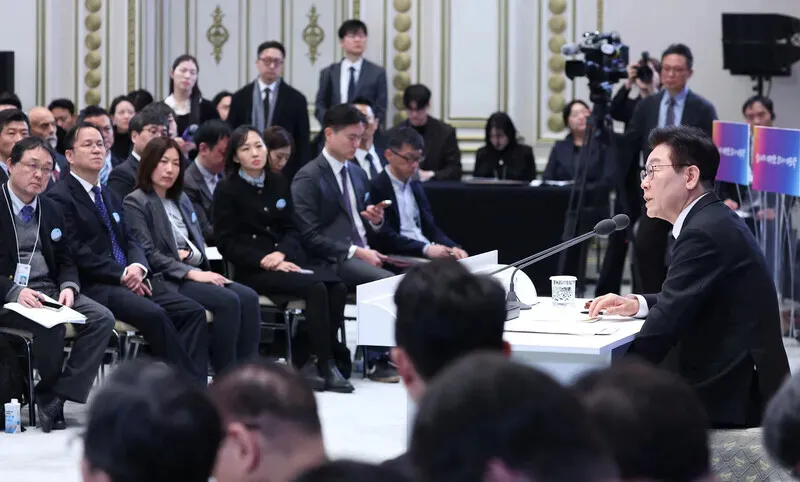
“We are now facing the grave challenge of ‘K-shaped’ growth,’” President Lee Jae Myung said on Jan. 9. During his New Year’s press conference on Jan. 21, Lee vowed to “overcome the challenge of K-shaped growth.”
Addressing this growing polarization of the economy is likely to be the government’s primary concern this year. Bank of Korea Governor Rhee Chang-yong said that the country’s economy is likely to make a K-shaped recovery this year, expressing his concerns about “the difficulty of achieving sustainable and complete recovery.”
Language regarding a K-shaped recovery started appearing in earnest during the COVID-19 pandemic. The shock produced by the pandemic drove down economic growth to -0.7%, which rebounded to 4.6% in 2021, drawing what many viewed as a “V-shaped” recovery.
However, upon closer inspection, the shape is actually closer to a “K,” with one arm angling upwards and other downwards — a type of recovery that exhibits a widening disparity.
While firms tied to the digital realm — online platforms, e-commerce and semiconductors — have profited immensely, business owners tied to retail and the food and beverage industry are shutting down or scraping by through debt. The divide between financial markets and the real economy has widened. Despite negative growth, the KOSPI has hit an all-time high, and real-estate prices are soaring to such heights that they are shaking the public’s faith in the administration.
The main leader of the upward-reaching arm of our K-shaped economy is obviously chipmakers. Starting in the latter half of last year, the artificial intelligence boom has ushered in a super cycle for semiconductors. The economy’s dependence on chipmakers is nothing new, and has produced rumblings about a “chip illusion” or bubble. Yet the proportion of exports that chips comprise rose to 24.4% last year — a record high — and has continued to rise 29.5% so far this year (Jan. 1-20).
When excluding chips, South Korea’s net exports last year actually diminished compared to the previous year — particularly in petrochemicals, rechargeable batteries, display technology, steel, and electronic appliances. In other words, the bulk of Korea’s industry. Domestic firms simply can’t compete with Chinese counterparts who offer the same products for cheaper. As of Jan. 22, Samsung Electronics and SK Hynix account for 35.4% of the KOSPI’s total market cap.
Korea is seeing a repeat of the juxtaposition of a chilly real economy and a steaming financial market. Last year, Seoul real estate prices reached the highest level since 2006, and we are now in the KOSPI 5,000 era. While one can’t definitively measure surging share prices according to the correlated rise of property values, both asset categories represent an increasingly expanding wealth disparity.
This K-shaped model of growth and recovery is, in other words, an exemplification of polarization, which is calcifying into a systemic problem in the Korean economy.
This perpetuating imbalance that favors certain industries will inevitably result in the expansion of inequality among the classes. There is a divide that separates exporters, major corporations, regular employees not beholden to short-term contracts, the Seoul metro area, and asset holders from domestic consumption, SMEs and small business owners, contracted employees, the economy outside of the Seoul metro, and people without assets. That divide is growing wider.
In his New Year’s address, the president said he would shift Korea’s growth strategy from one centered on big corporations to “growth that benefits all, in which opportunities and the fruits of growth are shared equitably.” He echoed that pledge during his New Year’s press conference when he vowed to transition to “growth shared by everyone.”
The “2026 Economic Growth Strategy” announced by the Lee administration on Jan. 9 also included “promoting balanced growth for all and addressing polarization” among its key objectives.
However, the majority of these pledges have been minimal or simple repetitions of previous policies, with little of note thus far. Lee identified the “massive task” of fostering the country’s startups and venture firms. True, such factors are essential in an innovative economy, but it is questionable whether they can lead to growth for everyone on their own.
There will be no overnight solutions for problems that have accumulated for a long time. Yet perhaps the answer is right under our noses. Industrial policies adjusted according to technological changes, the coexistence of conglomerates and SMEs, the resolution of discrimination between regular employees and contracted ones, stabilization of the property market, and increased redistribution through fair taxes and expanded welfare —these are the solutions already available.
What the Lee administration needs is the capacity to craft and fine-tune policies to such an end. He also needs a powerful will to walk the walk and to exhibit leadership that can get the public on board.
Please direct questions or comments to [english@hani.co.kr]

Editorial・opinion
![[Editorial] Trump’s baseless claim that Iran bombed girls’ school crosses line](https://flexible.img.hani.co.kr/flexible/normal/500/300/imgdb/original/2026/0309/4217730446901883.jpg "[Editorial] Trump’s baseless claim that Iran bombed girls’ school crosses line") [Editorial] Trump’s baseless claim that Iran bombed girls’ school crosses line
[Editorial] Trump’s baseless claim that Iran bombed girls’ school crosses line![[Correspondent’s column] JD Vance’s 67-hour disappearance](https://flexible.img.hani.co.kr/flexible/normal/500/300/imgdb/original/2026/0306/2517727866984907.jpg "[Correspondent’s column] JD Vance’s 67-hour disappearance") [Correspondent’s column] JD Vance’s 67-hour disappearance
[Correspondent’s column] JD Vance’s 67-hour disappearance- [Column] Withstanding Trump’s predatory hegemony
- [Editorial] US dragging Kurds into its war with Iran would be a disaster
- [Column] US allies in the Gulf are in flames. Can Korea avoid a similar fate?
- [Editorial] North Korea’s tough talk mustn’t deter Seoul’s efforts to rebuild trust
- [Editorial] Attack on Iranian girls’ school is an indefensible crime against humanity
- [Editorial] Trump’s unjustified war with Iran threatens chaos for us all
- [Column] What a Korean man’s foiled plan to seek assisted death in Switzerland reveals
- [Column] This is what accountability looks like
Most viewed articles
- 1Korea named as target of new Section 301 probe by US
- 2‘Made in USA’: Scraps of missile that killed Iranian children point to US responsibility
- 3[Editorial] No greater sign that South Korea must prioritize building its own defense abilities
- 4US may seek exit from Iran war by moving the goalposts of victory
- 5US Democrats say Trump’s investment pressure has ‘deeply unsettled’ alliance with Seoul
- 6[Column] Misconceptions about America’s war with Iran
- 765% of Korean men say gender equality has gone ‘far enough’; only 42% of women agree
- 8How much is the US willing to risk for the Strait of Hormuz?
- 9Coupang investors insinuate that US is planning Section 301 probe into Korea
- 10[News analysis] Air defense pullout signals new era of US strategic flexibility in Korea