hankyoreh
Links to other country sites 다른 나라 사이트 링크
Korea posts record $65.95 billion in exports in Sept. despite US tariff pressure
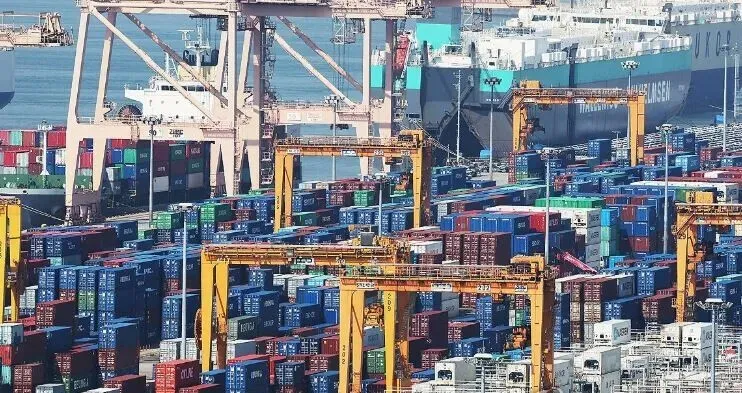
Despite the deadlock in Korea-US negotiations over reciprocal and sectoral tariffs, Korea posted its highest-ever export figures in September, thanks to a bull market in semiconductors and diversification of export markets. Some think the resilience of Korean exports might even give Korea some leverage in its negotiations with the US.
Korea’s Ministry of Trade, Industry and Energy said Wednesday that Korean exports in September were worth US$65.95 billion, up 12.7% year over year (YoY). That beat the previous record (US$63.48 billion), which was set three and a half years ago, in March 2022.
Korea imported US$56.4 billion of goods last month, for a YoY increase of 8.2%, resulting in a trade surplus of US$9.56 billion.
The export boom was driven by two key sectors: semiconductors and automobiles.
Chip exports set a new record of US$16.11 billion, up 22% from the previous year, as prices rose alongside demand for high-value-added products such as high-bandwidth memory (HBM) chips bound for AI servers.
Even as automobile exports to the US fell 2.3% because of the 25% sectoral tariffs, overall exports of both gas-powered cars and eco-friendly cars (including electric vehicles and hybrid vehicles) increased, hitting a total of US$6.4 billion (a 16.8% YoY increase).
Exports also rose in other major sectors, including shipping (21.9%), regular machinery (10.3%), biomedical and biotech (35.8%) and home appliances (12.3%). Steel (-4.2%) and petrochemicals (-2.8%) fell in value despite a rise in volume because of a supply glut. Another reason for the slump in steel exports was a 15% drop in exports to the US, which is currently imposing a 50% tariff on those products.
Thanks to strong performance in September, exports for the third quarter (July-September) stood at US$185.03 billion, another all-time record. September also represented the fourth month in a row that exports have risen in value.
While strong market conditions, including the semiconductor boom, are one of the main reasons Korean exports reached a new high despite the obstacles to US exports erected by the “tariffs war,” another major factor is the diversification of export markets.
In September, exports rose in eight of Korea’s nine biggest markets — all except the US (-1.4%). Korean exporters made great strides in the EU (19.3%), ASEAN (17.8%), Central/South America (34%), India (17.5%) and the Middle East (17.5%) and also halted four consecutive months of declines in China (0.5%).
Korea is hardly the only country that is boosting commercial relations overseas even as the US throws up trade barriers.
A report titled “Changes in Global Export Volumes after the US’ Tariff Policy and Implications” that was recently published by the Institute for International Trade (affiliated with the Korea International Trade Association) found that exports between non-US countries have trended upward even as the US’ import trend line has decreased sharply this year.
Nevertheless, export projections are complicated by the fact that the impact of the US’ reciprocal tariff of 15% on Korean products is still being factored in, as well as the likelihood of the US raising sectoral tariffs on semiconductors and pharmaceuticals.
Another factor to consider is that Korean companies had four more days of work this September than last year. (The Chuseok harvest holiday falls in October this year, but fell in September last year because of the vagaries of the lunar calendar.)
That said, the evident elasticity of Korean exports could aid negotiations with the US over a proposed investment fund of US$350 billion. If the US’ tariffs are not as destructive as some had feared, the Korean government has more room to maneuver.
“While we need to lower the automobile tariff rate to a level comparable with Japan or the EU (15%), we must not rush the negotiations,” said Chung Min-chirl, a senior analyst with the Korea Institute for International Economic Policy.
By Lee Bon-young, senior staff writer
Please direct questions or comments to [english@hani.co.kr]

Editorial・opinion
![[Editorial] A slap on the wrist for Korea’s former first lady](https://flexible.img.hani.co.kr/flexible/normal/500/300/imgdb/original/2026/0129/9917696774061325.jpg "[Editorial] A slap on the wrist for Korea’s former first lady") [Editorial] A slap on the wrist for Korea’s former first lady
[Editorial] A slap on the wrist for Korea’s former first lady![[Editorial] Korea must stick to principles in face of US pressure over Coupang](https://flexible.img.hani.co.kr/flexible/normal/500/300/imgdb/original/2026/0129/4217696775721014.jpg "[Editorial] Korea must stick to principles in face of US pressure over Coupang") [Editorial] Korea must stick to principles in face of US pressure over Coupang
[Editorial] Korea must stick to principles in face of US pressure over Coupang- [Editorial] Coupang cannot be allowed to lobby its way out of consequences
- [Editorial] Korean government must not bow to intimidation from Coupang’s US investors
- [Editorial] New US defense strategy highlights South Korea’s need to achieve defense autonomy
- [Column] This isn’t the world they told us it would be
- [Guest essay] Unjustifiable intervention, unforgivable inaction
- [Column] Modern gender gap tests Korea’s democracy
- [Editorial] 23-year sentence for Han is a fitting condemnation of self-coup
- [Column] Bleak premonitions of a redo of the First Sino-Japanese War
Most viewed articles
- 1As tensions flare over Coupang, US warns Korea against subjecting American execs to ‘discriminatory criminal liability’
- 2The never-ending saga of resume padding by S. Korea’s new first lady
- 3Ex-first lady convicted of taking Unification Church bribes, acquitted on other counts
- 4[Editorial] A slap on the wrist for Korea’s former first lady
- 5Brazen US interference in corporate regulation efforts puts Korea in awkward position
- 6Bessent says 25% tariff will apply until Korean legislature approves trade deal
- 7Lee vows to tackle geopolitical risks, market opacity and make Korea investment destination
- 8[Editorial] Korea must stick to principles in face of US pressure over Coupang
- 9[Editorial] Korea must not be rattled by Trump’s renewed tariff threats
- 10Seoul says China’s relocation of structure in Yellow Sea will ‘aid’ bilateral ties