hankyoreh
Links to other country sites 다른 나라 사이트 링크
[Interview] Population decline is inevitable — adapting to a no-growth world is paramount
 Add as preferred source on Google
The population of Greece in the fourth century BCE is estimated to have been around two million. That is around one-fifth of the country’s population today, but at the time it was big enough to raise concerns about overpopulation.
The thinkers of the time considered what an appropriate population might be. Aristotle, one of ancient Greece’s preeminent philosophers, did not attempt to approach the ideal city population issue in terms of any one fixed number. Instead, he considered it in terms of minimum and maximum scope.
The ideas he mentioned were things that people today would never agree to, including limits on childbirth and suitable ages for marrying. But he saw a great city as being one that allowed for economic self-sufficiency and maintaining an abundant life where laws and politics functioned as they should.
As he addressed the population issue in texts such as his “Politics” and “Nicomachean Ethics,” Aristotle stressed that a “great city” should not be confused with a “populous city.” His words were recalled by Center for Community Progress senior fellow and urban planning expert Alan Mallach, as he considered a 21st-century climate where cities with declining populations are viewed as “failed cities.”
In his book “Smaller Cities in a Shrinking World,” Mallach used this quote from a philosopher 2,300 years ago to begin a chapter with the somewhat strong title of “Embracing the End of Growth: Rethinking Cities in a Shrinking World.”
As we find ourselves in an era where we worry about population decline rather than the growth Aristotle referred to, Mallach suggests setting aside the growth-first paradigm centering on population increase and focusing instead on quality of life.
Indeed, quality of life seems to be the link bridging the gap of millennia between the two figures.
On Oct. 24, Mallach is scheduled to appear as a keynote speaker at the 15th Asia Future Forum, which is being held by the Hankyoreh Media Group.

A researcher who has explored population issues with a focus on urban settings, Mallach will be taking part in a special discussion with journalist Sohn Suk-hee on the topic of declining population and altering the global paradigm. The Hankyoreh met with him via videoconference for an interview on Sept. 12.
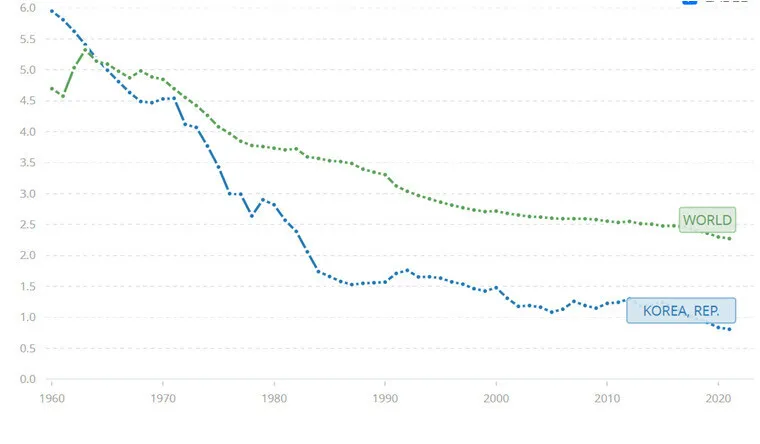
Mallach sounded a resolute note from the very start of the interview, calling population decline an inevitable reality. Populations are already declining not only in Japan and South Korea but also in various other countries. According to him, half the countries in the world have birth rates below the replacement level of 2.1.
The reasons that Mallach sees turning the clock back on population decline as impossible include the well-known ideas of material wellbeing, rising costs of child-rearing due to urbanization, inexpensive and affordable contraception, and more educational opportunities and workforce participation by women. In fact, he predicts that the world’s population will reach a peak of around 10 billion in around half a century before beginning to decline.
He doesn’t quibble with the fact that population decline in Korea — which boasts the lowest birth rate in the world — represents a “significant challenge.” He does, however, believe that Korea needs to acknowledge and understand why the birth rate continues to fall despite the government declaring a state of national emergency and pouring money and efforts to rectify low birth rates.
“Long-term decline is clearly inevitable,” Mallach said. “These efforts, number one, are not successful. And I think that has to be acknowledged. But I think the real issue is to try to understand why they’re not successful and what that means in terms of policy and direction going forward.”
The scholar says that stanching population decline is “not a realistic goal.” Even if Korea identified the particular factors that are affecting the birth rate and successfully counteracted them, Mallach argued the government would still find it difficult to exceed the birth rate of 1.2 — the rate Japan recorded last year — and said that recovering the replacement rate seemed to him “completely unrealistic.”
When it comes to factors unique to Korea — family structure, the competitive nature of Korean society, the rising costs of raising children due to educational fervor and accompanying tutoring costs, and patriarchal traditions in the culture — Mallach says that the birth rate might go up “somewhat” if there were changes to these factors, but even that would be difficult. While financial assistance to families is relatively easy, “changing cultural patterns, changing social values, changing family structures is extremely difficult,” he explained. He went on to underscore that it took Sweden, long thought of as a role model society, over 100 years to build the family structures and social structures it has today.
While saying it would be presumptive of him to tell the Korean government what it should do, he cautiously suggested, “They should be thinking about how to adapt to a society and an economy with a declining population even more than thinking about how to reverse population decline.” He then referred to local governments in Japan, with which he has extensive experience.
“There is a shift going on in Japan, a conceptual shift from trying to reverse decline to trying to manage decline, and especially trying to adapt to a society in which a growing and very large percentage of the population are older,” he noted.
So what does it mean to adapt to a shrinking world, as he suggests? Mallach was quick to note that a lack of precedent makes it a very difficult question to answer. Korea, he said, was in a “very challenging position” in terms of dealing with population decline and deglobalization simultaneously, and suggested that the focus be placed on improving quality of life. In particular, he listed expanding public goods — transit, open spaces, cultural opportunities — and individual Korean cities turning their focus to small-scale manufacturing and localizing supply chains.
“The key thing is reducing the reliance on large-scale economic growth and building stronger localized communities focusing on quality of life and public goods. Now, this is not an easy shift; it’s going to be extraordinarily difficult. But these are the kinds of issues that I think people should be starting to think about,” he said.
When asked about the effectiveness of housing support policies, one of Korea’s three pillars of its policies to counteract the low birth rate, the expert urban planner sounded skeptical.
“Will it change the birth rate? We don’t know,” he said. “I think the effect would probably be very small and very temporary.”
At the same time, he argued that regardless of birth rates, increasing housing production and providing subsidies to lower housing costs is good for a healthy and productive society.
As for an example city that Korea could look to when it comes to the disappearance of small rural communities occurring in tandem with population decline, Mallach cited Dortmund, in Germany. At one point a major industrial hub for the country, the city quickly began to decline alongside the decline of the coal and steel industries. The city of 640,000 continually shrank until the population fell to 570,000 in the mid-1980s. After that point, the trend of decline ended, and the population bounced back to around 600,000. The “Phoenix Project” that redeveloped the shuttered steel mill and aging industrial park brought new life to the city.
When speaking of Dortmund, Mallach said, “There’s a saying in America: If fate gives you lemons, make lemonade. The trick is to look at what happens as a result of decline and vacancy and [ask] how can I turn this to my community’s advantage and make it an asset rather than a problem?”
Shrinking cities is a phenomenon seen around the world. Setting aside the bustling greater Seoul metropolitan area, many Korean cities are seeing rapid declines in their populations. But Mallach suggests that Korea uses the proverbial lemon of population decline as an opportunity and chance to make lemonade, or communities that thrive.
Some cities in the US and Europe — two regions facing long-term population decline — have turned over a new leaf as “eco-friendly” cities or expanded open spaces and added tree canopies as part of a diverse array of attempts at raising the quality of life for local residents. Still, there are things that must come before such opportunities: “Cities will have to very fundamentally rethink how they operate, how they provide services, what services they provide, where the money is going to come from.”
In that process, attempts to reverse population decline can become a zero-sum game, says Mallach. “If you have a declining national population and one city can secure a larger share, somebody else is losing that share,” he said, arguing that that focus should be on increasing the quality of life for residents, not on a quantitative competition for larger populations.
Along with the inevitability of population decline, quality of life was one of the main points Mallach hammered home throughout our interview.
“The experience in the United States, at least, is that it is very difficult if you decide as a city you want to grow the population. It is very difficult to take measures successfully, directly, effectively to grow the population. If you offer incentives, you’ll get a few people, but you won’t get a steady flow. If you really want to grow the population, that’s where increasing the quality of life, increasing opportunity [is important]. If you have significant job opportunities, for example, people will come to those opportunities. If you have significant cultural opportunities or offer a social environment which is appealing to, say, young people, people will come for that social environment,” he said.
In order to do so, he ordered a shift in our current thinking that is obsessed with quantitative economic growth based on population increases.
“We have this problem in the United States, European cities also, which is the idea that growth equals success, decline or shrinkage equals failure. We have to get away from that mentality because ultimately, given the realities of population trajectory, that mentality is going to be self-destructive.”
Mallach took the concerns of an ancient philosopher over urban population sizes and succinctly addressed them as an issue of quality of life.
By Ryu Yi-geun, senior staff writer at the Hankyoreh Economy and Society Research Institute; Kim Hyo-jin, assistant researcher
Please direct questions or comments to [english@hani.co.kr]

Editorial・opinion
![[Editorial] When it comes to troop deployments, too much caution is never enough](https://flexible.img.hani.co.kr/flexible/normal/500/300/imgdb/original/2026/0907/561788769684846.jpg "[Editorial] When it comes to troop deployments, too much caution is never enough") [Editorial] When it comes to troop deployments, too much caution is never enough
[Editorial] When it comes to troop deployments, too much caution is never enough![[Column] A Trump-Kim summit may happen. A deal is another matter](https://flexible.img.hani.co.kr/flexible/normal/500/300/imgdb/original/2026/0906/931788659116202.jpg "[Column] A Trump-Kim summit may happen. A deal is another matter") [Column] A Trump-Kim summit may happen. A deal is another matter
[Column] A Trump-Kim summit may happen. A deal is another matter- [Correspondent’s column] AOC’s star is rising — as are hopes for a different America
- [Column] A costly war and a debt crisis… is a ‘Trump shock’ on its way?
- [Editorial] Cabinet reshuffle is a chance for Lee administration to turn things around
- [Column] What may come of a meeting of Trump and Kim Jong-un
- [Column] BTS is right to boycott the Grammys
- [Column] A woman went missing in Jeju. Why did police keep evidence from her family?
- [Column] Trump’s desperation after Iran doesn’t bode well for Korea
- [Editorial] The goal of a nuclear-free Korean Peninsula must not be abandoned
Most viewed articles
- 1Korea on track to become fourth country to hit $1 trillion in annual exports
- 2Generational wealth? Nearly 200 Korean preschoolers are already landlords
- 3[Column] A costly war and a debt crisis… is a ‘Trump shock’ on its way?
- 4[Exclusive interview] Could Coupang be the first case handled by KFTC’s new ‘grim reaper’ team?
- 5[Editorial] When it comes to troop deployments, too much caution is never enough
- 6[Video] Miraculous rescue at Nepal hydropower plant offers new hope for missing Koreans
- 7[News analysis] Hormuz deployment dilemma puts Seoul between a rock and a hard place
- 8Real-life heroes of “A Taxi Driver” pass away without having reunited
- 9Why Trump cut ROK-US drills, but not three-way drills with Japan
- 10Trump says he’ll ‘remember’ Korea’s refusal to help with Iran war, hinting at pressure