hankyoreh
Links to other country sites 다른 나라 사이트 링크
Korean corporations saw major declines in sales in China following THAAD debacle
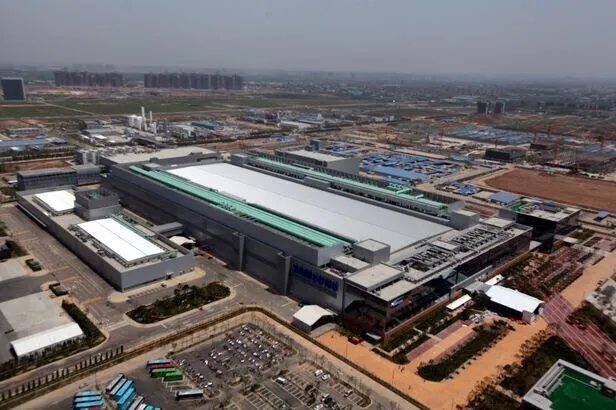
A new survey has found that major Korean businesses operating in China have seen a 13% decrease in sales since 2016, when Beijing took retaliatory measures against Korea over a US missile defense system installed there. When battery and chip businesses are taken out of the equation, sales were down around 40% for Chinese subdivisions of Korean companies. Sales by Hyundai and Kia’s Chinese businesses had plummeted to one-fifth of what they were six years ago.
Results of a survey of 113 of the top 500 Korean corporations (by revenue) that disclosed the performance of their Chinese subsidiaries carried out by CEO Score, a corporate data research center, showed aggregate sales of 111.424 trillion won (US$85.613 billion). That was down 13.1% from 2016, when the figure was 127.73 trillion won.
Excluding companies in the battery and semiconductor business, which have seen growing sales in China in recent years, sales dropped 37.3%, from 117.23 trillion won in 2016 to 73.45 trillion won in 2022.
“The Chinese government’s economic retaliation during the THAAD incident in 2016 turned up the pressure on Korean businesses operating within its borders, and the persistence of crises situations like the US-China trade war, supply chain crises, and Russia’s invasion of Ukraine has meant a retreat from doing business in China,” CEO Score wrote in its report.
THAAD stands for Terminal High Altitude Area Defense, a missile defense system that was installed by the US in Korea.
Korean automakers’ subsidiaries in China saw plummeting sales. Beijing Hyundai’s sales dropped a whopping 75.7%, from 20.13 trillion won in 2016 to 4.9 trillion in 2022. During the same period, Kia China’s sales fell 80.8%, from 9.80 trillion won to 1.88 trillion won.
Samsung Electronics’ production subsidiary in China saw sales down to 9.68 trillion won as of last September after recording 17.12 trillion won in 2016. The decrease is being interpreted as a result of shrinking sales of smartphones and electronics in the Chinese market coupled with Samsung liquidating its factory in Huizhou in 2021.
Samsung Display’s subsidiary in China saw a 49.9% drop in sales, from 10.78 trillion won in 2016 to 5.4 trillion won in 2022.
While the automakers and electronics companies that once held the Chinese market have lost their footing there, Korean battery and chipmakers continue to see growth. Last year, sales by LG Energy Solution’s subsidiary in China reached 12.85 trillion won, up a massive 431.6% from 2016 (2.42 trillion won). Samsung SDI’s business in China also saw a 483.5% increase in sales, from 929.8 billion won in 2016 to 5.42 trillion won in 2022.
Chip sales were up as well with the Chinese subsidiary of Samsung Electronics seeing 9.68 trillion won in sales in 2022, up 133.1% from 2016’s 4.15 trillion won, and SK Hynix’s Chinese arm seeing 7.55 trillion won in sales in 2022, up 151.5% from 2016’s 3 trillion won in sales.
By Kim Hoe-seung, senior staff writer
Please direct questions or comments to [english@hani.co.kr]

Editorial・opinion
![[Editorial] Mockery of Gwangju at high school ball game shouldn’t be treated lightly](https://flexible.img.hani.co.kr/flexible/normal/500/300/imgdb/original/2026/0701/1817828951697517.jpg "[Editorial] Mockery of Gwangju at high school ball game shouldn’t be treated lightly") [Editorial] Mockery of Gwangju at high school ball game shouldn’t be treated lightly
[Editorial] Mockery of Gwangju at high school ball game shouldn’t be treated lightly![[Column] Does profit-driven investment by chaebol make them ‘national heroes’?](https://flexible.img.hani.co.kr/flexible/normal/500/300/imgdb/original/2026/0701/8317828953365056.jpg "[Column] Does profit-driven investment by chaebol make them ‘national heroes’?") [Column] Does profit-driven investment by chaebol make them ‘national heroes’?
[Column] Does profit-driven investment by chaebol make them ‘national heroes’?- [Column] Korea at a crossroads: ‘Yoon Again’ or real change?
- [Column] Stuck in Strait of Hormuz, US can no longer pivot to Asia
- [Column] The harder US pushes N.Korea to denuclearize, the greater the risk to S. Korea
- [Correspondent’s column] The new generation of ‘sewer socialists’ are in it to win it
- [Editorial] Who benefits from tug-of-war over jurisdiction in the DMZ?
- [Column] Inequality in Korea hits high not seen since colonial era
- [Editorial] Unity doesn’t mean embracing defenders of insurrection
- [Editorial] Stiff sentence for ex-justice minister shows abetting insurrection won’t go unpunished
Most viewed articles
- 1Korea on pace to record $1 trillion in exports in 2026, joining world’s top 4
- 2[Column] Korea at a crossroads: ‘Yoon Again’ or real change?
- 3Prosecution begins its investigation of bank sale to Lone Star
- 4Police refer Morse Tan to prosecutors on suspicion of defaming Korean president
- 5[Column] Does profit-driven investment by chaebol make them ‘national heroes’?
- 6After Starbucks, anti-Gwangju mockery rears its head at high school baseball game
- 7Student athletes suspended from competitive play after mocking Gwangju massacre
- 8‘All doors open if you knock long enough’: Lee vows to achieve peace with North Korea
- 9[News analysis] Can Lee and Moon’s push for unity get Democrats on the same page?
- 10US Republican lawmakers claim Korea’s NIS coerced Coupang