hankyoreh
Links to other country sites 다른 나라 사이트 링크
Don’t be so sure China will economically retaliate against Korea this time around
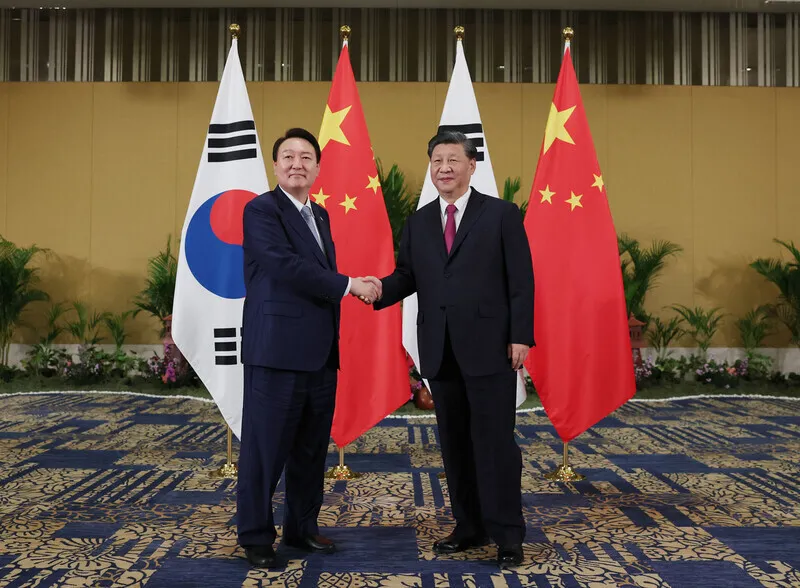
With South Korea’s relationship with China nearing the historical nadir reached during the THAAD controversy of 2016-2017, there are concerns that China might soon retaliate against Korea. But what’s different from the THAAD controversy is that a consensus has formed among major countries about the need to form a coalition against China’s “economic coercion.” That means that Chinese punishment of Korea could escalate into a broader conflict involving the US and other countries.
Experts call on both Korea and China to have the prudence to stop provoking each other and the responsibility to seek a solution together.
A March report titled “Deny, Deflect, Deter: Countering China’s Economic Coercion” by US-based think tank the Center for Strategic and International Studies examined eight instances in which China exacted economic retribution on other countries for political reasons since 2010, when China’s rise began in earnest.
Provocations over Taiwan, which China regards as one of its core interests (Lithuania’s establishment of a delegation there in 2021), territorial issues (the conflict with Japan over the Senkaku Islands in 2010 and with the Philippines over the South China Sea in 2012), issues that directly impact national security (the deployment of the THAAD missile defense system in South Korea in 2016), and other issues related to the prestige of the state (Australia’s request for a COVID-19 investigation in 2020 and Canada’s detention of Huawei Chief Financial Officer Meng Wanzhou in 2018) have invariably led to China unleashing economic retaliation, using its economic might as a cudgel.
Given that precedent, one might expect that South Korean President Yoon Suk-yeol’s comparison of the Taiwan issue to inter-Korean relations in an April 19 interview with Reuters and his foreign policy focus on strengthening a trilateral alliance with the US and Japan would prompt retaliation from China, since Yoon’s moves impinge upon China’s core interests and national security.
After tracking the diplomatic moves of the Yoon administration for a year, China did in fact communicate “Four Noes” — including a threat to halt cooperation with Korea if it meddled in China’s core interests (such as Taiwan) or if it moved forward with an unbalanced pro-US and pro-Japan foreign policy — in a meeting of mid-level bureaucrats in Seoul on May 22.
Since that ultimatum, China has only repeated its position that the “current difficulties and challenges in the China-ROK relations are not caused by China,” as Chinese Foreign Ministry spokesperson Wang Wenbin remarked on Friday. Korea is also refusing to take back what amounts to a summons of Chinese Ambassador Xing Haiming for his remarks about “betting” against China.
In effect, the two countries are locked into a battle of nerves, with both sides digging in their heels and demanding concessions from each other.
But there’s a formidable counternarrative that China may not be in a position to crack the whip against its neighbors as it has done in the past. Major countries have been building a coalition against China’s “economic coercion” since Joe Biden became US president in January 2021.
The leaders of the US and the other Group of Seven countries said in a communiqué following their Hiroshima summit on May 20 that they “will enhance collaboration by launching the Coordination Platform on Economic Coercion to increase our collective assessment, preparedness, deterrence and response to economic coercion, and further promote cooperation with partners beyond the G7.”
After American chipmaker Micron Technology was slapped with sanctions by the Chinese authorities on May 21, the US announced it would keep working closely with the G7 countries and its partners and allies to counteract distortions in the semiconductor market caused by China’s measures.
Since the country the US will need to work with there is South Korea, the only country capable of selling China products to replace Micron’s chips, the US probably can’t remain a bystander to a Korean conflict with China as it did during the THAAD controversy.
China also knows that the moment it exacts retribution, it might legitimize American criticism that it always resorts to economic coercion against its neighbors.
By Gil Yun-hyung, staff reporter
Please direct questions or comments to [english@hani.co.kr]

Editorial・opinion
![[Editorial] Top priority in North Korean POW case should be human rights, not politics](https://flexible.img.hani.co.kr/flexible/normal/500/300/imgdb/original/2026/0928/6117905733887763.jpg "[Editorial] Top priority in North Korean POW case should be human rights, not politics") [Editorial] Top priority in North Korean POW case should be human rights, not politics
[Editorial] Top priority in North Korean POW case should be human rights, not politics![[Column] Fixing the blurred border between South and North Korea](https://flexible.img.hani.co.kr/flexible/normal/500/300/imgdb/original/2026/0928/8617905750498627.jpg "[Column] Fixing the blurred border between South and North Korea") [Column] Fixing the blurred border between South and North Korea
[Column] Fixing the blurred border between South and North Korea- [Editorial] Shark sighting in Busan is a warning from nature
- [Column] Is AI about to destroy humanity?
- [Column] Harari’s 2030s: A new age of repressive desublimation
- [Guest essay] This Chuseok, think of the seasonal workers who plant and pick your food
- [Editorial] To build back public confidence, Lee must address issues affecting everyday Koreans
- [Column] Korea-Japan cooperation still has a long way to go
- Trump has taken a wrecking ball to America’s democratic institutions
- [Column] Sending troops to Hormuz would be a fatal miscalculation by Seoul
Most viewed articles
- 1Korea in talks to inject $10 billion into US nuclear reactor project this year despite still reviewing viability
- 2Seoul pushes back on Trump’s Alaska LNG claims, says investment must be commercially viable
- 3[Notice] Hankyoreh’s Asia Future Forum to explore ‘navigating the great upheaval’
- 4Ukraine releases interrogation footage of captured North Korean soldiers, proposes prisoner swap
- 5Lee hails peace as ‘surest form of security’ on Korean Peninsula
- 6Korea’s monthly exports exceed $120 billion for first time in September
- 7How to interpret North Korea’s response to explosions in the DMZ
- 8Tensions mount over DMZ mine blast as North Korea alludes to military response
- 9Kyiv was first to request confidentiality in North Korean POW transfer, Seoul’s NIS says
- 10Less than half of South Koreans see need to reunify with North, survey finds