hankyoreh
Links to other country sites 다른 나라 사이트 링크
[Editorial] Stagnant Four Rivers project needs ecological revival
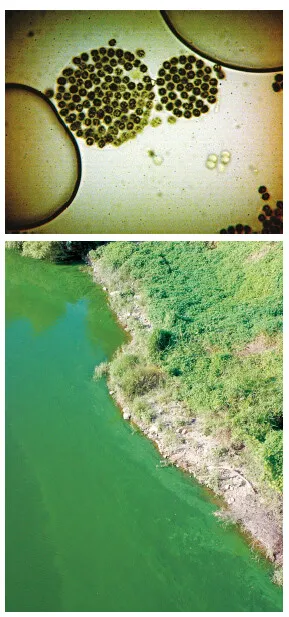
The Four Major Rivers Restoration project has left water stagnating behind massive weirs and laid waste to the banks of the Han, Nakdong, Geum, and Yeongsan Rivers. In pushing the effort, the government said visitors would be able to bask in clearer waters and rest in riverside parks once it was complete, but the current conditions show this to be the empty PR it always was. Already, local governments are agonizing over the massive amounts they will have to pour into upkeep for the riverside facilities. One has to ask just why this huge drain on taxpayer money was created in the first place.
The most serious problem is the declining water quality. Early this month, the Hankyoreh teamed with Green Korea United on an investigation that found specimens of the cyanobacteria Microcystis as far north as Daegu. The government attributed this to high temperatures, but experts said it had more to do with the sluggish flow of river waters blocked by the project’s weirs. By all accounts, there was no cyanobacteria in the middle course of the Nakdong before the project came along. This recent discovery merely highlights a well-known truth: trapped water stagnates.
More worrisome still is the possibility that our drinking water may become contaminated with this bacteria. Microcystis is known to be a toxin that causes liver disease. Long-term exposure to inadequately purified water could have devastating effects on the human body. It has been reported that the Gumi Filtration Plant and a number of other purification facilities along the Nakdong lack the equipment to filter out Microcystis. We do need to locate the source of the bacteria and cut it off, but until then we should be doing everything in our power to ensure the safety of our water by establishing adequate filtration facilities.
The 234 man-made riverside parks along the four rivers’ banks are another headache. Things aren’t so bad at the ones managed directly by the Korea Water Resources Corporation, but most of them have been neglected. This is what happens you decide to simply go ahead and build them, without any blueprint for how they will be managed or at what cost. One can imagine the frustration of the local governments that took over the reins and now have to spend huge sums each year on maintenance. We need to fundamentally reconsider whether to keep these parks or allow nature to restore them to their original state.
The project is now in its final stages. The Lee Myung-bak administration may have succeeded in turning the four rivers into great big water jugs, but at what cost? Instead of focusing only on the feather in its cap while ignoring the devastating side effects, it needs to fix its mistakes and address any inadequacies. If the best option is to simply get rid of the weirs, then that’s what it should do. And it goes without saying that it should be consulting with the environmental groups that have been opposing the project these past few years.
Please direct questions or comments to [english@hani.co.kr]

Editorial・opinion
![[Editorial] PPP’s shameless parade of disgraced presidents](https://flexible.img.hani.co.kr/flexible/normal/500/300/imgdb/original/2026/0602/1417803899056627.jpg "[Editorial] PPP’s shameless parade of disgraced presidents") [Editorial] PPP’s shameless parade of disgraced presidents
[Editorial] PPP’s shameless parade of disgraced presidents![[Column] From complete denuclearization of North Korea to managing nuclear risk](https://flexible.img.hani.co.kr/flexible/normal/500/300/imgdb/original/2026/0601/8617803026931084.jpg "[Column] From complete denuclearization of North Korea to managing nuclear risk") [Column] From complete denuclearization of North Korea to managing nuclear risk
[Column] From complete denuclearization of North Korea to managing nuclear risk- [Editorial] Korea is a model US ally on defense. It’s time it regains wartime OPCON.
- [Editorial] Election fraud conspiracy theorists are the real threats to Korea’s democracy
- [Column] Israel: The definition of a democratic fascist regime
- [Column] The tyranny of merit and the distribution of profit in the AI era
- [Editorial] Working groups on Korea-US fact sheet must yield tangible results
- [Editorial] Head of USFK continues to cross the line with inappropriate political remarks
- [Editorial] A disgraced former president like Park Geun-hye has no place on the campaign trail
- [Editorial] Korea’s online hate problem calls for platform regulation and anti-discrimination law
Most viewed articles
- 1[Column] From complete denuclearization of North Korea to managing nuclear risk
- 2Little-known former US official sets off flurry of election misinfo in Korea
- 3Ripped from families for not being ‘Korean enough,’ mixed-race adoptees seek truth and justice
- 4[Editorial] Korea is a model US ally on defense. It’s time it regains wartime OPCON.
- 5[Column] The tyranny of merit and the distribution of profit in the AI era
- 6[Column] Israel: The definition of a democratic fascist regime
- 7[Editorial] Election fraud conspiracy theorists are the real threats to Korea’s democracy
- 8Another deadly explosion casts shadow over Hanwha Aerospace’s cutting-edge image
- 9Korean activists say Israeli captors physically and sexually assaulted flotilla activists
- 10South Korea is ready for OPCON handover, defense chief tells US lawmakers