hankyoreh
Links to other country sites 다른 나라 사이트 링크
[Column] A year on from ‘Liberation Day,’ is America any greater?

By Jang Young-ook, associate research fellow at the Korea Institute for International Economic Policy
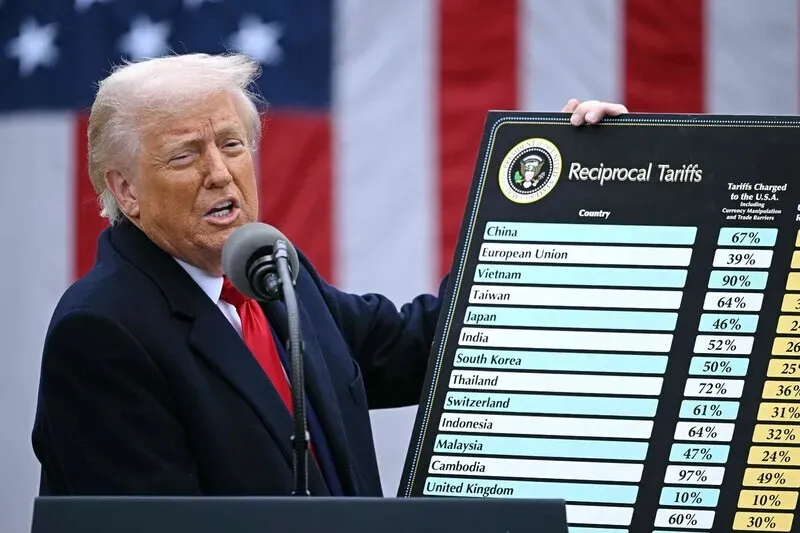
A year ago today, US President Donald Trump stood in the White House’s Rose Garden and declared April 2 to be America’s “Liberation Day.” In his words, the US had been “looted, pillaged, raped and plundered by nations near and far, both friend and foe alike.”
To correct this travesty and make the nation great again, Trump turned to what he called “reciprocal” tariffs. These new import taxes were slapped on allies and even on islands almost indiscernible on maps.
Now that a year has passed, can we say that Trump has achieved the liberation he so touted?
A number of economic indicators show that the US actually did somewhat well in the past year. At 2.1%, the US had the highest rate of GDP growth of all developed countries in 2025. The stock market was shaky for a few moments, but bullish sentiment is building again with major stock market indexes up 10%-20% compared to last year. The inflation rate has also remained stable over the past year by staying within the mid-2% range, and the unemployment rate has also stayed low in the 4% range.
While it is too early to tell whether this America is the “great” one promised by Trump, the economic crisis that many economists warned of has not materialized.
Of course, these indicators alone do not justify Trump’s tariffs. Firstly, despite his tough talk, the tariffs that were implemented were not sky-high. Research by Gita Gopinath, a professor of economics at Harvard University, indicates that while statutory tariffs peaked at 32.5% around Liberation Day, they fell to 25% after negotiations and adjustments. Various delays, exemptions, and exception clauses meant the actual tariff rate stayed at 14%.
That dipped to the 5%-8% range after the US Supreme Court ruled in February that the reciprocal tariffs were unlawful, therefore becoming invalidated and replaced with lower rates. US importers and consumers bore the brunt of the tariffs, but luckily — or unluckily, depending on how one looks at it — the tariffs themselves were not large enough to have a significant impact on the economy.
So, while it is true that tariff rates have increased since Trump came into office, it is impossible to tell if the implementation of those tariffs has had the desired effect.
On Liberation Day, Trump claimed that the goal of these tariffs was to reduce trade deficits, ensure fiscal revenue, and protect national manufacturing. However, the US goods trade gap in 2025 was US$1.24 trillion, an increase from the year before. Tariff revenue increased by more than US$200 billion compared to 2024, contributing to some extent to the national budget. However, due to the recent Supreme Court ruling invalidating Trump’s reciprocal tariffs, a significant portion of that revenue must now be refunded.
Furthermore, with other tax revenues declining due to large-scale tax cuts and spending rising due to the war, eliminating the fiscal deficit has become a distant prospect. These tariffs also failed to protect local manufacturing. As artificial intelligence replaces workers, demand for human labor has fallen. Since Liberation Day, the supply of workers has also dipped and continues to fall due to the deportation of immigrants. Manufacturing output has also been hit as the prices of imported intermediate goods have risen due to tariffs.
The US economy has fared fairly well due to the country’s structural strengths, not tariffs. The US holds a leading position in key industries such as AI, biotechnology and energy. Its dominance in the dollar-based global financial markets puts it in a favorable position to attract investment and defend stock prices.
As the world’s largest economy, its formidable purchasing power makes it difficult for trading partners to redirect their exports to other countries. Trump may disagree, but it was the global economic order established by the US that protected the US economy from his erratic policies.
Unfortunately, the problem lies in the fact that Trump is destroying said order. Armed with economic and military power, he is constantly putting the screws to America’s rivals and allies to get what he wants. He is firing off social media posts about policies that make one doubt whether he consulted any of his advisers, only to retract them shortly thereafter. Often, he faces backlash for recklessly addressing major economic and security issues without prior coordination with allies.
His every word sends global financial markets into turmoil, only for us to hear that one of his close aides has somehow profited from other people’s misery. As trust in the US weakens, major trading partners have begun to seek alternative sources for goods. The global economy without the US that the country itself is bringing about will never work in America’s favor.
A year has passed since Trump declared Liberation Day, but it is difficult to find any evidence that America has been made great again. If anything, it seems that the only thing strong enough to keep the US upright during this state of crisis is its past glory.
The US is not well-equipped to tackle the tasks of solving the negative side effects of globalization or protecting peace in the Middle East by itself. The real lesson the US is teaching the world a year after it declared Liberation Day is that true liberation is born from connection, not isolation.
Please direct questions or comments to [english@hani.co.kr]

Editorial・opinion
![[Editorial] Top priority in North Korean POW case should be human rights, not politics](https://flexible.img.hani.co.kr/flexible/normal/500/300/imgdb/original/2026/0928/6117905733887763.jpg "[Editorial] Top priority in North Korean POW case should be human rights, not politics") [Editorial] Top priority in North Korean POW case should be human rights, not politics
[Editorial] Top priority in North Korean POW case should be human rights, not politics![[Column] Fixing the blurred border between South and North Korea](https://flexible.img.hani.co.kr/flexible/normal/500/300/imgdb/original/2026/0928/8617905750498627.jpg "[Column] Fixing the blurred border between South and North Korea") [Column] Fixing the blurred border between South and North Korea
[Column] Fixing the blurred border between South and North Korea- [Editorial] Shark sighting in Busan is a warning from nature
- [Column] Is AI about to destroy humanity?
- [Column] Harari’s 2030s: A new age of repressive desublimation
- [Guest essay] This Chuseok, think of the seasonal workers who plant and pick your food
- [Editorial] To build back public confidence, Lee must address issues affecting everyday Koreans
- [Column] Korea-Japan cooperation still has a long way to go
- Trump has taken a wrecking ball to America’s democratic institutions
- [Column] Sending troops to Hormuz would be a fatal miscalculation by Seoul
Most viewed articles
- 1Kyiv was first to request confidentiality in North Korean POW transfer, Seoul’s NIS says
- 2Less than half of South Koreans see need to reunify with North, survey finds
- 3Tensions mount over DMZ mine blast as North Korea alludes to military response
- 4How to interpret North Korea’s response to explosions in the DMZ
- 5Trump gloats over Korean investment in Alaska LNG project still under review by Seoul
- 6[News analysis] Trump’s Alaska LNG project announcement smacks of midterm anxiety
- 7[Photo] Annual “prettiest postcard” contest for Hangul Day
- 8S. Korean chaebols comprise 84% of GDP but only 10% of jobs
- 9[Exclusive] Seoul will need 16% rate of return on US investments to recoup principal
- 10Lee’s approach runs risk of normalizing North Korea as a nuclear power