hankyoreh
Links to other country sites 다른 나라 사이트 링크
[Guest essay] Korea is a ‘content’ powerhouse — is AI about to change that?

By Hong Won-sik, professor at Dongduk Women’s University ARETE College of Liberal Arts
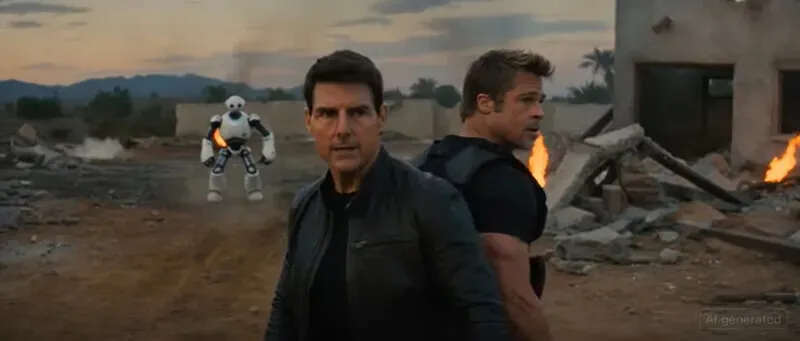
Last week, a video surfaced that sent shockwaves through the film and media industry. The video, showing Hollywood heavyweights Tom Cruise and Brad Pitt fist-fighting on a rooftop, had been made by Seedance 2.0, ByteDance’s AI-powered video generator. The video of the fake fight required only a two-sentence prompt to make.
The 15-second clip not only recreated the two stars’ good looks during their respective golden eras, but it also perfectly replicated their gasps for breath and the impact of each wallop, shocking the entertainment and media industries. Going beyond technological advances, the video showed how AI can almost completely replace an actor’s unique presence. It was a nightmare come true in Hollywood. It’s no exaggeration to say that the clip fueled despair for many, with predictions of traditional production methods going extinct abounding.
South Korea’s framework act on AI went into effect in January, making it the first country to legislate regulations that require AI-generated content to be labeled as such. Violations carry a penalty of 30 million won (US$20,758) — what could be called a bare-minimum safety measure to protect ordinary people and industries from deepfakes and indiscriminate violations of copyright laws.
But from the perspective of media scholars, such regulations are not the solution; they are only the first step toward reckoning with a massive systemic problem. Just because fake content comes with a label doesn’t mean that basic copyrights aren’t being violated.
Rather, the point to focus on isn’t AI services themselves, but the devastation it will wreak on the media and entertainment industries. Warning signs of crisis in the film and TV industry have already begun to appear. Last year, the number of films produced by Korean studios diminished by over 30% compared to previous years, and many commercial films were scrapped at the planning stage. This indicates more than economic troubles.
AI-generated content is quickly eating into not only advertising but the short-film market, and the entertainment industry is suffering as investment capital attempts to avoid uncertainty during this period of technological transition.
Because the world is undergoing an unprecedented acceleration of technological development, we can’t blame the government for everything. But considering that Korea wants to turn its culture industry into a key national industry, we have clearly arrived at the critical point where we can’t simply just stand by and watch any longer.
There needs to be an in-depth discussion about the Korean AI action plan recently announced by the Presidential Council on National Artificial Intelligence Strategy.
The presidential council has adopted a “use first, compensate later policy” that would allow AI developers to use data and content for training AI models without obtaining permission from the original creators of the data and content. The idea is to allow developers to use data immediately without going through the relevant copyright procedures that would otherwise delay development. The developers would then compensate the original intellectual property holders after making a profit.
The advisory council argued that the country doesn’t have time to wait around for organic cooperation to develop between AI businesses and conventional content creators, because the global competition surrounding AI is too intense. This is an understandable argument, but the industry’s concerns that such exemptions effectively nullify the core copyright concept of “exclusive right to give permission” are also an undeniable existential reality.
The council backpedaled by saying it would make exemptions when it came to industries with a clear market, like music and news, but the fundamental problem remains.
The “opt out” method adopted by the EU considers pathways that allow content creators to retain their IP rights even after services utilize their data and content to train AI models. These pathways call for increased accountability and transparency on the part of AI service providers and developers. Yet in Korea, we’re heavily leaning towards sacrificing the rights of creators under the banner of fostering the industry.
Without a basic level of transparency from AI firms regarding how they use data for training their models, the pledge of “compensate later” is likely to become an empty promise. If the aggregated quality content produced by media outlets and creators is subjected to unauthorized “data training” conducted by AI firms, at the very least, any creative force left within the media ecosystem will dry out during this period of technological transition.
There’s no fighting the tide of AI. However, if we want to ensure that it doesn’t result in the collapse of the media and content ecosystem, we need to go beyond a mere labeling regulation — we need a macro-media industry policy. We need to step outside convenient concepts like “use first” and seriously consider installing minimal legal obligations for companies to be transparent about where they get their training data.
Additionally, we need creative policies that offer education for skilled workers being replaced by technology while protecting the value of high-quality content. I expect there will be fierce debate and deliberation among policymakers to create an ecosystem where technology doesn’t encroach on the dignity of content producers.
Please direct questions or comments to [english@hani.co.kr]

Editorial・opinion
![[Guest essay] Korea is a ‘content’ powerhouse — is AI about to change that?](https://flexible.img.hani.co.kr/flexible/normal/500/300/imgdb/original/2026/0301/311772326354815.jpg "[Guest essay] Korea is a ‘content’ powerhouse — is AI about to change that?") [Guest essay] Korea is a ‘content’ powerhouse — is AI about to change that?
[Guest essay] Korea is a ‘content’ powerhouse — is AI about to change that?![[Column] Coupang’s play in Washington](https://flexible.img.hani.co.kr/flexible/normal/500/300/imgdb/original/2026/0227/7817721808892682.jpg "[Column] Coupang’s play in Washington") [Column] Coupang’s play in Washington
[Column] Coupang’s play in Washington- [Editorial] Clarification and accountability needed on USFK standoff with Chinese jets
- [Editorial] USFK’s provocation of China demands more than perfunctory protest by Seoul
- [Editorial] PPP’s refusal to cut ties with Yoon will be its undoing
- [Editorial] Korea is no staging ground for US operations against China
- [Editorial] Court convicts Yoon, but fails to fully reckon with his attempted coup
- [Editorial] Just because Japan is rushing US investments doesn’t mean Korea should
- [Column] Moment of truth: What the Epstein files really show us
- [Editorial] Coupang’s lobbying in US won’t win back Korean customer base
Most viewed articles
- 1[Guest essay] Korea is a ‘content’ powerhouse — is AI about to change that?
- 2USFK denies apologizing to Seoul for standoff with Chinese jets
- 3[News analysis] Behind split strategies, Kim Jong-un stays focused on regime security, advancement
- 4Threatening North Korea has not made peninsula any safer, says South Korea’s Lee
- 5South Korea‘s top 100 income tax payers earned 1,523 times the median
- 6Koreans are getting taller, but half of Korean men are now considered obese
- 7[NBS] Korea’s Lee logs 67% approval rating, his highest since taking office
- 8[Column] Coupang’s play in Washington
- 9Former bodyguard’s dark tale of marriage to Samsung royalty
- 10S. Korea secures lives of 391 Afghans in Operation Miracle