hankyoreh
Links to other country sites 다른 나라 사이트 링크
[Column] Coupang’s play in Washington

By Kim Ji-eun, international news editor
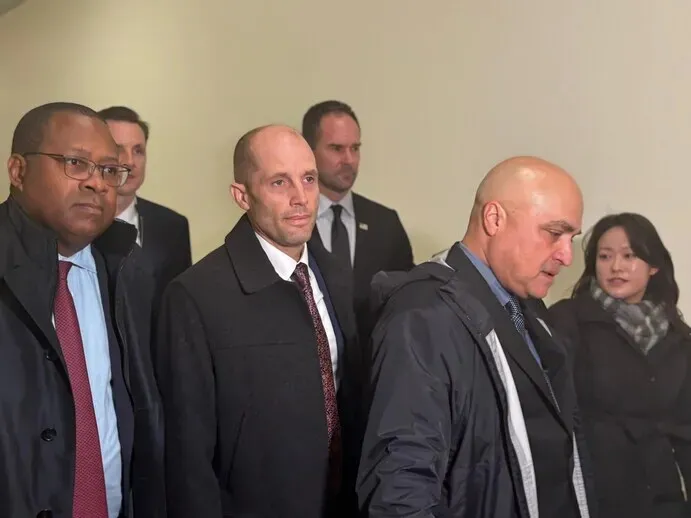
After a prolonged absence from the public eye, Harold Rogers, the interim CEO of Coupang’s Korean subsidiary, appeared for a deposition before the US House Judiciary Committee earlier this week. It is not known what he said, as the testimony was given behind closed doors. However, in contrast to his scowling expression when facing the press in Korea, Rogers appeared far more relaxed after his lengthy testimony before US lawmakers.
On Feb. 5, the House Judiciary Committee explicitly called out the Korean government for “discrimination” against US companies and initiated a probe into the treatment of Coupang and other parties. The press release for the subpoena the committee issued to Rogers states, “Korean regulators and enforcement agencies, including the Korea Fair Trade Commission (KFTC), have repeatedly subjected an innovative American e-commerce company, Coupang, Inc., to discriminatory treatment, unfair enforcement practices, and even the threat of criminal penalties.” In claiming that Seoul’s conduct amounts to discrimination, the committee echoed the claims made by Coupang.
Not that the committee seems to care very much, but the actual crux of the case is the massive leak of customers’ personal data at Coupang last year. In a country of 51.6 million, approximately 148 million pieces of data, including delivery addresses, shared lobby entrance security codes, and 33.67 million names and email addresses, were leaked or improperly accessed. This was the largest cybersecurity breach in Korea’s history.
While the Judiciary Committee said that the “breach only resulted in limited, non-sensitive information being retained for around 3,000 customers that has since been recovered,” this simply is not the case. Even after the Korean government’s attempt to set the record straight, the House Judiciary Committee’s spokesperson office reportedly responded that Korea was “punishing Coupang to advantage domestic Korean competitors.”
In addition to downplaying the scale of the data leak, Coupang violated regulations that require it to report a breach within 24 hours. The government ordered the preservation of data to analyze the cause of the leak, but five months’ worth of internet access logs had disappeared. On Wednesday, it was revealed that data for 200,000 accounts held by customers in Taiwan — a user base which the company had initially claimed had not been affected — had in fact been compromised.
Rogers played up supposed instructions to investigate the incident given by the National Intelligence Service in a National Assembly hearing, but this was denied by the spy agency and led to accusations of perjury in the National Assembly. It is high time for Coupang to learn the difference between right and wrong.
These baffling developments have led to increased scrutiny of the company’s lobbying activity in the US. Coupang has spent at least US$10.75 million on lobbying over the past five years. Although lobbying is legal in the US, the nominee to become the next chairman of the Federal Reserve is an outside director at the company, and key economic power players in the Trump administration also have ties to Coupang.
Coupang has meticulously assembled a team of close allies, and they are certainly paying for themselves. Several major investors in the company have also urged the US Trade Representative to investigate allegations of “discrimination,” and Korean President Lee Jae Myung and the ruling party have been smeared as anti-US and pro-China.
With that said, is there any substance to the claims of discrimination by the Korean government? Legal provisions on penalty limits and criminal punishment in the Personal Information Protection Act and the Act on Promotion of Information and Communications Network Utilization and Information Protection apply irrespective of corporate nationality. Although there are some differences in the scale and nature of the leaked data, previous cyber breaches at domestic companies including Interpark and SK Telecom have been dealt with under the same laws.
Coupang has called the National Assembly hearings explosive and claims the reaction and response from the Korean political sphere vindictive. However, this is just Coupang reaping what it has sown, as the reaction is a function of Coupang and Rogers’ own responses combined with previous stains on the company’s reputation, including allegations that its founder and chairman of the board, Kim Bom-suk, attempted to cover up the death of a warehouse worker.
The real victims in this upside-down case are not American corporations, but Korean consumers. The pressure from the US is astonishing in light of the fact that 60% to 70% of Korean adults had their data stolen.
Please direct questions or comments to [english@hani.co.kr]

Editorial・opinion
![[Editorial] Trump’s baseless claim that Iran bombed girls’ school crosses line](https://flexible.img.hani.co.kr/flexible/normal/500/300/imgdb/original/2026/0309/4217730446901883.jpg "[Editorial] Trump’s baseless claim that Iran bombed girls’ school crosses line") [Editorial] Trump’s baseless claim that Iran bombed girls’ school crosses line
[Editorial] Trump’s baseless claim that Iran bombed girls’ school crosses line![[Correspondent’s column] JD Vance’s 67-hour disappearance](https://flexible.img.hani.co.kr/flexible/normal/500/300/imgdb/original/2026/0306/2517727866984907.jpg "[Correspondent’s column] JD Vance’s 67-hour disappearance") [Correspondent’s column] JD Vance’s 67-hour disappearance
[Correspondent’s column] JD Vance’s 67-hour disappearance- [Column] Withstanding Trump’s predatory hegemony
- [Editorial] US dragging Kurds into its war with Iran would be a disaster
- [Column] US allies in the Gulf are in flames. Can Korea avoid a similar fate?
- [Editorial] North Korea’s tough talk mustn’t deter Seoul’s efforts to rebuild trust
- [Editorial] Attack on Iranian girls’ school is an indefensible crime against humanity
- [Editorial] Trump’s unjustified war with Iran threatens chaos for us all
- [Column] What a Korean man’s foiled plan to seek assisted death in Switzerland reveals
- [Column] This is what accountability looks like
Most viewed articles
- 1Korea named as target of new Section 301 probe by US
- 2‘Made in USA’: Scraps of missile that killed Iranian children point to US responsibility
- 3[Editorial] No greater sign that South Korea must prioritize building its own defense abilities
- 4US may seek exit from Iran war by moving the goalposts of victory
- 5US Democrats say Trump’s investment pressure has ‘deeply unsettled’ alliance with Seoul
- 6[Column] Misconceptions about America’s war with Iran
- 765% of Korean men say gender equality has gone ‘far enough’; only 42% of women agree
- 8How much is the US willing to risk for the Strait of Hormuz?
- 9Coupang investors insinuate that US is planning Section 301 probe into Korea
- 10[News analysis] Air defense pullout signals new era of US strategic flexibility in Korea