hankyoreh
Links to other country sites 다른 나라 사이트 링크
[Column] Tu Anh deserved better than to die in fear of immigration raid
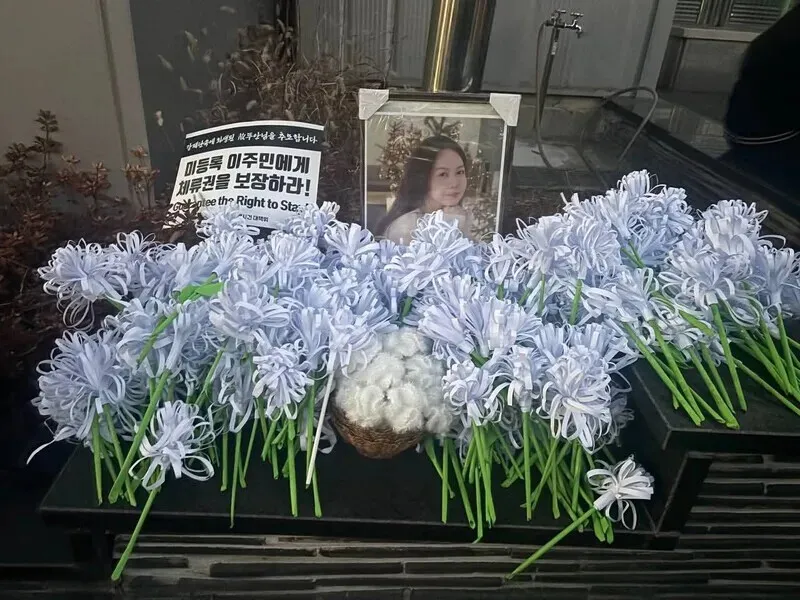

By Jang Young-ook, research fellow at the Korea Institute for International Economic Policy
Tu Anh, a 25-year-old from Vietnam, died at her workplace in Daegu on the evening of Oct. 28, a mere three days before the leaders of the world gathered in Gyeongju for the APEC summit. A Keimyung University graduate who majored in international trade, Tu Anh had wanted to help facilitate trade between South Korea and Vietnam. She successfully managed to obtain a job-seeking visa after graduating, which allowed her to reside longer in Korea, but finding work in her field proved difficult.
Eventually, she started working at a manufacturing plant to make ends meet, a job that she was not legally allowed to have on her particular visa. While working without proper residency status is indeed illegal, it is hard to hold it against Tu Anh for deciding to take the job. An employer was willing to hire her, and the local economy and labor market are structured in a way that makes it impossible to function without migrant workers.
Two weeks after Tu Anh began her job at the plant, the factory was subject to a government immigration sweep. The Ministry of Justice had, for the past month, been conducting widespread crackdowns on undocumented residents. The raids were characterized as targeting aliens who were “infringing on the job opportunities of Koreans” and “threatening their safety” as part of an effort to “support the successful hosting of the APEC summit.” In an attempt to evade immigration enforcement, Tu Anh hid behind an air conditioning unit on the third story of the building. Sadly, that was where she fell to her death.
Was Tu Anh really “infringing on the job opportunities of Koreans” and “threatening their safety”? To answer those questions, we need to take a look at the kinds of job opportunities that exist in Korea.
A September survey conducted by the Korea Federation of Small and Medium Business (KBIZ) showed that 90% of domestic companies that hired foreigners did so because it was difficult to hire Koreans. Businesses that hired undocumented migrants were likely in a situation where they struggled to hire foreigners with appropriate visas, let alone Korean workers.
That gives the lie to the argument that hiring undocumented migrants infringes on job opportunities for Koreans. In fact, it is often reported that when the local economy is revitalized through foreign employment, the quality of jobs for domestic workers also improves.
What about the claim that the workers “threaten” the safety of Koreans? A public official in Ulsan went so far as to claim that “the influx of migrant workers is causing consternation among Koreans” in an official setting, reflecting a diffuse fear of foreign crime. In reality, foreigners commit crimes at lower rates than Korean nationals, with the number of crimes per 1,000 foreign residents at 13, barely half that of Koreans (25). Even when we look exclusively at serious crimes, foreigners account for 0.30 cases per 1,000 people, compared with 0.45 for Koreans.
If anything, foreigners are the ones who are more vulnerable to threats to their safety. A Statistics Korea survey from 2024 found that 27% of foreign residents in the country reported experiencing discrimination because of language or skin color. The housing conditions and working environments for foreign nationals are also wanting compared to those of their Korean counterparts.
Even official statistics, which often underrepresent reality, show that the probability of experiencing wage theft and dying in industrial accidents is more than twice as high for foreigners as for Korean nationals. When they exceed the strictly defined duration of stay or stray from the workplaces or industries that they are permitted to work at, they are immediately labeled as “illegal aliens” or “illegal workers.” Such labels subject them to crackdowns, detention, deportation and even death.
Managing immigrant residency is a complex issue. As noted above, we should not place the blame on the individual for being undocumented. Companies are anxious to meet market demand by hiring workers accordingly, but the current immigration system rigidly dictates which and how many workers can enter which sectors in the name of “protecting Koreans,” failing to meet employers’ needs.
In the words of one wise observer, we are witnessing a situation where people are “jaywalking because there are no crosswalks.” On one side of the road, we have migrants who wish to cross. On the other hand, we see businesses that want those migrants to come over and work for them. If there are not enough lawful ways of crossing or the official crossroad is too far away, we will see a rise in jaywalkers. While we should not completely condone jaywalking, continuing to rely on heavy-handed crackdowns while experiencing a shortage of immigration enforcement personnel is far from sustainable.
The fundamental solution to reducing undocumented migration lies in minimizing the clash between the needs of the labor market and the rigidity of the immigration system. For example, if a job-seeking visa had allowed employment in manufacturing, Tu Anh would not have felt the need to flee to avoid the immigration raid. If we make it easier for foreigners meeting specific conditions to extend or change their visas and expand the scope of activities permitted under them, it will reduce undocumented migration.
Korea’s current policy is already shifting in that direction, but it remains stuck in old patterns as most adjustments are minor and incremental. It is now time for us to overhaul our immigration policy.
As for Tu Anh, I pray that she may be free from fear and suffering and rest in peace. It is the duty of those still here to ensure such senseless deaths never happen again by coming up with institutional and policy alternatives.
Please direct questions or comments to [english@hani.co.kr]

Editorial・opinion
![[Column] Harari’s 2030s: A new age of repressive desublimation](https://flexible.img.hani.co.kr/flexible/normal/500/300/imgdb/original/2026/0927/7317904739856884.jpg "[Column] Harari’s 2030s: A new age of repressive desublimation") [Column] Harari’s 2030s: A new age of repressive desublimation
[Column] Harari’s 2030s: A new age of repressive desublimation![[Guest essay] This Chuseok, think of the seasonal workers who plant and pick your food](https://flexible.img.hani.co.kr/flexible/normal/500/300/imgdb/original/2026/0927/771790472388276.jpg "[Guest essay] This Chuseok, think of the seasonal workers who plant and pick your food") [Guest essay] This Chuseok, think of the seasonal workers who plant and pick your food
[Guest essay] This Chuseok, think of the seasonal workers who plant and pick your food- [Editorial] To build back public confidence, Lee must address issues affecting everyday Koreans
- [Column] Korea-Japan cooperation still has a long way to go
- Trump has taken a wrecking ball to America’s democratic institutions
- [Column] Sending troops to Hormuz would be a fatal miscalculation by Seoul
- [Guest essay] A tribute to Gloria Steinem and her legacy in Korea
- [Correspondent’s column] Korea has its own ‘red lines,’ too
- [Column] An open letter to Kim Jong-un and Donald Trump
- [Editorial] It’s time to pump the brakes on AI’s development
Most viewed articles
- 1[Column] Harari’s 2030s: A new age of repressive desublimation
- 2Not just Korea: Google leaked identifying info for sex crime victims across the world
- 3[Paris Olympics] An Se-young wins Korea’s first women’s badminton singles gold in 28 years
- 4Swedish IOC member’s adoptee wife seeking her birth parents
- 5June Huh becomes first mathematician of Korean descent to win prestigious Fields Medal
- 6Korea’s atrocities in Vietnam, in the words of those who saw and survived them
- 7Do Korea’s conservative frontrunners have what it takes to become president in 2030?
- 8South Korea’s president forgoes ‘denuclearization’ for ‘peninsula free from nuclear weapons’ in UN speech
- 9Korea a half century ago
- 10[Photo] Dismissed MBC journalists return to work