hankyoreh
Links to other country sites 다른 나라 사이트 링크
[Column] Why is South Korea clamoring for yesterday’s nuclear submarines?

By Kim Jong-dae, former Justice Party lawmaker
The US Navy’s efforts to construct underwater infrastructure are the subject of much debate. The US Congress and manufacturing industry declare that the country needs to buy more Virginia-class nuclear submarines (Block IV and V) to provide more job opportunities and to support industries. The Pentagon and Navy, on the other hand, argue that it needs to change direction by forgoing single-platform nuclear submarines and opting for extra-large uncrewed undersea vehicles (XLUUV) like the Orca.
At the heart of this debate is whether the US should prioritize current job opportunities or look toward the future to assert dominance over China and Russia.
The Pentagon and US Navy are loath to commit to the construction of more nuclear-powered submarines as it comes with quite considerable costs, as each vessel requires a crew of 134, US$4 billion to US$4.5 billion for construction, and US$60 million to US$100 million in annual maintenance costs.
The Orca XLUUV would only require US$55 million per vehicle, can traverse 6,000 nautical miles — the distance from Los Angeles to Seoul — and its capabilities can be augmented easily, enabling it to be utilized for various missions. The argument here is that 30 to 40 underwater drones are more efficient than a single nuclear-powered submarine.
The US Navy’s “distributed maritime operations” and “Project 33” initiatives demonstrate how it is strongly pushing for a future system that relies less on manned platforms, such as nuclear-powered submarines, and instead focuses on unmanned systems. The vision for this strategy is clear: Load more ammunition on more platforms and spread them out over a wide range to overload our opponents’ surveillance target attack systems.
The magnificent silhouette that the blue-water navy conjures to mind is now a thing of the past; naval hegemony is now achieved through an invisible net of sensors and shooters.
The US Congress is highly critical of the delays in the Orca program’s development and its overwhelming budget. The US Congress’s Government Accountability Office previously stated that it is “unclear whether the Navy will transition the XLUUV to a program of record.”
Instead of investing in the potential of unmanned systems, Congress wants to pour resources into the tried-and-tested capabilities of the present. The US House Committee on Armed Services added US$1 billion in funds for Virginia-class submarines in the National Defense Authorization Act for Fiscal Year 2026.
It doesn’t take a genius to deduce that the US shipbuilding industry and military-industrial complex, which is exceedingly sensitive to the possibility of adding more job opportunities, are behind that decision. US President Donald Trump stands in the middle of these clashing parties, siding with no one while attempting to clumsily bring their opposing interests together.
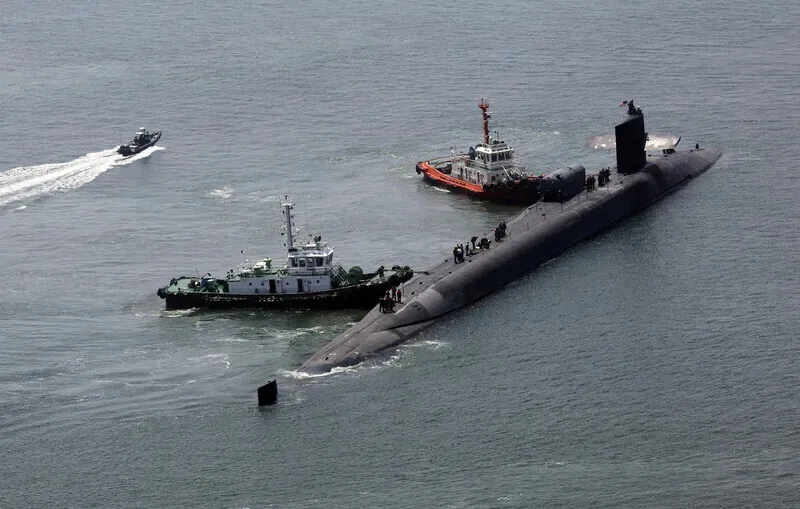
Then, out of nowhere, South Korea declared that it would independently build nuclear-powered submarines, the very vessels at the center of so much heated debate in the US. South Korean nuclear-powered submarines would lack nuclear weapons. It is an odd weapons system that, despite lacking nuclear deterrence capabilities, attempts to swiftly track and spy on submarines deployed by North Korea and other neighboring countries.
In short, it’s a perfect illustration of the US Navy’s analysis that deploying an exorbitantly priced, giant submarine to the hostile environment of the Korean Peninsula, the West Sea and the East China Sea would be an overconcentration of value exposed to enemy surveillance and targeting networks.
Of course, the US military-industrial complex has no reason to shun these plans. If it uses nuclear fuel supply as bait to ensure that a portion of South Korean submarines are constructed at US shipyards, the US Congress does not have to go out of its way to expand its defense budget. This also explains why the US was initially reluctant to give the green light when the Moon Jae-in administration expressed its desire to construct nuclear-powered submarines, only to authorize it later. But Korea should think long and hard about whether this policy will be a wise one for our own national security.
China has already joined hands with Russia to pursue its “transparent ocean” strategy, which involves creating a five-layer surveillance network within its neighboring waters. The strategy combines satellites, air surveillance, wave gliders, underwater drones and seabed sensors and is rapidly gaining momentum due to the country’s advanced manufacturing abilities and shipbuilding ecosystem.
South Korea will have to consider how to establish a unique maritime strategy based on AI technology and manufacturing, which begs the question of whether we should be so attached to the idea of manufacturing nuclear-powered submarines when it will burn more than 10 trillion won and make us dependent on US technology.
This is even without considering the various political costs we will have to waste to achieve this goal. The shallow waters surrounding the Korean Peninsula and its complex coastline require a distributed sensor network rather than one massive delivery platform. This is a sector where South Korean technology and its manufacturing ecosystem can demonstrate its prowess, and one that is rich with possibilities. It will not be too late to pursue this goal after we contemplate future security issues and the trajectory of advances in technology.
Building nuclear-powered submarines in the mid-2030s? Why are we in such a rush to chase after the US military-industrial complex system?
Please direct questions or comments to [english@hani.co.kr]

Editorial・opinion
![[Column] Coupang’s play in Washington](https://flexible.img.hani.co.kr/flexible/normal/500/300/imgdb/original/2026/0227/7817721808892682.jpg "[Column] Coupang’s play in Washington") [Column] Coupang’s play in Washington
[Column] Coupang’s play in Washington![[Editorial] Clarification and accountability needed on USFK standoff with Chinese jets](https://flexible.img.hani.co.kr/flexible/normal/500/300/imgdb/original/2026/0226/4817720940359806.jpg "[Editorial] Clarification and accountability needed on USFK standoff with Chinese jets") [Editorial] Clarification and accountability needed on USFK standoff with Chinese jets
[Editorial] Clarification and accountability needed on USFK standoff with Chinese jets- [Editorial] USFK’s provocation of China demands more than perfunctory protest by Seoul
- [Editorial] PPP’s refusal to cut ties with Yoon will be its undoing
- [Editorial] Korea is no staging ground for US operations against China
- [Editorial] Court convicts Yoon, but fails to fully reckon with his attempted coup
- [Editorial] Just because Japan is rushing US investments doesn’t mean Korea should
- [Column] Moment of truth: What the Epstein files really show us
- [Editorial] Coupang’s lobbying in US won’t win back Korean customer base
- [Column] Today’s diverging paths of human virtue, hegemony and tyranny
Most viewed articles
- 1Real-life heroes of “A Taxi Driver” pass away without having reunited
- 2Threatening North Korea has not made peninsula any safer, says South Korea’s Lee
- 3Russian Embassy in Seoul ignores host nation’s request to remove pro-war banner
- 4[News analysis] Behind split strategies, Kim Jong-un stays focused on regime security, advancement
- 5Former bodyguard’s dark tale of marriage to Samsung royalty
- 6Trump open to talking with Kim Jong-un ‘without any preconditions,’ says White House
- 7[NBS] Korea’s Lee logs 67% approval rating, his highest since taking office
- 8Hard labor an increasing punishment for poor people unable to pay fines
- 9Rosé’s ‘APT.’ was best-selling single of 2025, a first for singer not from North America or Europe
- 10[Editorial] USFK’s provocation of China demands more than perfunctory protest by Seoul